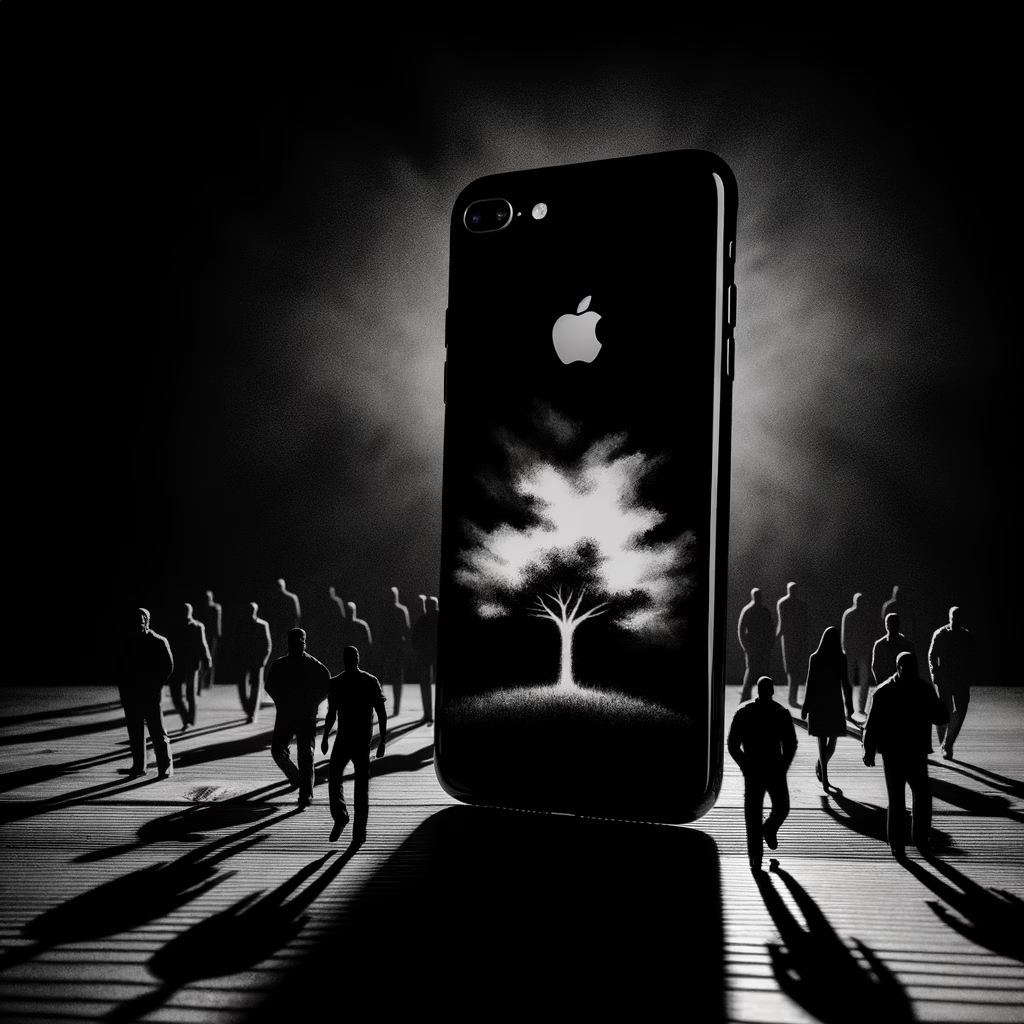
Apple’s terse line — “We take all reports of potential vulnerabilities extremely seriously” — reads less like corporate boilerplate and more like an acknowledgment that something private went very wrong. Security researchers and reporting from The Register say Apple patched a serious zero‑day last month and then backported the fix to older devices, including the iPhone 8 and several iPad models, after evidence suggested the bug may have been used in extremely sophisticated attacks against specific targeted individuals. That phrasing and the decision to support legacy hardware raise urgent questions: who was targeted, how the exploit was delivered, and why older devices suddenly required emergency attention.
H2: Targeted spy attacks — what happened and why it matters
A zero‑day is a software flaw unknown to the vendor and unpatched at the time of exploitation. These vulnerabilities are prized by nation‑state actors, mercenary spyware firms, and criminal groups because they allow attackers to bypass defenses before victims can update. Apple fixed a critical issue in a recent iOS release; in response to reports of active exploitation, the company issued a security update that reaches back to devices outside its usual support window, notably the iPhone 8.
The Register’s reporting suggests the vulnerability was weaponized in targeted spy attacks. Apple’s choice of the phrase “extremely sophisticated” — one it has used before when describing high‑risk surveillance tools — implies attackers employed advanced tradecraft and operational security rather than launching opportunistic, wide‑scale scans. That distinction matters: targeted spy attacks aim for precise surveillance and usually involve reconnaissance, social engineering, or highly tailored exploit delivery, increasing the odds of long‑term, hard‑to‑detect compromise.
Why the iPhone 8 was included
Released in 2017, the iPhone 8 is several generations old but still widely used. Backporting a security fix to that model signals that Apple judged the exploitation risk high enough to justify the engineering effort. Supporting older hardware requires bespoke patches for older kernels and chipsets and exhaustive testing across device variants — work companies don’t undertake lightly. For users who rely on older phones because of cost, carrier restrictions, or organizational procurement cycles, the update is a crucial safety net; for everyone else, it’s a reminder that vulnerabilities don’t respect product life cycles.
What we know — and what remains opaque
– Apple patched a zero‑day in a recent iOS release and extended the fix to older hardware, including iPhone 8 and select iPads.
– Apple said the flaw may have been used in “extremely sophisticated” attacks targeting specific individuals; the company did not name the targets.
– Reporting indicates the exploit appears to have been used in targeted surveillance rather than broad indiscriminate campaigns.
Technical and operational lessons
For technologists, the episode reinforces several truths. High‑value targets remain attractive to well‑resourced adversaries capable of acquiring or developing zero‑days. Sophisticated implants can evade ordinary defensive tools, making detection hard and elevating the importance of layered telemetry and threat intelligence. Security on older devices depends not only on hardware capability but on vendor willingness to patch — and that willingness often hinges on credible evidence of real‑world exploitation.
Policy implications
Policymakers face a thorny calculus. The apparent use of a zero‑day in targeted spyware campaigns factors into debates over trade controls for offensive cyber tools and the transparency of government vulnerability use. Advocates for stricter regulation point to incidents like this as proof the status quo endangers civilians; opponents warn that constraining offensive capabilities might hamper legitimate national security operations. Expect both sides to cite this case in future arguments.
Practical advice for users and defenders
The immediate, actionable step is straightforward: install Apple’s updates on affected devices as soon as possible. For defenders, this is also an opportunity to hunt for indicators of compromise — unusual network traffic, unexpected persistence mechanisms, or signs of lateral movement — especially for accounts or devices tied to high‑risk individuals.
But reality complicates the ideal. Many users and organizations run older phones due to budgets, contractual constraints, or procurement timelines. Patching is a critical safety layer, yet it cannot eliminate all risk. Good security practices — timely updates, cautious handling of unsolicited links or attachments, multifactor authentication, and endpoint monitoring — remain essential.
Broader context and the market for zero‑days
Adversaries will study this episode. Active exploitation followed by a vendor update demonstrates both the efficacy of the tool and the risk of exposure, prompting attackers to refine tactics or seek new vulnerabilities. The commercial market for zero‑days remains lucrative and opaque, with private vendors and state actors alike willing to pay for exclusive access to powerful exploits. That economic reality sustains a cycle of discovery, weaponization, and eventual disclosure or detection.
Conclusion: targeted spy attacks demand layered responses
Apple’s description of these incidents as “extremely sophisticated” and the decision to backport fixes to the iPhone 8 underscore a troubling asymmetry: a single undisclosed flaw can convert a personal device into a surveillance instrument. Targeted spy attacks will continue to pose high risks to individuals and institutions alike. Users should update affected devices immediately; security teams must hunt for signs of compromise; and policymakers should reconsider whether current rules adequately limit the proliferation of offensive cyber tools. In a world where your pocket computer can be turned into a remote listening post by an unseen bug, relying on hope is a risky strategy — layered defenses, timely patches, and transparent governance are the realistic alternatives.



