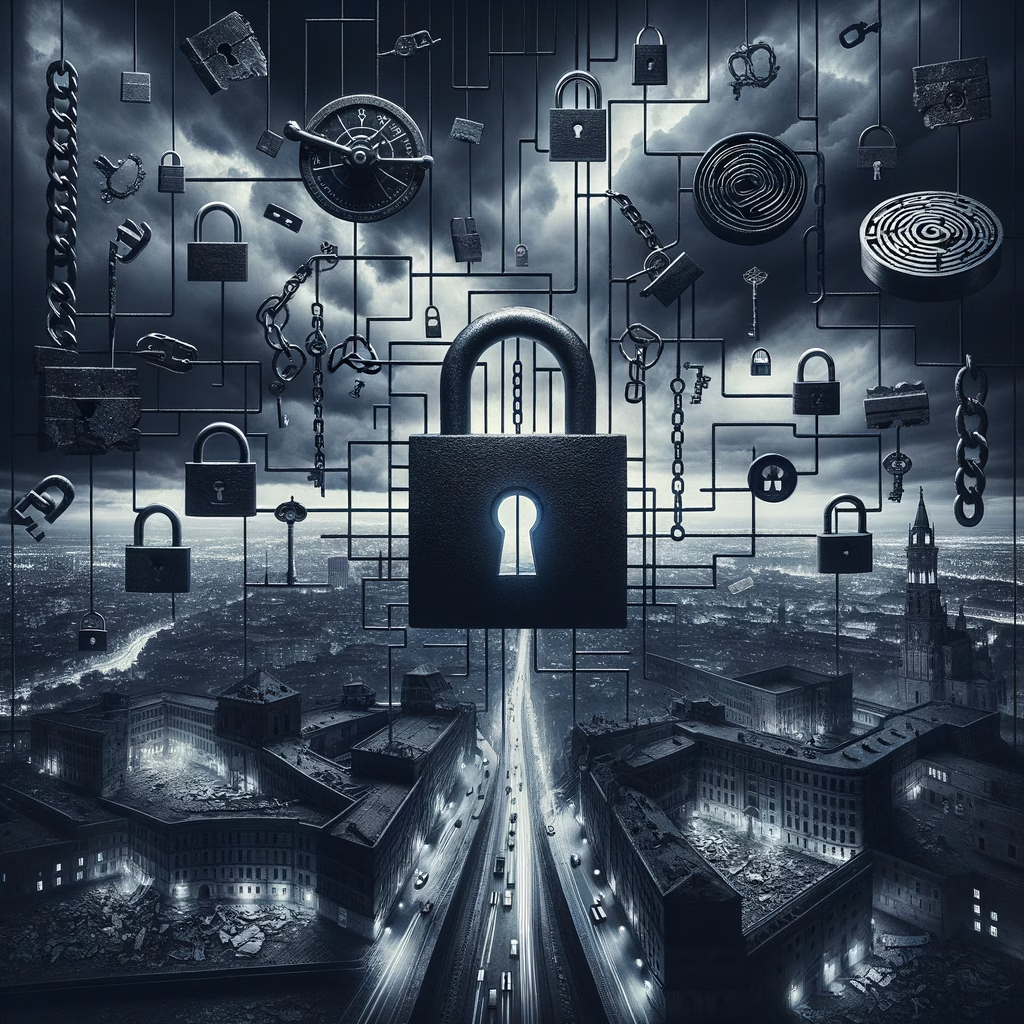
630M passwords were stolen — and the question becomes not only how it happened, but what we are prepared to do about it.
Lead
“Passwords are the keys to the kingdom,” FBI officials and cyber experts have long warned. When a haul measured in the hundreds of millions lands on criminal marketplaces, organizations and ordinary users face an immediate dilemma: treat passwords as sacred and fragile, or accept that they are a commodified asset attackers will forever attempt to harvest and reuse.
Background: what happened and how we know it
The recent disclosure that roughly 630 million passwords have been collected and circulated underscores a simple fact: credential collections remain among the most valuable single items in cybercrime economies. Large compilations—assembled from breaches, leaks and automated scraping—feed credential-stuffing tools that try known username/password pairs across email providers, corporate systems, cloud services and consumer apps. As defenders note, when attackers possess a tested list, they don’t need to guess; they only need to test and automate. Security analysts and incident responders therefore treat such collections as high-probability, high-impact threats that demand rapid detection and mitigation .
Why this matters now
– Scale becomes value: at 630 million entries, the collection includes many reused credentials tied to corporate and personal accounts. Each reused password increases the chance an attacker can pivot from a low-value site to a high-value target (financial accounts, corporate email, administrative consoles).
– Economies of attack: credential lists are resold, aggregated into “combo lists,” and fed into automated tooling. That lowers the cost of breach for attackers and raises the real-world risk for defenders. The attacker economics are stark: once a list exists, the marginal effort to exploit it is low, and the potential return is high .
– Detection and response lag: many organizations lack automated ways to detect that an employee or service account appears in such lists, delaying resets, session revocation and access changes that could stop an intrusion.
Technical perspective: what technologists recommend
Technologists and identity-security leaders emphasize layers that reduce the usefulness of stolen credentials:
– Enforce unique passwords and eliminate reuse through enterprise password managers. These tools, when properly configured, generate, store and rotate credentials securely, reducing the chance that a leaked password works across sites. Enterprise password managers also enable auditing and rapid credential rotation after exposure .
– Adopt strong, phishing-resistant multi-factor authentication (MFA) such as hardware tokens or platform FIDO2/WebAuthn methods rather than SMS-based codes, which are more easily bypassed.
– Integrate credential-exposure feeds into identity governance so accounts appearing in breach lists can be remediated automatically (force resets, revoke tokens, apply conditional access).
– Assume compromise in architecture: segment access, apply least privilege, and reduce blast radius so a single credential cannot yield lateral movement across systems .
Policy and governance perspective
Policymakers and corporate boards must confront trade-offs between usability, privacy, and security investment:
– Regulation and standards can accelerate adoption of identity-centric controls (mandatory MFA for critical services, breach notification improvements, minimum password hygiene standards).
– Smaller organizations may balk at subscription costs or centralization but must weigh those costs against the demonstrable threat of large-scale leaks; reputable password managers use end-to-end encryption so vendors cannot read stored vault contents, addressing some privacy concerns while delivering stronger defenses .
– Public–private cooperation in sharing breach intelligence and automated takedowns of credential marketplaces can reduce churn in criminal ecosystems, but such actions require cross-border coordination and sustained resources.
User perspective: what individuals should do now
For individuals the guidance is practical and immediate:
– Use a password manager to generate and store unique, high-entropy passwords.
– Turn on phishing-resistant MFA where available.
– Monitor accounts with reputable breach-notification services and act quickly to change exposed credentials and enable stronger authentication.
– Avoid storing passwords in plaintext files, spreadsheets, or browser notes.
Adversary perspective: why attackers prize these lists
Attackers value credential collections because they drastically reduce attack costs. Rather than crafting a bespoke phishing campaign or guessing passwords, criminals can run automated scripts that attempt logins across a list of popular services. Combine that with stolen session tokens, SIM-swap fraud, or phishing to undermine MFA, and the path from a leaked password to account takeover becomes practical and profitable.
Operational recommendations (brief)
– Assume some credentials will leak; design to limit damage.
– Deploy enterprise password managers and mandate their use for employees and service accounts.
– Enforce MFA everywhere possible and prefer phishing-resistant methods.
– Monitor for exposures and feed alerts into identity governance and incident-response playbooks.
These actions are practical defensive steps that make credential lists far less valuable to attackers .
Conclusion
The theft of 630 million passwords is more than an alarming statistic; it is a clarifying moment. Passwords remain a widely used, simple form of identity but also an increasingly industrialized target. The choice facing organizations and users is clear: continue to treat passwords as primary defense and accept recurring casualties, or elevate identity controls, eliminate reuse, and shrink the value of every stolen list. Which will we choose — the convenience of old habits, or the resilience of an identity-first approach?
Source: https://www.securitymagazine.com/articles/102054-630m-passwords-stolen-fbi-reveals-what-this-says-about-credential-value



