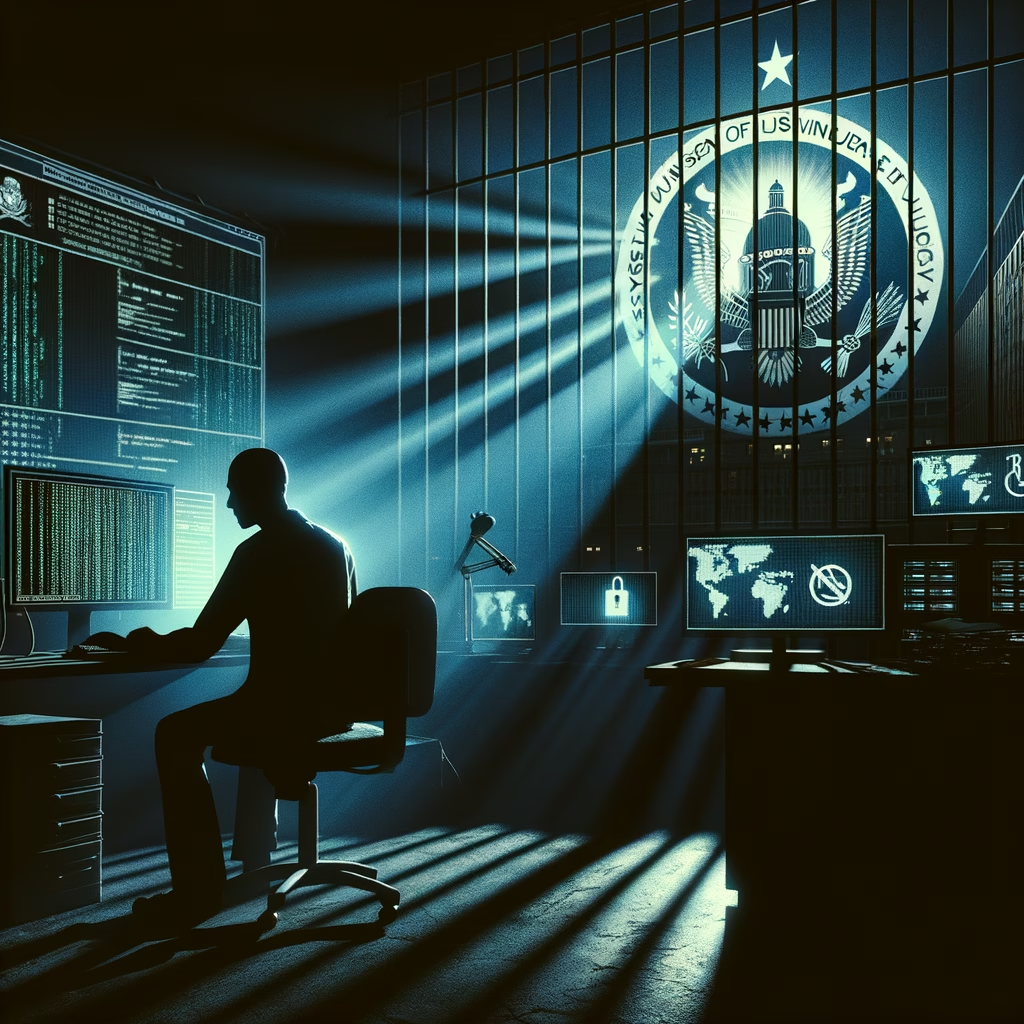
State-sponsored actors lead the race to weaponize vulnerabilities
What happens when the cycle of disclosing software flaws collides with the urgent intent to weaponize them? Recent analysis from Recorded Future delivers a stark answer: state-sponsored actors are responsible for the majority of observed exploit activity that follows public disclosure of vulnerabilities. That reality forces governments, companies and individual users to confront a new truth — a published vulnerability is often the starting gun for politically motivated cyber operations, not merely a prompt to patch.
When disclosure becomes a target-rich environment
For decades, vulnerability disclosure has been framed as a public good: security researchers reveal bugs, vendors issue patches, and users update systems. Recorded Future’s telemetry and incident analysis, however, shows that capable state actors convert public disclosures into operational exploit chains with alarming speed. The result is not only more incidents, but a shifting balance of power in cyberspace where speed, intelligence and political motive matter as much as technical skill.
Every connected system contains unintended weaknesses. The process of disclosure triggers three critical timelines that determine risk:
– Time to patch — how quickly vendors produce fixes and how rapidly users apply them.
– Time to exploit — how soon adversaries develop reliable attacks based on the disclosed flaw.
– Time to weaponize — how quickly threat actors adapt exploits to target specific organizations or geopolitical objectives.
Recorded Future highlights a dangerous pattern: nation-state groups routinely outpace other attackers across these timelines. Their advantages include advanced intelligence-gathering, dedicated exploit and zero-day development teams, and the ability to act with political or military intent rather than purely financial motives.
Why state-sponsored actors are different
State-sponsored actors bring institutional resources and strategic patience that criminal groups lack. They can:
– Combine human intelligence, signals intelligence, and open-source research to prioritize high-value targets.
– Invest in bespoke exploit development and testing pipelines that convert public bug reports into reliable intrusion methods in days or weeks.
– Use compromises as part of larger campaigns for espionage, sabotage, or coercive signaling — often calibrated to avoid kinetic escalation.
This institutionalized rapid weaponization means a seemingly technical event — a security bulletin or blog post — can escalate into espionage or disruption at a geopolitical scale.
Evidence and practical implications
Recorded Future’s findings align with broader industry observations: sophisticated espionage and sabotage campaigns frequently rely on newly disclosed or unpatched vulnerabilities to gain initial access or to pivot inside networks. Critical infrastructure, government systems and large enterprises are most at risk because they run complex, heterogeneous environments that are hard to fully patch. Even organizations with aggressive patch programs can be exposed by legacy hardware, embedded systems, third-party suppliers, or undisclosed zero-days.
The consequences are immediate and multifaceted:
– Strategic: States can project power below the threshold of conventional conflict, gathering intelligence or degrading adversary capabilities without open warfare.
– Economic: Exploits can siphon intellectual property, disrupt supply chains, and impose remediation costs and reputational damage that far exceed the cost of the technical fix.
– Societal: Attacks on hospitals, utilities or transportation systems create real-world harms and erode public trust in digital services.
Defensive perspectives: what technologists recommend
Security practitioners emphasize layered defenses to blunt the advantage of rapid exploiters. Practical recommendations include:
– Rigorous patch management and automation where safe, to reduce time-to-patch across environments.
– Comprehensive asset inventories and network segmentation to limit lateral movement.
– Adoption of zero-trust principles and least-privilege access controls.
– Investment in detection, threat hunting and incident response so breaches can be identified and contained quickly.
– Improved telemetry sharing between private and public sectors to accelerate detection and attribution.
Policy debates and the disclosure dilemma
The role of disclosure in this dynamic is highly contested. Some experts argue for more restrained disclosure timelines in high-risk cases, allowing vendors time to patch before full public release. Others insist transparency accelerates patching and reduces total harm by mobilizing broader defensive resources. There are real trade-offs: secretive disclosure may shelter vulnerabilities from public view but can also concentrate power with well-resourced states and vendors; unrestrained disclosure can empower state-sponsored actors to weaponize flaws faster.
Policymakers face hard choices. Some call for stronger international norms and agreements to limit state behavior in cyberspace; others prioritize resilience and deterrence, including investments in offensive cyber capabilities. Regulatory incentives for secure software lifecycle practices and greater liability for insecure products are also being debated as ways to shift incentives toward safer development.
What can be done: pragmatic steps
Reducing the window of opportunity for attackers requires coordinated action:
– Vendors should prioritize secure development practices, rapid patch issuance, and clear communication about mitigations and workarounds.
– Organizations should automate patching where feasible, improve asset inventories, segment networks, and invest in detection and response.
– Governments should strengthen public-private information sharing, improve attribution capabilities, and support norms that discourage aggressive state behavior.
– The research community should weigh disclosure decisions against geopolitical risk and advocate responsible timelines that protect vulnerable ecosystems.
Conclusion: confronting the reality of state-sponsored actors
Recorded Future’s finding — that state-sponsored hackers drive most exploitation of newly disclosed vulnerabilities — is more than a technical observation. It reveals a strategic dynamic in which the timing of information release, the capacity to act swiftly, and political intent reshape cyber conflict. Addressing this challenge requires better engineering, more resilient operations, smarter policy, and honest dialogue about the trade-offs of disclosure. In an era where a published security bulletin can become an instrument of statecraft within days, treating vulnerability disclosure as merely a technical matter is no longer an option.



