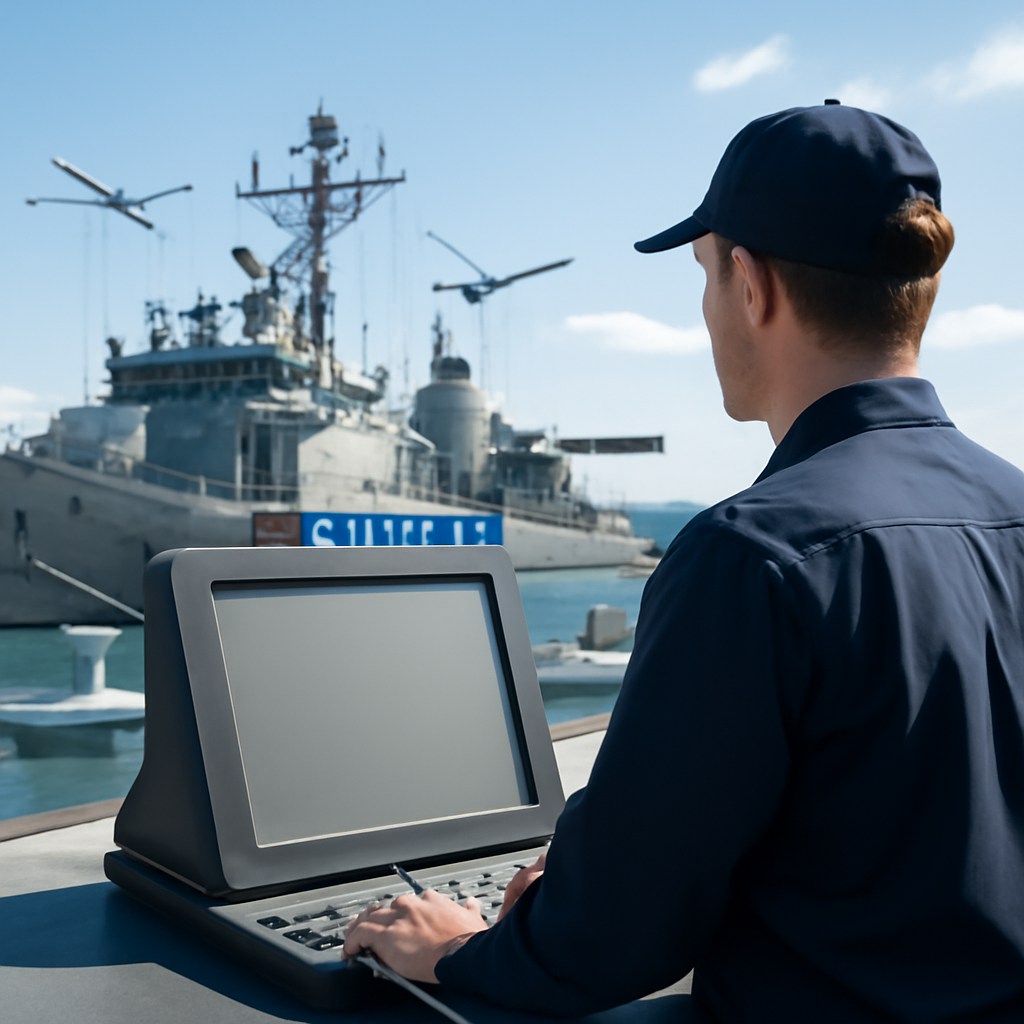
“The demonstration proved the firm’s physical AI technology for optimizing operations between crewed and uncrewed maritime forces,” Yoo Moon-ki said, summarizing the claim behind a trial the Republic of Korea Navy and Hanwha Systems staged on 3 August at Busan Naval Base. The event put an artificial‑intelligence mission planner at the center of a mixed crewed–uncrewed mine countermeasures sequence, testing command-and-control, sensing and autonomy layers together — albeit with important limits.
Busan Naval Base exercise: sequence and scenario
The exercise began with a scenario in which enemy mines blockaded Busan Port after an unexplained maritime explosion. Assets included the 730‑tonne minesweeper ROKS Ongjin, aerial reconnaissance drones, two unmanned surface vessels (USV) and an autonomous underwater vehicle (AUV) tasked with subsurface search. According to the published account, a large language model platform received a natural‑language order to generate a mission plan to locate mines at the explosion coordinates; Haeryeong, the reconnaissance USV, deployed alongside Ongjin while a drone conducted aerial reconnaissance and the AUV executed the AI‑generated search pattern.
The AI planner and the operator‑on‑the‑loop arrangement
Hanwha Systems’ description and Korean coverage framed the AI as an “AI combat staff officer.” The platform analyzed weather and current conditions, generated search plans, and recommended actions to Ongjin’s commanding officer rather than issuing commands directly — an operator‑on‑the‑loop model that kept a human in the approval role. Data from the AUV streamed in realtime to Hanwha Systems’ Automatic Mine Detection System, which classified contacts and fixed mine positions before vessels repositioned for disposal.

Audit-ready is a season. It shouldn't be.
Evidence in spreadsheets, controls drifting between audits, frameworks multiplying on flat headcount. Nubivance runs continuous compliance on Rapid7 Cyber GRC - SOC 2, HIPAA, ISO 27001, PCI, CMMC.
End the scramblePlatforms, comms and system provenance
Both USVs in the trial came from Hanwha Systems: a 30‑tonne combat USV first launched in June 2026 and a reconnaissance vessel designated Haeryeong. Hanwha Systems is the group’s electronics, sensor and command‑and‑control arm and is distinct from shipbuilder Hanwha Ocean, which holds concept design work for the RoKN’s reconnaissance UUV and mine‑warfare USV. Control of the multiple platforms during the exercise ran over Eutelsat OneWeb low‑earth‑orbit satellite communications, enabling simultaneous shore‑based direction of several unmanned systems at once.
What was proven — and what was not
The trial exercised the MUM‑T command‑and‑control and autonomy layers end‑to‑end, yet the record narrows what the exercise actually validated. Hanwha’s USVs are not currently equipped for minesweeping; during the trial they “acted as if” they were expected to be upgraded with mine‑clearing capabilities in future. The mines themselves were simulated rather than live, leaving the physical neutralization chain untested. From the RoKN side, Lee Kwang‑hoon of Navy Operations Command’s unmanned systems operations innovation division said the concept was sufficiently valid for future maritime operations, with AI supporting mission planning and target analysis while the minesweeper and unmanned systems operate together.
Procurement link: MSH‑II, awards and roadmaps
The work demonstrated at Busan maps to a concrete procurement path. In November 2024 the Defense Acquisition Program Administration awarded Hanwha Systems the combat management system for MSH‑II, the RoKN’s next‑generation minehunter, with delivery by 2029. The contract scope explicitly covers automated mine warfare mission planning, AI‑based mine detection and integrated manned‑unmanned mine search and disposal. Rival LIG Nex1 holds complementary underwater mine surveillance work; results from both firms feed into the RoKN’s Navy Sea GHOST roadmap, which targets testing of autonomous mine surveillance and neutralization systems by 2027.
What this means for technologists, procurement leads, and regional navies
- Technologists and system integrators will watch how AI mission‑planning LLMs are incorporated into operator‑on‑the‑loop workflows, and whether realtime detection/classification pipelines (AUV → Automatic Mine Detection System → human approval) scale to live mines.
- Procurement and program offices will treat the exercise as a developmental milestone but note the untested neutralization chain and the need to upgrade USVs for mine‑clearing roles before operational deployment of the full MUM‑T capability in MSH‑II.
- Regional navies tracking subsurface search capability will note the use of satellite comms for simultaneous shore control and the RoKN’s stated roadmap timelines, set against broader shifts in Western mine countermeasures capacity referenced in the report.
The Busan trial stitched together sensors, autonomy and shipboard command, and it offered a tangible preview of the RoKN’s intended direction: AI‑assisted mission planning, mixed crewed–uncrewed execution, and procurement paths already underway. Yet the exercise also left the most kinetic element — live mine neutralization — on the bench and flagged hardware upgrades as a precondition for fully realized unmanned mine‑clearing. With MSH‑II delivery scheduled by 2029 and Navy Sea GHOST testing targeted for 2027, the coming years will show whether the concept matures from a demonstrable C2 and sensing chain into an operationally complete MUM‑T mine‑warfare capability.