“Military commanders are asking for capability that enables them to deploy worldwide into austere environments,” said Ramsey Bentley, director of Sikorsky Advanced Concepts, speaking at AUSA.
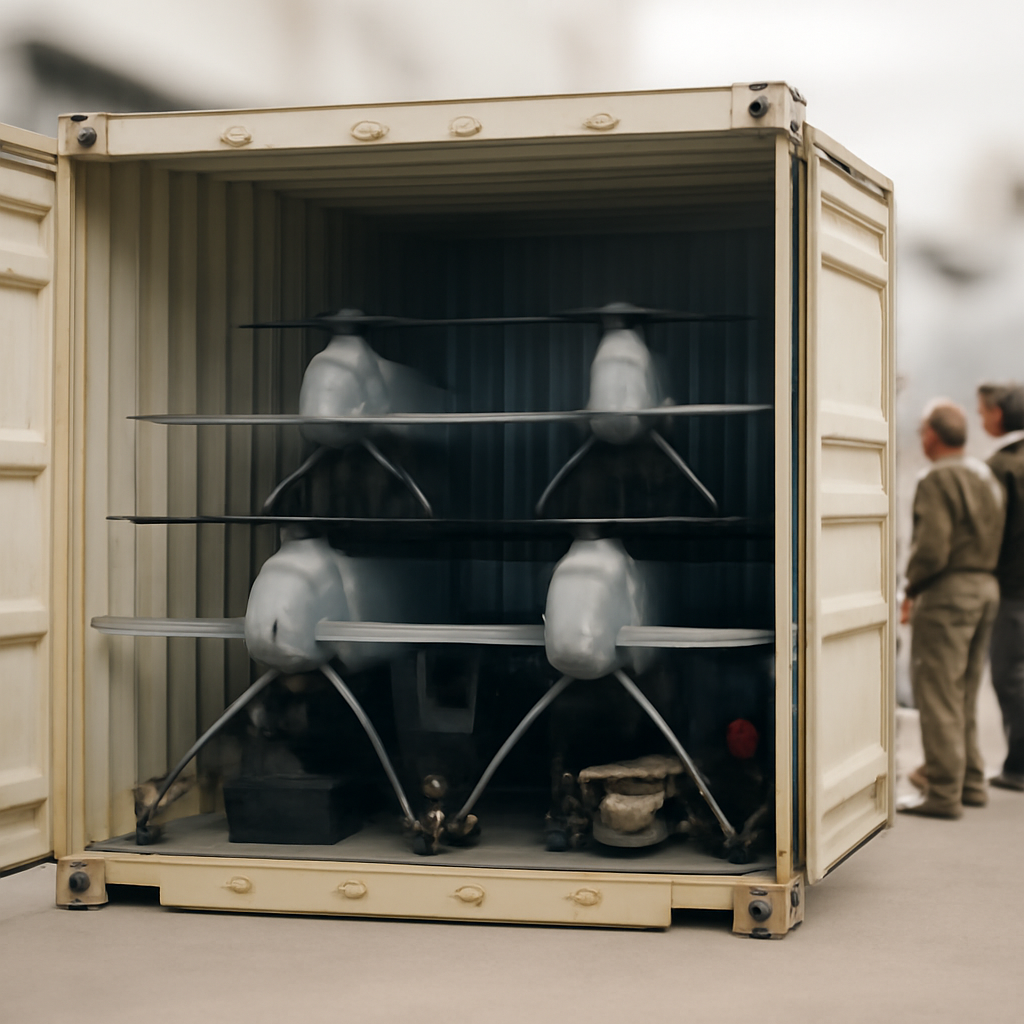
Nomad 100 Fast Pack: a 20‑foot container holding four VTOL UAS
Sikorsky unveiled the Nomad 100 Fast Pack on October 12 at the Association of the U.S. Army’s annual convention in Washington, D.C. The concept places four Nomad 100 vertical takeoff and landing uncrewed aircraft systems, plus mission-command equipment, communications, power, and sustainment supplies, inside a single standard 20‑foot ISO shipping container. Sikorsky describes the package as self-contained and relocatable, designed to be moved into forward locations, put into operation, and moved again quickly.
Rapid readiness and transport options
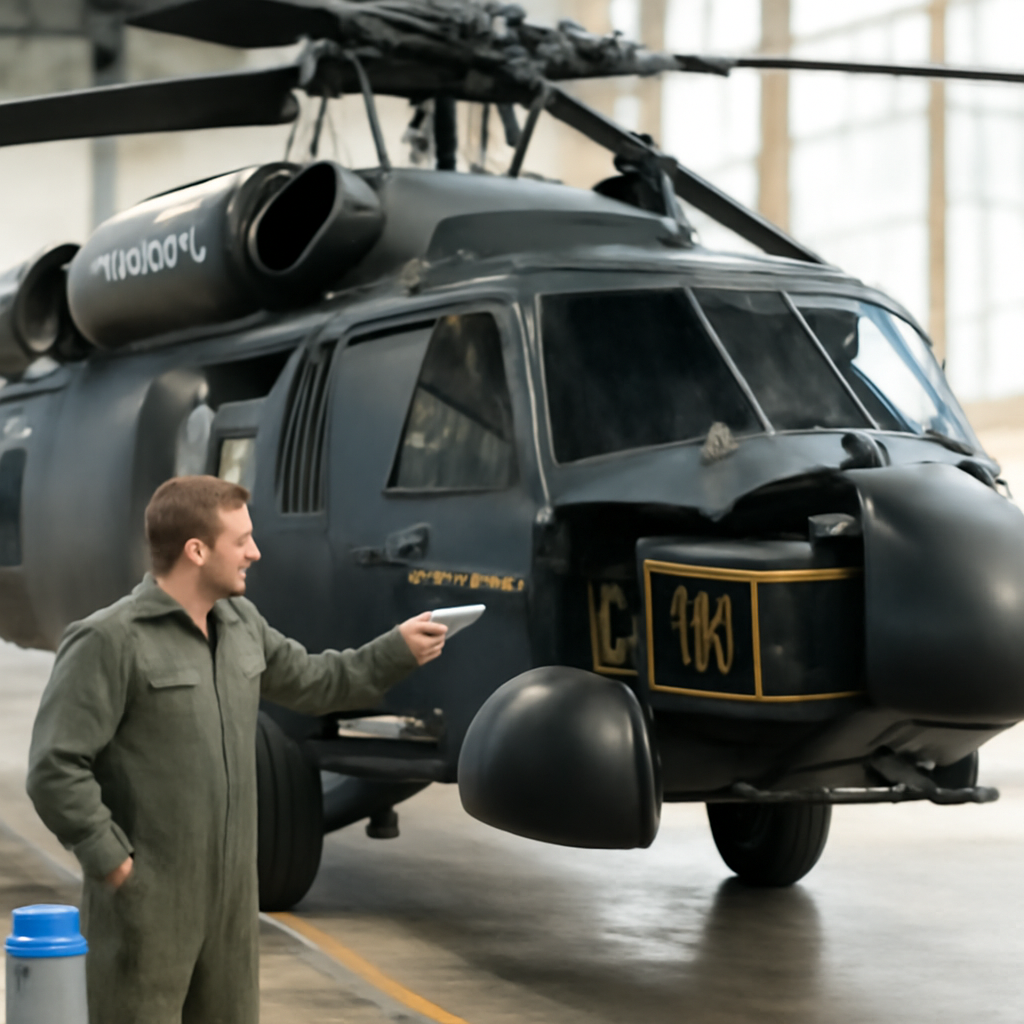
Sikorsky says two Nomad 100s can be prepared for flight “out of the box” in less than 15 minutes, with the remaining two — stored on an upper shelf inside the container — available within four to six hours. Promotional material shown at AUSA depicts the Fast Pack being transported into theater as a slung load under a Black Hawk helicopter. Beyond container transport, Ramsey Bentley said Nomad can be trucked or trailered and “potentially self‑deploy in a smaller package.” Sikorsky is also developing container concepts for larger Nomad family members.

This site is the portfolio.
OSINTSights runs on Cloudflare Workers, D1, R2, and Vectorize, with an AI pipeline on Hetzner ARM. Nubivance designed, built, and operates it. We do the same for clients.
See what we buildNomad 100 performance and modular payloads
Sikorsky presents the Nomad 100 as a hybrid VTOL that transitions to fixed‑wing flight. Bentley said the design delivers airplane‑like endurance and range while remaining runway‑independent. Sikorsky cites endurance of 10 to 14 hours depending on payload, a range exceeding 800 nautical miles, and a cruising speed of 70 miles per hour with a dash speed of 90 miles per hour. The aircraft’s hybrid‑electric drivetrain uses combustion engines to drive a generator that powers rotors and mission systems and is designed to run on multiple fuels, including JP‑8, JP‑4, and Jet A.
The Nomad 100 carries a 60‑pound mission payload and has a modular center fuselage that can be configured as a cargo bay or adapted for other mission equipment. On display at AUSA was a Nomad equipped with a forward‑looking infrared (FLIR) turret with laser designation and four Northrop Grumman Hatchet glide munitions. Sikorsky lists other potential payloads such as electro‑optical/infrared sensors, synthetic aperture radar, launched effects, and electronic‑warfare systems for jamming.
MATRIX autonomy, communications, and operator workflow
The Fast Pack relies on Sikorsky’s MATRIX autonomy to reduce operator workload. Bentley said MATRIX has “over 1,000 flight hours” and noted that operators use a tablet‑based interface to assign missions rather than continuously piloting each aircraft. According to Bentley, an operator selects a mission, designates a point on a map, and initiates the flight; MATRIX manages engine start, preflight checks, launch, navigation, mission execution, and adaptation to changing environmental and tactical conditions.
Communications are described as network‑agnostic. Bentley identified Starlink and Starshield for beyond‑line‑of‑sight connectivity in the current configuration and referenced tactical mobile ad‑hoc networking (MANET) equipment for line‑of‑sight links. Sikorsky also uses MATRIX in other programs, including a fully uncrewed U‑Hawk and an optionally piloted Black Hawk concept; the company promotes a common tablet interface to manage different autonomous aircraft.
Orders, development lineage, and family scaling
The Nomad 100 originated under DARPA’s EVADE program. Bentley said two customers associated with that program placed initial orders; Sikorsky has a contract for three Nomad 100s under EVADE. The company announced in July that the first had been delivered to the customer and that a second was entering flight testing at the time of the interview. Bentley also told Army Times that the U.S. Marine Corps is buying two Nomad 100s. Sikorsky is developing larger members of the family: one Nomad 500 fits in a 20‑foot container (three fit in a 40‑foot container), while a single Nomad 1000 requires a 40‑foot container.
What this means for expeditionary forces, the U.S. Marine Corps, and logistics planners
- Expeditionary forces: The Fast Pack’s small logistical footprint plus long‑range flight could enable sensor or logistics missions from locations without runways, supporting reconnaissance, target designation, or supply delivery without crewed helicopters, Sikorsky says.
- The U.S. Marine Corps: As an announced buyer of two Nomad 100s, the service will be an early user of the platform and of containerized deployment concepts that aim to reduce requirements for ground control stations and large operator teams, according to Rich Benton and Ramsey Bentley.
- Logistics planners and transport units: The ability to ship four UAS and sustainment gear in a single 20‑foot container — and to move that container by truck, trailer, or slung under a Black Hawk — changes deployment calculations for forward basing, especially where runways and fixed infrastructure are limited.
The Fast Pack concept combines a compact containerized logistics approach, a VTOL that transitions to efficient fixed‑wing cruise, and an autonomy suite designed to reduce operator burden. Sikorsky positions the package as a way to distribute durable air capability across dispersed locations; the company has moved from DARPA development into initial deliveries and continued flight testing as it scales the Nomad family.