Russian Military Footprints: Unraveling the Strategic Signal in Mali
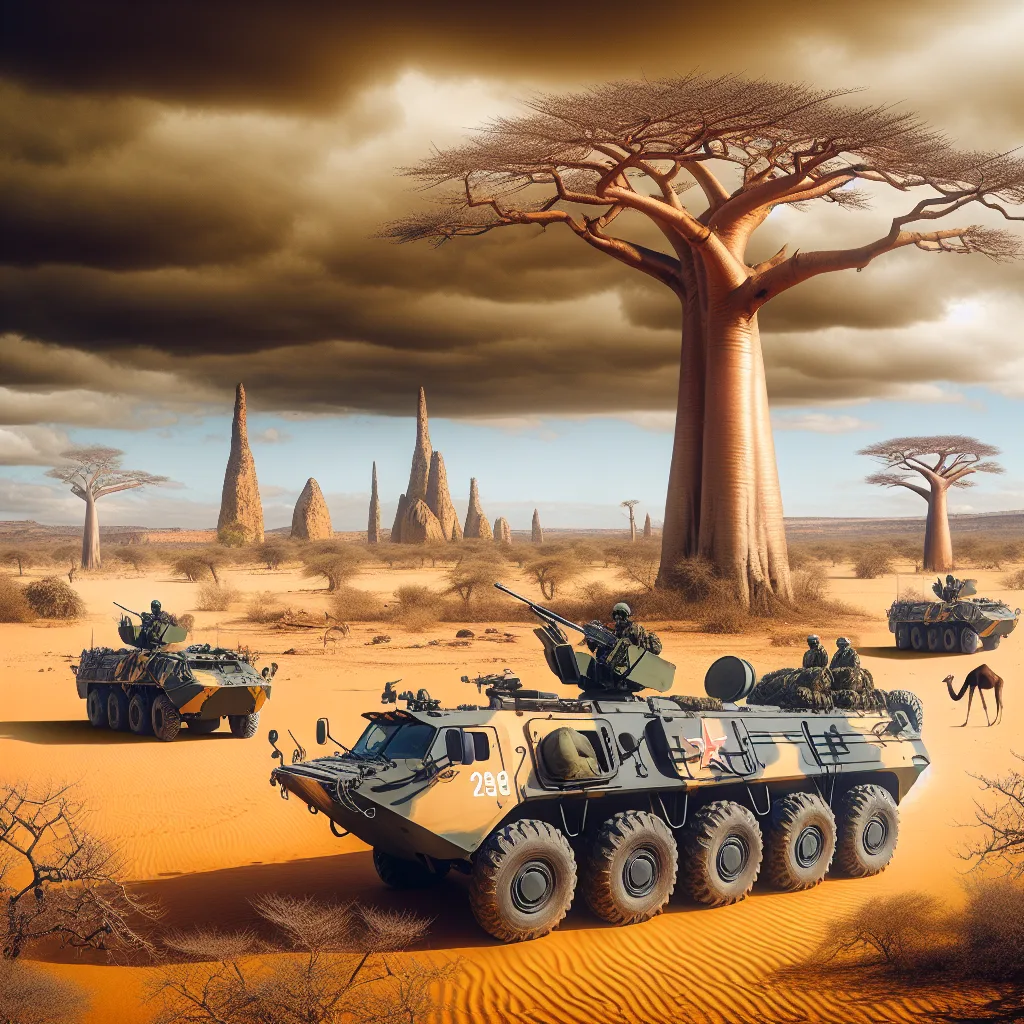
The desert expanses of Mali have long played host to complex power dynamics, but a new development now underscores the shifting landscape of regional military influence. In a recent release that has sparked both intrigue and apprehension, Russia’s Africa Corps—officially known as the Russian Expeditionary Corps (REK)—has showcased a BMP-3 infantry fighting vehicle operating in an undisclosed African locale, with earliest indications pointing to Mali as its stage.
This visual revelation, disseminated widely by Defence Blog and accompanied by compelling images, has reinvigorated discourse among military experts and policy strategists, who view it as a bold statement in Russia’s quest to expand its tactical and geopolitical influence on the African continent.
As Moscow’s adaptive use of military assets and innovative force projection tactics come under renewed scrutiny, the BMP-3’s presence resonates beyond the pixels and headlines. Instead, it signals Russia’s evolving operational blueprint in environments where political fragility and conflicting interests intersect—a development with both regional and international implications.
Historically, Russia’s military expeditions have carried layers of geopolitical intent. The origins of the current operation can be traced back to an era where global power contests were increasingly being waged in les formal theaters—places where strategic ambiguity could mask calculated engagement. Russia’s involvement in Mali is not merely an isolated deployment; it is a component of a broader strategy aimed at forging military partnerships, diversifying influence, and perhaps more controversially, challenging Western dominance in security affairs.
Recent reports noting the arrival of Russian military convoys in Mali provided fertile ground for speculation before the release of this new image. Analysts have long maintained that Russia is capitalizing on opportunities arising from state fragility in parts of Africa. The deployment of the BMP-3, a vehicle designed for both mobility and combat versatility, bolsters these interpretations, suggesting that the Russian military is prepared to engage in power projection beyond conventional roles.
Mali, a nation that has been a crucible for both internal discord and external intervention, has, for years, wrestled with insurgencies and administrative instability. The presence of the REK in such a context is layered with significance. With the nation seeking new alliances to augment its security apparatus, Russian involvement introduces both opportunities and risks. Moscow’s historical expertise in hybrid warfare, combined with a demonstrated willingness to engage in unconventional military operations, underscores that the deployment is as much about signaling intent as it is about tactical empowerment.
A closer look at the BMP-3 itself reveals a platform engineered for rapid response and adaptability, vital in fluid combat environments. Its design—integrating mobility, firepower, and protection—has made it an asset not only in mechanized infantry operations but also as a deterrent. Russian military spokespeople and published operational analyses have previously noted that such systems instill a blend of operational agility and force-multiplying effects in conflict zones. Independent verification from defense think tanks, including the International Institute for Strategic Studies (IISS), lends credence to the notion that the BMP-3 deployments are calculated moves aimed at creating leverage in international negotiations and regional alignments.
In conversations hosted by Reuters and interpreted by several military experts, such deployments have been linked to broader concerns about the proliferation of advanced military systems in fragile states. Observers caution that while the images serve as potent propaganda, they also represent an evolving challenge to traditional arms control paradigms and strategic stability in regions already marked by volatility.
Significantly, the multi-layered involvement of external military actors in Mali has raised questions among policymakers in Europe and North America. Strategic analysts at the Atlantic Council have stressed that while Russia’s military modernization efforts have been closely watched in regions like Eastern Europe, their extension into African security affairs potentially complicates the geopolitical calculus. What was once a theater of indirect engagement now appears to be transformed into a competitive domain where tactical innovations may juxtapose direct military cooperation with key state actors.
Beyond the precision mechanics of armored vehicles and convoys, however, lies the human dimension. Local populations in Mali, who continue to bear the weight of decades-long political and economic instability, face the possibility of becoming inadvertent players in an expanded geopolitical contest. The presence of foreign military forces—whether opportunistically invited or unilaterally deployed—risks exacerbating local tensions, challenging an already compromised security infrastructure. Human rights organizations, including Amnesty International, have in the past warned that the entry of foreign military aid or intervention can sometimes lead to unintended consequences, complicating efforts toward sustainable peace and inclusive governance.
In expert circles, there is a measured nod toward both the tactical innovation and the risk underpinning this deployment. Notably, General Mark Milley, former Chairman of the U.S. Joint Chiefs of Staff, has remarked in multiple interviews that the evolution of military deployments into untested geopolitical territories challenges longstanding norms of international military engagement. Although his statements did not directly reference Africa, the thematic parallels resonate in analyses of current Russian operations.
Looking ahead, the implications of the BMP-3’s deployment in Mali demand vigilant observation by global and regional stakeholders alike. Analysts predict that Moscow may use such high-visibility military assets to influence diplomatic negotiations, secure arms contracts, or even leverage strategic concessions from states seeking alternatives to Western security guarantees. This trajectory also opens avenues for military modernization partnerships that could redefine the contours of regional security alliances in Africa.
For Mali’s government, embracing Russian military support could be viewed both as an opportunity for bolstering national security and as a calculated risk, potentially alienating traditional allies and complicating commitments to multilateral security frameworks. Observers at the United Nations have, in past deliberations, stressed the importance of maintaining balanced international relations—highlighting that reliance on any single external partner for military support can inadvertently undermine a nation’s broader strategic autonomy.
In summing up the strategic calculus, one must consider all facets: the tactical benefits of the BMP-3 in highly mobile warfare, the symbolic weight of Russian military prowess, and the broader geopolitical negotiation that such deployments invariably trigger. The deployment is less a solitary military maneuver and more a harbinger of a new era in which power is as much about the control of narratives as it is about controlling terrain.
As global audiences watch, the silent hum of such vehicles across the rugged terrains of Mali may well be the prelude to richer strategic symphonies—a confluence where military might intersects with diplomatic strategy, redefining the contours of influence in regions most in need of security and stability. The question that remains is whether these bold deployments will pave the way for a new balance of power or simply add another layer to an already complex mosaic of global military interventions.
Ultimately, the dispersion of Russia’s Africa Corps in Mali underscores a timeless truth: in the realm of international security, no maneuver is ever isolated. Every advance, every convoy, every image released is steeped in historical context and future implications—a reminder that while technology and tactics evolve, the inexorable interplay of power and politics endures.



