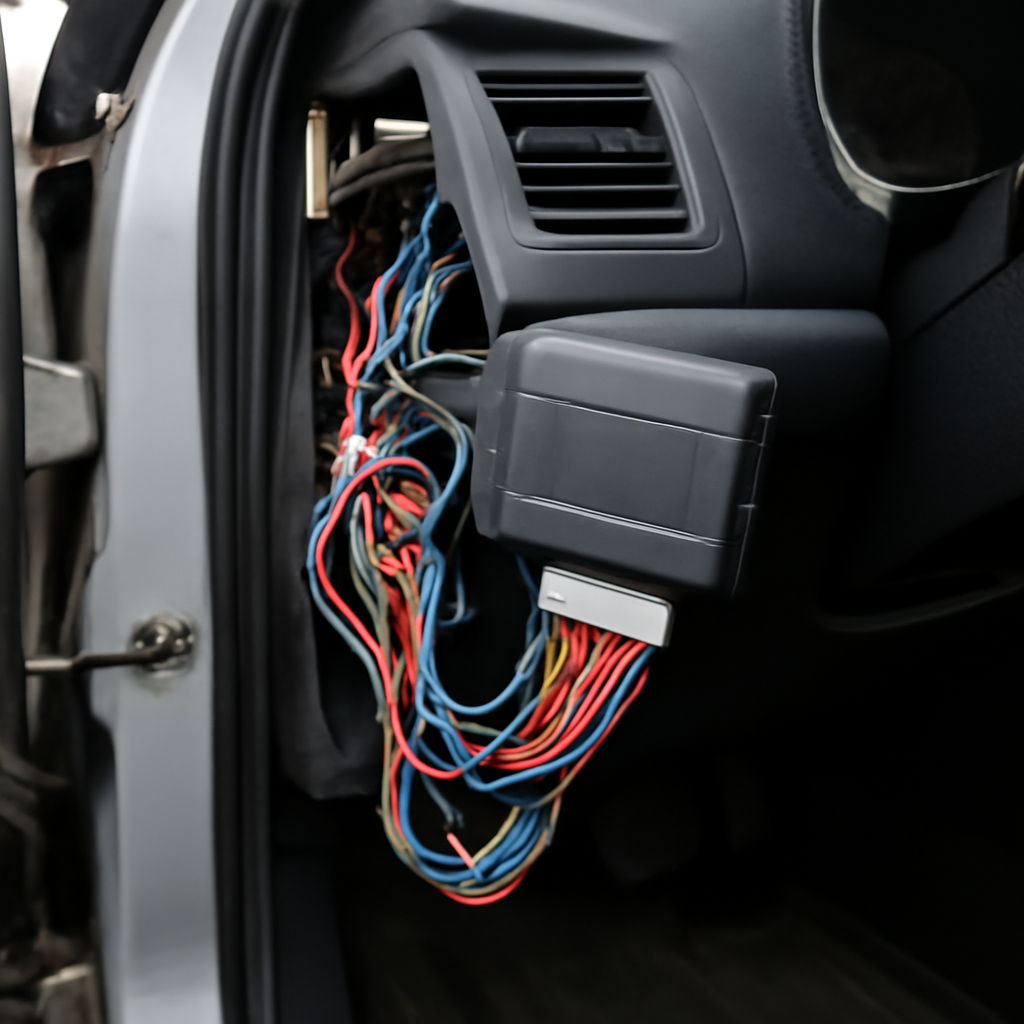
Installed in more than 2 million vehicles across the US by their estimate, the KARR Security System — an aftermarket car alarm model — is the subject of a security finding that, if accurate, places ordinary drivers and their cars within reach of a nearby attacker.
The UC San Diego research team and the core finding
A team of security researchers at UC San Diego examined the KARR Security System and reported that the device "can let any hacker within Bluetooth range send radio commands" to a vehicle. The researchers’ description ties a single, inexpensive wireless proximity — described in the report as "Bluetooth range" — to the ability to inject command traffic into the alarm system. The finding is cast not as a nuisance but as a set of direct, safety- and property-impacting consequences.
What the system reportedly allows an attacker to do
The researchers list a set of capabilities an attacker can exercise once within Bluetooth range. Quoting their finding, an attacker can: "silently unlock the car at will, turn off its alarm, honk the car’s horn or flash its lights, or even disable its ignition and leave a driver stranded." Those are not hypothetical software bugs alone; they are control actions that interact with vehicle locks, alarms, audible and visual signals, and the ignition circuit.

Audit-ready is a season. It shouldn't be.
Evidence in spreadsheets, controls drifting between audits, frameworks multiplying on flat headcount. Nubivance runs continuous compliance on Rapid7 Cyber GRC - SOC 2, HIPAA, ISO 27001, PCI, CMMC.
End the scrambleWhy those capabilities matter for drivers
Each capability in isolation is a workplace for trouble: a silent unlock facilitates covert entry; turning off the alarm suppresses warning signals; honking and flashing can be used to harass or distract; and an ignition disablement moves the issue from theft risk to safety and mobility risk. Taken together, the researchers’ list describes a range of outcomes from property loss to potential safety incidents where a driver finds their vehicle disabled with no prior warning.
How drivers, installers, and security teams are likely to respond
Drivers and vehicle owners will be watching for confirmation of the UC San Diego finding and for guidance from the vendor and installers. Owners of vehicles with aftermarket alarm systems will naturally want to know whether their specific KARR Security System unit is affected and what immediate steps — if any — reduce exposure.
Aftermarket installers and vendors who sold or fitted KARR Security System units will face questions about the scope of installations and any available firmware updates or recalls. They will be under pressure to identify affected serial numbers and to communicate remediation or replacement options to customers.
Vehicle security researchers and incident responders will be looking to reproduce the UC San Diego results, to document the attack chain precisely, and to prepare technical mitigations and disclosure details that can be applied without increasing misuse. Confirmatory analysis will also be necessary before broader operational responses such as advisories or coordinated mitigations are issued.
What this episode leaves on the table
The UC San Diego researchers’ description links a common wireless proximity (Bluetooth range) to previously local vehicle controls, producing a set of practical attack actions that affect millions of installed units, by the researchers’ estimate. The report as summarized identifies a clear exposure for vehicle owners and a narrow technical entry vector for attackers who can get within Bluetooth range.
What remains to be supplied in public fora — and what those affected will be awaiting — are vendor statements, technical details that allow precisely targeted fixes, and any guidance about how affected owners can verify whether their unit is vulnerable. Until such follow-up is available, the researchers’ finding stands as a specific, reproducible claim that ties control of physical vehicle functions to a nearby wireless interface.
Original report: https://www.schneier.com/blog/archives/2026/08/vulnerabilities-in-car-anti-theft-device.html