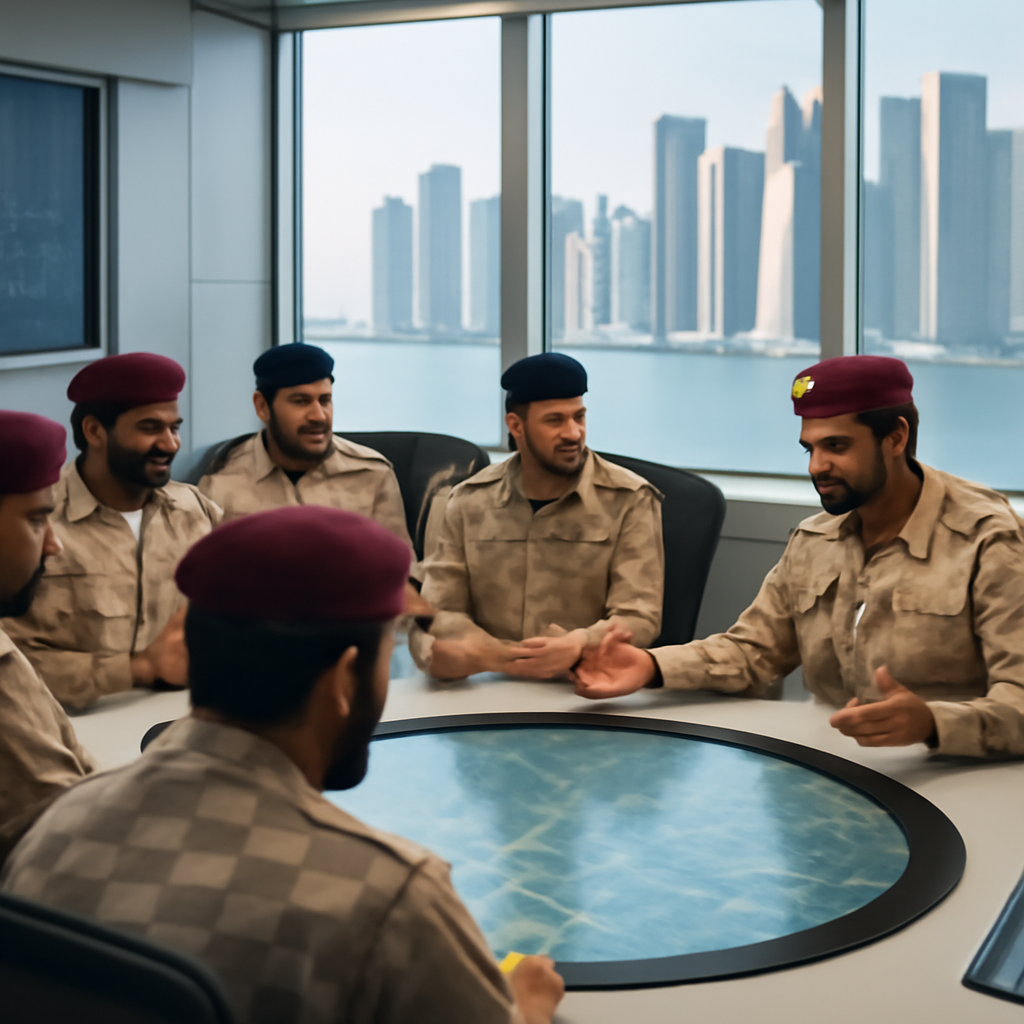
"It's the first time that a mediator has been attacked. This never happened," Sheikh Saoud bin Abdulrahman Al Thani, Qatar's deputy prime minister and minister of state for defense affairs, told the Global Security Forum in Doha.
Qatar's shift in defense priorities after September 2025 strikes
The Israeli strike on Doha in September 2025 and subsequent Iranian attacks have prompted Qatari officials to accelerate moves to secure allies and strengthen domestic defenses. A 2025 defense review cited by Qatari leaders identified four near-term priorities: air defense, counter-drone capabilities, cybersecurity and electronic warfare. Officials say those areas will shape both procurement choices and the architecture of any domestic weapons-production effort.
A proposed partnership with the United Kingdom
Qatar is exploring a broader defense partnership with the United Kingdom that would go beyond typical buyer-seller relationships. Maj. Gen. Mohammed Abdul Latif Al Mannai described a partnership that could "incorporate operational requirements, intelligence and assessments of emerging threats into weapons development." Gen. Sir Roly Walker, chief of the General Staff of the British Army, framed the ambition in generational terms: "We have high-level political ambition for a 50-year strategic partnership to gear ourselves up for the future." Walker added a practical rationale for deeper cooperation: "We need to position ourselves almost as a design partner to allow the ingenious engineers and creative entrepreneurs to develop the solutions to our problems."

Audit-ready is a season. It shouldn't be.
Evidence in spreadsheets, controls drifting between audits, frameworks multiplying on flat headcount. Nubivance runs continuous compliance on Rapid7 Cyber GRC - SOC 2, HIPAA, ISO 27001, PCI, CMMC.
End the scrambleBarzan Holdings and the push to build a domestic hub
Qatar is positioning state-linked investment as a lever to move from being primarily a purchaser of foreign systems to a participant in design and production. Mohammed bin Badr Al Sada, group CEO of Barzan Holdings, said that British companies were already in discussions about a proposed hub and that the working assumption is an active facility soon: "We work very closely with UK industries. Actually some of them, they are already in town as we speak. And we hope that we can see this hub active very soon." The push reflects a deliberate policy choice to increase investment in defense companies rather than simply buying finished products.
Industry constraints visible at Milipol Qatar
A visit to Milipol Qatar, the security exhibition held alongside the Global Security Forum, underlined the starting point for Doha's ambitions: the show "suggested a banking trade show as much as a military expo," a shorthand the reporting uses to indicate that Qatar lacks the large defense-manufacturing base of some regional neighbors. That gap helps explain why Qatari officials emphasize partnerships with foreign suppliers and investment arms like Barzan Holdings as routes to close capability shortfalls quickly.
U.S. presence, deterrence limits, and statements from Washington's envoy
Qatar's reassessment also reflects questions about the extent of U.S. protection in the face of new threats. Iran's June 2025 missile attack on Al Udeid Air Base demonstrated, in Qatari thinking, that the presence of U.S. troops on Qatari soil "did not, by itself, prevent an attack," a point the government has cited as it pursues self-help options. Tom Barrack, identified in the forum as the U.S. ambassador to Turkey and special presidential envoy for Syria and Iraq, acknowledged a shift in Washington's posture in an onstage interview: "We're not leaving. But what everybody's doing is saying, 'Okay, I can't rely on America to solve all my problems anymore,'" he said.
What this means for technologists, policymakers, and regional militaries
- Technologists and security teams: Expect demand for integrated solutions across air defense, counter-drone systems, cybersecurity and electronic warfare as Qatar seeks design partners and domestic capabilities tied to operational requirements.
- Policymakers and procurement leaders: The proposed 50-year strategic outlook with the United Kingdom and explicit moves to invest in defense firms signal a shift toward longer-term industrial cooperation rather than one-off platform sales.
- Regional militaries and defense planners: Qatar's emphasis on self-reliant capabilities and closer intelligence-informed development could change procurement timelines and create new opportunities for suppliers already engaged in early-stage design discussions.
Qatar has moved publicly from a role defined by diplomacy and hosting foreign forces to one of active defense industrialization and long-term partnerships. With British firms already in talks, a stated hope that a production hub will be active "very soon," and senior leaders calling for a 50‑year partnership horizon, the coming months will show whether discussions convert into firm contracts, facilities and operational changes that alter the Gulf's security balance.