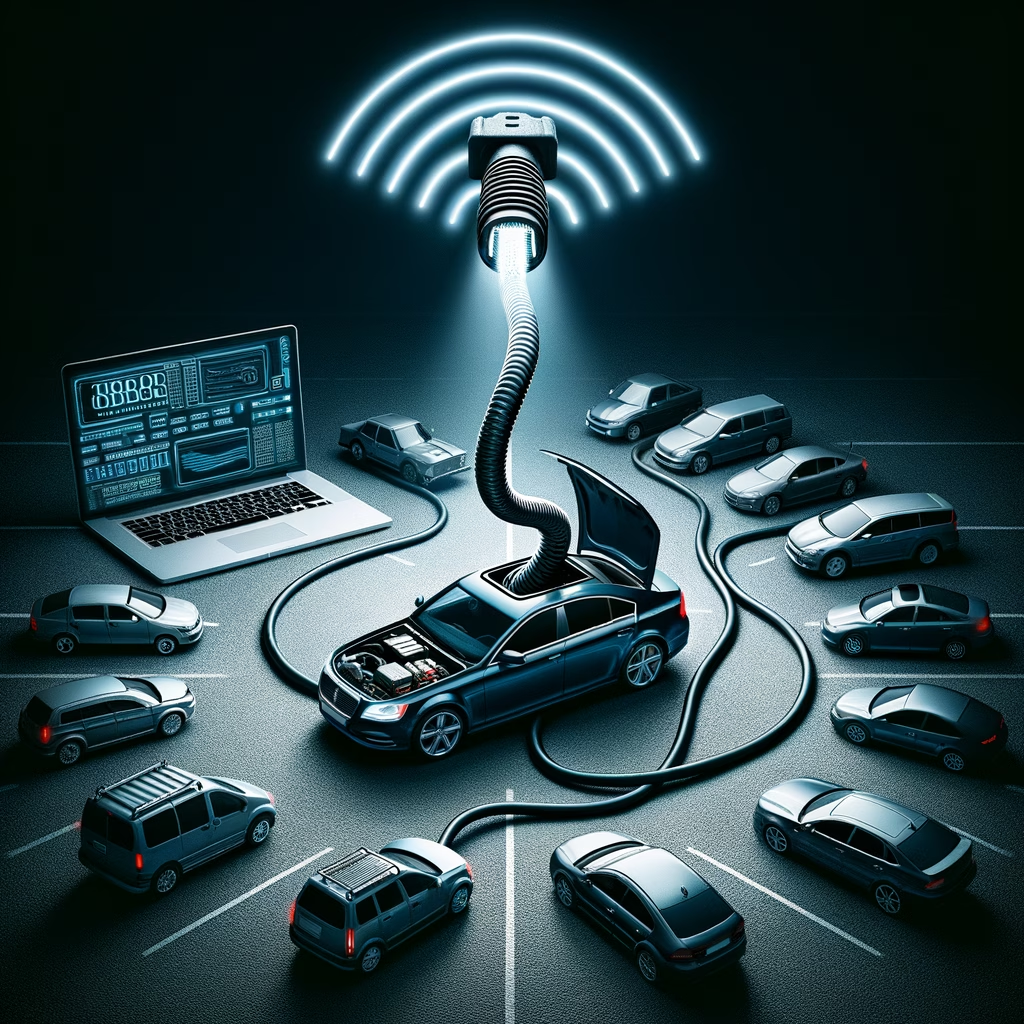
What happens when the very technology designed to connect us turns into a conduit for danger? This is the stark question facing millions of vehicle owners worldwide following the discovery of four critical vulnerabilities in OpenSynergy’s BlueSDK Bluetooth stack. Dubbed PerfektBlue by cybersecurity researchers, these flaws present a terrifying scenario: remote attackers potentially seizing control of cars from multiple manufacturers, threatening safety on the roads with nothing more than a Bluetooth signal.
Bluetooth technology, embedded in most modern vehicles, underpins key features such as hands-free calling, media streaming, and increasingly, integration with mobile apps. OpenSynergy’s BlueSDK, a widely deployed software component, facilitates these Bluetooth connections in the automotive sector. But a team of researchers recently identified a quartet of security weaknesses that can be chained together into a powerful exploit, enabling remote code execution without physical access. In practical terms, this means a hacker could inject malicious commands to manipulate vehicle systems remotely.

According to a detailed report published by the cybersecurity firm SentinelOne, the PerfektBlue vulnerabilities affect millions of transport vehicles from at least three major automakers. While the companies involved have not been publicly named due to coordinated disclosure protocols, the scope and severity of the flaw are unmistakable. “Our analysis shows that these bugs can be combined to bypass security controls and take over critical vehicle functions,” said Luan Dang, a principal researcher at SentinelOne. “This is a wake-up call for the automotive industry’s cybersecurity practices.”
The risk posed by PerfektBlue is not hypothetical. Modern vehicles increasingly resemble rolling computers, with interconnected subsystems controlling everything from braking and steering to navigation and infotainment. A remote attacker exploiting these flaws could compromise safety features or cause disruptions, endangering both drivers and passengers. “What we’re seeing is a shift in the attack surface,” explained Bruce Schneier, a renowned security technologist. “Cars are no longer isolated mechanical devices; they’re part of the Internet of Things—and that means they’re vulnerable in entirely new ways.”
From a policy perspective, the discovery intensifies ongoing debates about automotive cybersecurity standards and regulatory oversight. Governments worldwide have been grappling with how to enforce minimum security requirements for connected vehicles, but technological advancement often outpaces legislation. “We need robust frameworks that mandate security by design in all automotive software,” said Dr. Camille Stewart, former advisor on cybersecurity and emerging technologies at the U.S. Department of Homeland Security. “Waiting for incidents to happen before acting puts public safety at risk.”
For consumers, the revelation of PerfektBlue vulnerabilities raises uncomfortable questions about trust and transparency. How many vehicle owners are aware of such latent threats? Can automakers and suppliers deliver timely patches to millions of cars already on the road? The automotive industry’s capacity for rapid, large-scale updates remains uneven, with some manufacturers better equipped than others to respond effectively.
Adversaries, naturally, take note. While no widespread exploitation of PerfektBlue has been reported to date, the existence of a ready-made exploit chain in a critical system is an invitation to attackers with motives ranging from mischief to organized crime or even state-sponsored sabotage. “Attackers are always looking for new vectors,” noted Katie Moussouris, CEO of Luta Security. “When vulnerabilities like these are discovered, it’s a race against time to mitigate risk before they can be weaponized.”
OpenSynergy has acknowledged the vulnerabilities and is working closely with automotive partners and security researchers to issue patches. Still, the task of updating millions of vehicles in circulation is daunting, highlighting the broader challenges of securing a rapidly evolving technological ecosystem. It also underscores the importance of continuous vigilance and collaboration between industry stakeholders and cybersecurity experts.
Ultimately, the PerfektBlue case forces us to confront the complex intersection of innovation, convenience, and security in our connected world. As cars become more digitally sophisticated, the imperative to safeguard them grows ever more urgent. How prepared are we to handle the risks that come with the promise of a seamlessly connected driving experience? And what lessons will we take from this chapter as we steer toward a future where every vehicle might be a potential target?



