Commissioning in Sanya: PNS/M Hangor enters service
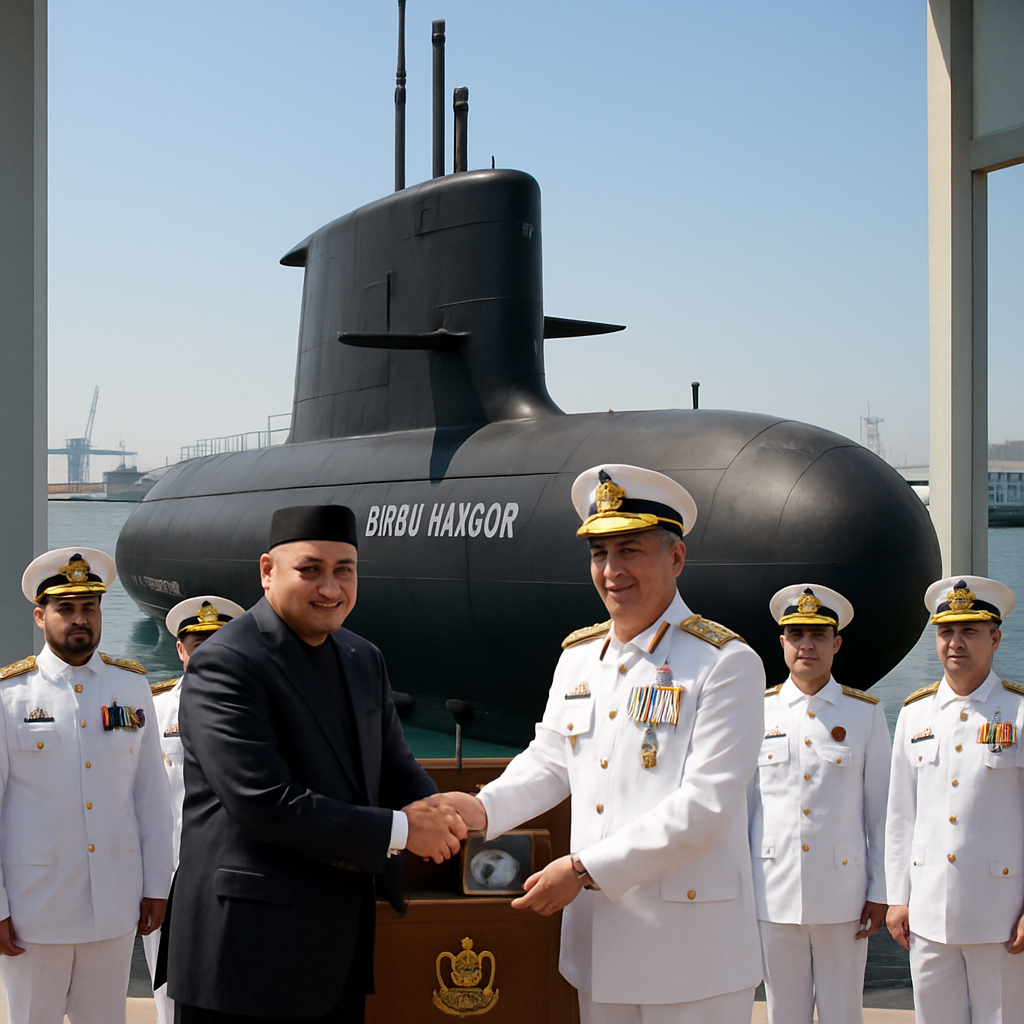
President Asif Ali Zardari and Chief of the Naval Staff Admiral Naveed Ashraf attended the commissioning ceremony in Sanya, China, where the Pakistan Navy (PN) formally inducted the lead Hangor-class air-independent propulsion (AIP) submarine, PNS/M Hangor. Admiral Ashraf framed the induction around the security of sea lines of communication (SLOC) across the Arabian Sea and the wider Indian Ocean, saying the Hangor-class — armed with advanced weapons, sensors, and AIP — will play a key role in deterring aggression and maintaining maritime order.
Germany's MTU engine export refusal and COVID-19 delays reshaped the program
The Hangor program traces back to talks begun after a separate HDW (Type 214) deal collapsed around 2011. Pakistan approved purchase of eight AIP-equipped boats from China Shipbuilding & Offshore International Co. Ltd (CSOC) in April 2015, with the Ministry of Defence Production initially designating the effort ‘S20’ and later identifying the boats as derivatives of the S26 export design. Reports placed the overall deal at $4–5 billion, though those figures did not clearly isolate whether frigates ordered later were included.
That early momentum was interrupted when Germany refused to issue export licences for the MTU diesel engines specified for the submarines. Pakistan and CSOC switched to Chinese CHD-620 diesel engines; the change required the propulsion package to be re-engineered and introduced delays. The COVID-19 pandemic compounded schedule slippage. Despite these setbacks production at Wuchang Shipbuilding’s Shuangliu Base in Wuhan resumed and accelerated from 2024 onward.

Audit-ready is a season. It shouldn't be.
Evidence in spreadsheets, controls drifting between audits, frameworks multiplying on flat headcount. Nubivance runs continuous compliance on Rapid7 Cyber GRC - SOC 2, HIPAA, ISO 27001, PCI, CMMC.
End the scrambleDesign — Stirling AIP, armament, and endurance
The Hangor-class is broadly derived from the Yuan-class (Type 039B) family, though the Pakistani variant carries distinct specifications. The submarine is listed at 2,800 tons displacement and 76 m in length — heavier than the 2,550-ton S26 export baseline and slightly shorter than a 77.7 m reference design. It features six torpedo tubes capable of firing heavyweight torpedoes, anti-ship cruise missiles (ASCM), and, the PN believes, in all likelihood the Babur 3 submarine-launched cruise missile (SLCM), which Pakistan has tested with a stated range of 450 km.
Crucially, the Hangor uses a Stirling-cycle AIP system that burns a carbon fuel source to generate electricity for propulsion and onboard systems. In general terms — and as the PN emphasizes — an AIP system allows a submarine to operate underwater without snorkeling for oxygen for extended periods, potentially several weeks. That endurance changes operational posture: instead of routinely surfacing or snorkeling to recharge batteries and risk detection by maritime patrol aircraft, surface ships, or sensors, an AIP-equipped boat can remain on station submerged for far longer and sustain open-ocean patrols.
China-built units, KSEW transfer, and schedule reality
The lead boat was launched for sea trials in April 2024. According to the PN’s Director General of Public Relations, the second (PNS/M Shushuk), third (PNS/M Mangro), and fourth (PNS/M Ghazi) followed in March, August, and December 2025 respectively, and all four Chinese-built boats had been in the final stages of handover prior to PNS/M Hangor’s commissioning. Four remaining boats are being assembled at Karachi Shipyard & Engineering Works (KSEW) under a technology transfer arrangement: steel cutting for the fifth (the first KSEW-built) took place in December 2021 and the keel laying for the sixth occurred in February 2025.
KSEW has invested in infrastructure to support submarine construction, installing a Ship Lift & Transfer System (SLTS) with two parking stations specifically allocated to submarines, according to the Ministry of Defence Production’s 2022–2024 Yearbook. Even so, the KSEW-built units are tracking behind the original schedule, which had envisaged all eight boats delivered by 2028; the new realistic timeline pushes completion into the early 2030s.
What this means for the Pakistan Navy, KSEW/MoDP, and defence budget planners
- Pakistan Navy: Once the eight Hangor-class boats are in service, the PN will nearly quadruple its AIP-equipped submarine fleet from three to 11 boats. The Hangor’s larger displacement and open-ocean design position it as the primary asset for patrolling SLOCs across the Arabian Sea and into the Indian Ocean, enabling a forward A2/AD posture beyond Pakistan’s littoral zone.
- KSEW and the Ministry of Defence Production: Technology transfer and shore infrastructure work are now central tasks. Completing the KSEW-built boats, sustaining maintenance facilities for a larger submarine arm, and expanding crew training will require sustained program management through the late 2020s and into the 2030s.
- Defence budget planners: The commissioning sharpens procurement choices. The PN’s submarine arm sits alongside competing priorities — surface combatants, maritime patrol aircraft (the Sea Sultan LRMPA is noted as yet to be contracted), and the prospective SWATS program — on a defence budget that, though increased by 20% in 2025–2026, remains stretched. Completing the Hangor fleet and any follow-on ambitions will demand multi-year funding commitments.
PNS/M Hangor’s commissioning is the culmination of more than a decade of procurement effort — and the opening move in a structural reorientation of Pakistan’s submarine force. Expect the three remaining Chinese-built boats to follow relatively quickly, potentially within 2026, while the KSEW-built hulls and broader ambitions such as SWATS or a dedicated nuclear-capable platform will hinge on funding, industrial learning curves, and program patience through the next decade.