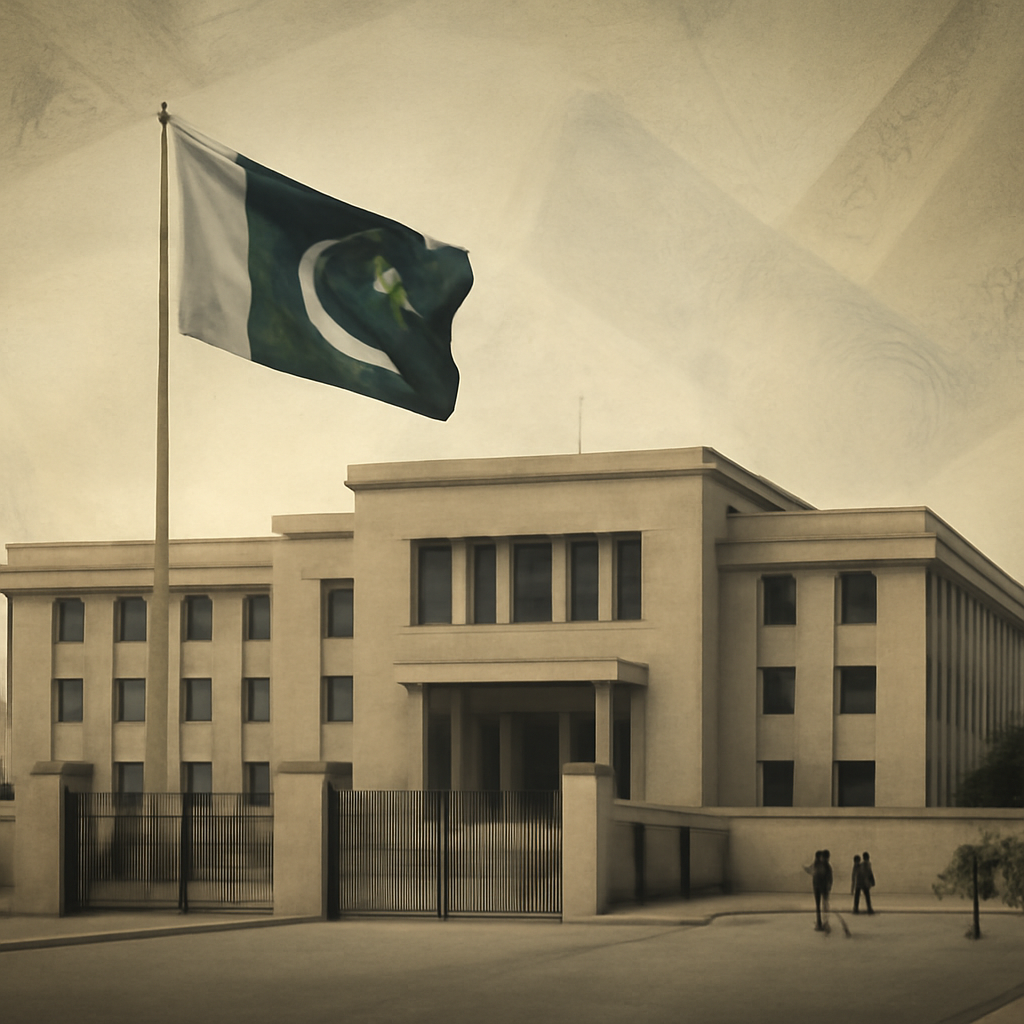
“The provincial contribution had been ‘partly reflected in next year’s defence budget,’” Finance Minister Muhammad Aurangzeb said after the budget was tabled — a concise admission of a larger fiscal shift behind Pakistan’s record PKR figures. The government has allocated PKR 3.0 trillion to defence for 2026–27, a 17.65% rise over the original PKR 2.55 trillion for 2025–26; at today’s exchange rate (PKR 278.75 = $1) that PKR figure equals about $10.76 billion U.S., the largest defence budget Pakistan has set in real dollar terms.
PKR 3 trillion, the dollar story, and why the rupee matters
The headline PKR increase masks a longer story driven by exchange-rate volatility. The conversion to dollars depends entirely on the spot rate: the 2026–27 USD figure uses PKR 278.75/$, producing the $10.76 billion estimate. By contrast, the defence budget’s dollar value peaked once before at roughly $9.6 billion in 2018–19 when the PKR traded near 115 to the dollar, then tumbled as the PKR weakened in subsequent years. The rupee fell to an interbank low of 307.1 in September 2023, briefly recovered after policy moves and an IMF programme, and has since settled in the high-270s to mid-280s. Over a decade the currency has lost nearly two-thirds of its value versus the dollar (roughly 105 PKR/$ in 2016–17 to the current level), and that depreciation is the single most important constraint on what the increased PKR allocation can actually buy.
Physical assets (A09) jumps ~40% — procurement prioritized
The Annual Budget Statement divides the PKR 3.0 trillion services allocation into object heads and shows where growth was concentrated. Physical assets (A09) climbed from Rs 663.1 billion to Rs 925.8 billion — a 39.6% year‑on‑year jump (about $3.32 billion at the 2026 budget‑time rate) and roughly 31% of the services total. By contrast, employees-related expenses (A01) rose 14.4% to Rs 967.5 billion and operating expenses (A03) rose 5.5% to Rs 743.5 billion. The near‑40% rise in the physical‑assets head is the clearest budgetary signal that procurement — arms, ammunition and equipment — is the immediate priority within the services book.

The cyber insurance questionnaire just landed. Now what?
SOC 2, HIPAA, insurance renewals - someone has to own security strategy. Nubivance provides fractional CISO leadership without the full-time salary.
Get a security leadService-arm split: inter‑services and the joint pool swell
ARY News published a per‑service breakdown from official documents that clarifies how the increase is allocated across the Army, Pakistan Air Force, Navy and the joint balance. The Army’s allocation is Rs 1,284 billion (+8%), the PAF Rs 573 billion (+10%), and the Navy Rs 293 billion (+7%). The balance — roughly Rs 850 billion, up about 48% — sits in an inter‑services/other line. In other words, most of the year‑on‑year increase did not go to the three services directly but into a joint pool, matching the jump in the physical‑assets head and suggesting procurement will be directed at the strategic or inter‑service level rather than apportioned along traditional service lines.
Provincial contribution and the frozen divisible pool
The federal government asked provinces for more than Rs 1.2 trillion to meet defence and water needs in 2026–27, and Finance Minister Muhammad Aurangzeb confirmed the provincial contribution was “partly reflected” in the defence numbers. The mechanism uses a frozen divisible pool: the share‑split pool has been fixed at Rs 13.35 trillion for three years even though collections are targeted at Rs 15.264 trillion, with the roughly Rs 1.9 trillion difference remaining at the centre as grants. Dawn described the arrangement as a “backdoor NFC revision.” This fiscal re‑engineering effectively draws on the same limited national revenue pool to support a larger defence outlay without addressing structural revenue shortfalls.
What this means for the Army, the Pakistan Air Force, and the Navy
- Army: The enlarged joint pool and the procurement emphasis point to stockpiling guided munitions, force sustainment and air‑defence support for land formations — priorities shaped by the May 2025 conflict with India and discussed by Quwa.
- Pakistan Air Force: Expect munitions and air‑defence investments first; additional JF‑17 Block‑3 and J‑10CE airframes are the base case, with the J‑35 described as a longer‑term item.
- Navy: Procurement is likely to prioritise anti‑ship and sea‑denial capabilities and munitions that can be indigenised, reflecting the budget’s wider tilt toward ordnance that carries a smaller imported component.
The budget book also makes two caveats plain. Military pensions add another Rs 822 billion (bringing defence‑related outlays nearer Rs 3.8 trillion or about $13.6 billion before classified strategic imports), and the nuclear and missile programme remains undisclosed. More broadly, Quwa and other analysts argue the most efficient procurement choices under a weak PKR are those with higher indigenisation potential — guided munitions and certain air‑defence systems — because they reduce the imported‑content share priced in foreign currency.
The 2026–27 budget is therefore a study in trade‑offs: a record PKR allocation that, by necessity, channels most new money into a joint procurement pool and into categories that deliver more capability per rupee. But the underlying constraint — a weak currency and a limited revenue base that is being reallocated rather than expanded — remains unresolved.



