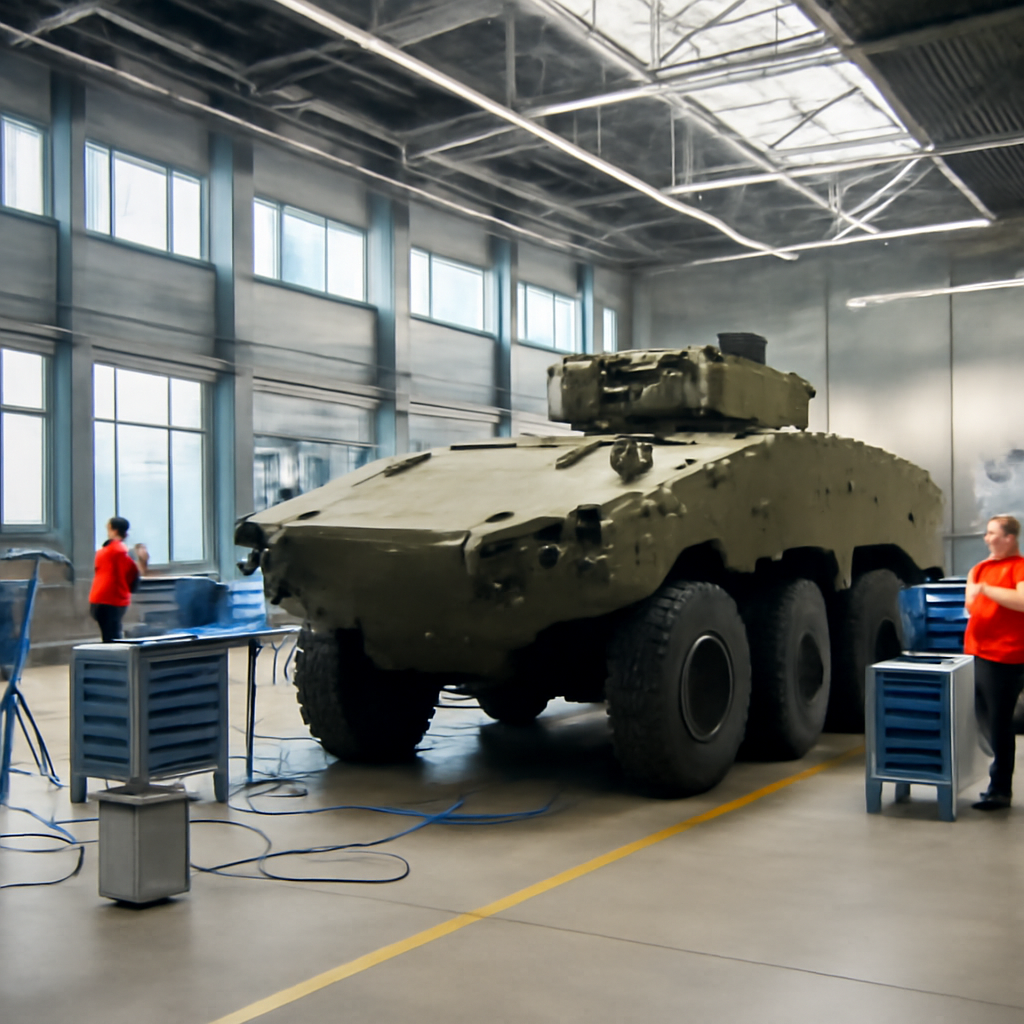
"We call it the Vehicle Integration Center. It allows us to prove out and test conformance in the real world. So that's work that we'll be doing in '27," Logan Jones, Oshkosh Defense’s chief growth officer, told Defense One.
Oshkosh Defense’s Vehicle Integration Center
Oshkosh Defense is building a dedicated Vehicle Integration Center intended to speed how new technologies are added to combat vehicles after manufacture. The company’s stated goal is to cut the time to “prove out and test conformance” from what Jones described as roughly “a year and a half” down to weeks. While the center will focus on Oshkosh offerings, Jones said it “could help other combat vehicle makers” and that primes are likely to be interested because the effort would “take risk out of their program.” Oshkosh aims to begin work at the center early next year.
Interface control documents and the engineer’s burden
Jones framed part of the problem as practical: engineers adding systems — for example, a counter‑UAS solution — need precise information about where to bolt equipment. That information typically lives in interface control documents, or ICDs, he said, and “we don't make that easy today.” The Vehicle Integration Center will be coupled with an effort to “clean up ICDs” and, in Jones’s words, move toward what he described as a “turnkey system” where ICDs are straightforward to access.

Audit-ready is a season. It shouldn't be.
Evidence in spreadsheets, controls drifting between audits, frameworks multiplying on flat headcount. Nubivance runs continuous compliance on Rapid7 Cyber GRC - SOC 2, HIPAA, ISO 27001, PCI, CMMC.
End the scrambleDerk Boswijk and the Netherlands’ "on‑call" industrial model
Derk Boswijk, the Netherlands’ minister for arms procurement and personnel, told reporters the country is rethinking acquisition to keep industry ready for rapid shifts in demand. “We can buy 1 million drones, but I know one thing for sure: that weeks from now they are outdated. So we have to come up with a new model, and we are already working on it,” Boswijk said.
His proposal: pay commercial companies to be effectively “on‑call” to produce specified military items if conflict breaks out. Boswijk used an automaker‑turned‑drone producer as an example: the firm would conduct research and build prototypes during peacetime and then “put everything aside and…produce the drones instead of the automobiles” when required. He argued for taking risks now rather than waiting for full certainty: “The most dangerous thing we can do is play [it] safe …I have to take [risks] because otherwise, when I want to have 100 percent certainty, then I know for sure…it will be too late.”
Bell, Lockheed Skunk Works and Netherlands‑U.S. industry ties
At the annual Netherlands‑U.S. defense industry event, two U.S. companies signed new agreements with Dutch organizations. Bell Textron signed two memorandums of understanding: one with PhotonFirst to explore fiber‑optic sensing to monitor aircraft structural health, and another with the Netherlands Industries for Defense & Securities intended “to facilitate relationships on how they can help us and find other partners in the Netherlands,” Robbie Yarbrough, director of international industrial cooperation at Bell Textron, told Defense One.
Lockheed Martin Skunk Works signed an agreement with the Royal Netherlands Aerospace Center in support of the Dutch air force. The company said the deal expands an existing agreement and “broadens industrial base access.” These arrangements underscore Boswijk’s stated push to bind Dutch and U.S. industry more closely to accelerate development and manufacturing when needed.
The Navy’s MQ‑25 satellite‑linked test and Applied Intuition award
The Navy reported a successful preliminary sea‑trial that synced the aircraft carrier USS Ronald Reagan to an unmanned tanker more than 2,100 miles away via satellite “to validate procedures, networks and interfaces.” Once the satellite link was established, air vehicle pilots aboard USS Ronald Reagan connected to the MQ‑25A air vehicle on the ground in Mascoutah, Illinois. Using the MD‑5C unmanned air command and control station aboard the ship, the AVPs gave the air vehicle multiple commands to exercise subsystems and verify the connection.
The MQ‑25 program was described in the source as a “pathfinder” effort intended to relieve F/A‑18E/F aircraft of refueling duties so they can focus more on strike missions. Separately, the Navy awarded Applied Intuition a contract for AI data infrastructure “across the manned and unmanned fleet,” expanding on an earlier award for the company's data engine solution. Applied Intuition said its Intelligent Perception System will be the first fleet‑scale capability deployed, starting with five Arleigh Burke‑class destroyers under the Portfolio Acquisition Executive Robotic and Autonomous Systems and PAE Mission Systems initiative.
What this means for primes, engineers, and procurement leaders
- Primes: The market signal that Oshkosh described — “speed, and…low risk” — suggests primes will look for partners or facilities that reduce integration risk and improve schedule predictability.
- Engineers and integrators: Easier access to cleaned‑up ICDs and a physical testbed could shorten iterative cycles from months to weeks, shifting where and how validation work happens.
- Procurement leaders and defense ministries: The Netherlands’ proposal to pay commercial firms to be “on‑call” creates a procurement model that trades steady peacetime investment and prototypes for surge capacity in crisis — a policy choice tied explicitly to Boswijk’s warning that buying en masse today risks rapid obsolescence.
Oshkosh plans to start Vehicle Integration Center work in early 2027 while the Dutch experiment with contractual readiness and the Navy advances long‑range command links for unmanned tankers. Each thread in this report — test infrastructure, clearer ICDs, on‑call production commitments, and satellite‑linked MQ‑25 trials — is a practical response to the same pressure: how to move faster without multiplying program risk. Whether those experiments deliver the shorter timelines and greater industrial resilience their proponents promise will be the next set of facts to watch.