“How do you trust an email that looks exactly like one from a colleague?” That question, posed by researchers studying recent North Korean operations, frames a growing dilemma for defense contractors in Europe: defenders must choose between the convenience of digital collaboration and the heightened risk that those same tools are being used to steal the very systems they build.
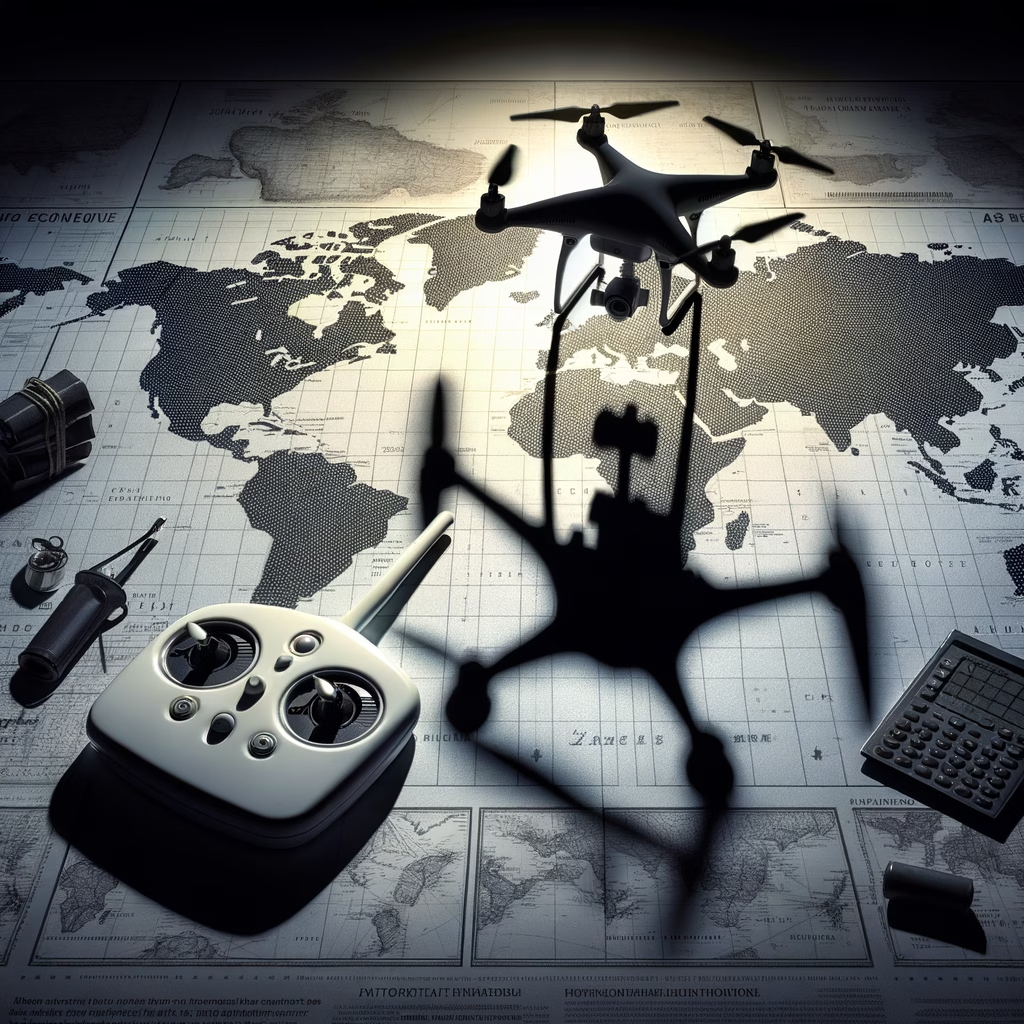
Over the past year security firms and independent investigators have traced a renewed wave of cyber-espionage campaigns tied to North Korean threat actors, collectively described in reporting as Operation Dream Job. The campaign has focused on companies active in the defense sector across Europe — and, importantly, several targets are heavily involved in unmanned aerial vehicle (UAV) development. That concentration suggests a deliberate effort to collect designs, supplier lists, procurement data, and software artifacts that could accelerate Pyongyang’s own drone programs.
The tactics are at once low‑tech in temperament and high‑tech in execution. Attackers rely on highly tailored social engineering — calendar invites, spear‑phishing messages impersonating trusted contacts, and lures referencing real meetings — to coax victims into opening links or attachments. Once a foothold is gained, operators hide payloads and command‑and‑control infrastructure in plain sight by using mainstream developer services such as GitHub, complicating detection and takedown.
From a technical standpoint, the operation exploits trust: organizations routinely whitelist or implicitly trust large collaboration and code‑hosting platforms, so traffic to those services often bypasses defensive filters. That habit gives attackers a path to deliver malware or exfiltrate data while blending into ordinary network noise. The consequence is not only data loss but strategic intelligence gain — blueprints, control‑software, and supplier relationships — assets of acute value to any state seeking to scale up an unmanned arsenal.
For technologists, the campaign is a reminder that security controls cannot be purely binary. Zero‑trust architectures, rigorous code auditing, and supply‑chain scrutiny remain essential, but they must be paired with human‑centered defenses: robust awareness training, careful handling of calendar invites and external meeting links, and stricter policies around developer tool allowlisting. As one analyst observed while discussing similar supply‑chain incidents, “When malicious code finds its way into a platform as central as npm, it’s not just a matter of a single user being infected—it’s an entire ecosystem at risk.” That sentiment echoes in the Dream Job findings.
Policymakers face a layered problem. On one level, the response requires traditional attribution, sanctions, and diplomatic pressure — tools that are blunt and slow. On another level, it demands better coordination between governments, platform providers, and industry to speed removals, share indicators of compromise, and harden supply chains. The use of public collaboration platforms as attack infrastructure raises thorny questions about platform responsibility and the speed at which takedowns or mitigations can be effected without disrupting legitimate development.
From the vantage of companies in the UAV supply chain, the calculus is practical and immediate. Their engineering outputs — control loops, sensor-fusion code, materials testing results, and vendor rosters — are precisely the kinds of intellectual property adversaries covet. The risk is amplified for smaller subcontractors whose security maturity may lag that of prime contractors yet whose designs or parts are nonetheless essential to whole systems. The incentive for adversaries is clear: targeting a few suppliers can yield outsized returns.
Adversaries — in this case actors linked to North Korea — benefit from asymmetric economics. A well‑crafted spear‑phish or a cleverly staged repository once delivered can harvest years’ worth of programmatic knowledge at a fraction of the cost of fielding comparable research. The Dream Job operation illustrates how state actors repurpose common cyber‑espionage tradecraft into industry‑specific campaigns, prioritizing persistence and intelligence over headline‑grabbing disruption.
What should defenders do differently? Steps that move from incremental to structural: enforce multi‑factor authentication, segment networks so engineering assets are isolated, adopt robust software‑bill‑of‑materials practices, and treat developer platforms as untrusted by default unless specifically authorized and monitored. Equally important is information sharing: rapid disclosure of indicators of compromise and exploitation techniques among industry, CERTs, and platform operators can blunt an adversary’s window of advantage.
There are also legal and ethical tradeoffs. Heavy‑handed restrictions on collaboration platforms could slow innovation, increase costs, and introduce new single points of failure. Over‑criminalizing or escalating every intrusion into a diplomatic spat risks normalizing cyber confrontation as a permanent state of affairs. Yet doing nothing risks allowing a persistent intelligence campaign to erode competitive advantage and, at scale, shift regional military balances. Policymakers must weigh these competing risks with an eye toward proportionality and resilience.
Operation Dream Job is not a headline‑only event; it is symptomatic of a broader evolution in state cyber operations: weaponizing trust, exploiting platform ubiquity, and targeting niche industrial ecosystems that matter strategically. For a Europe that relies on a web of contractors and suppliers to field advanced UAVs, the lesson is stark — digital hygiene is now national security.
If defenders can treat collaboration platforms as part of the attack surface rather than benign infrastructure, they will make it harder for operators to hide in plain sight. If industry, governments, and platform owners coordinate faster and share more openly, they can shorten the adversary’s window of operation. But even then the question remains: can the convenience of modern engineering be reconciled with the discipline required to defend it, or will the very tools that accelerate innovation continue to be repurposed as instruments of strategic theft?
Source: https://thehackernews.com/2025/10/north-korean-hackers-lure-defense.html