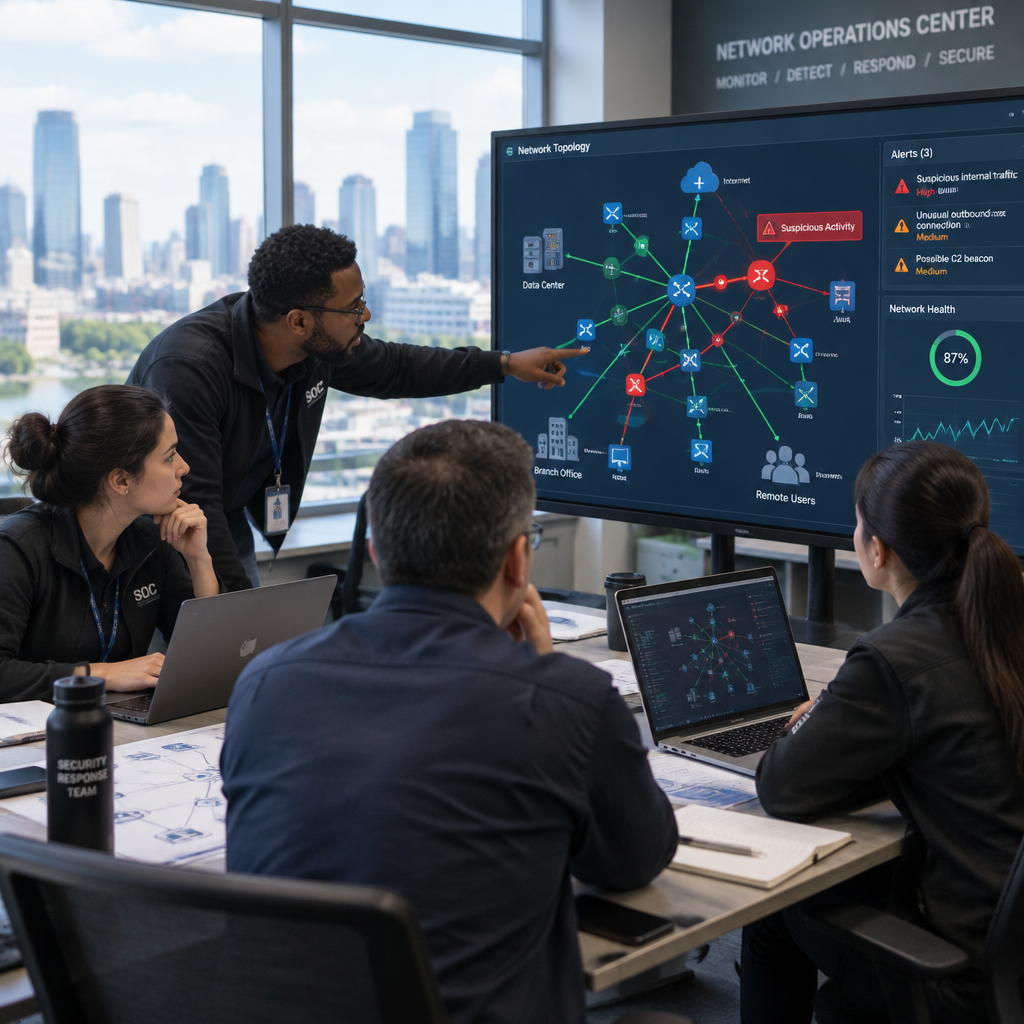
"At some point your security will fail." — Corelight
Alerts mark an event, not the end of the story
An alert tells you something happened, but it does not tell you what comes next. Corelight frames that distinction plainly: gaining network access does not necessarily mean data has been stolen or systems have been disrupted. Attackers often still need to obtain additional access, move laterally, or explore before they reach their objective. That interval — what Corelight calls the intervention opportunity — is where response succeeds or fails.
Security teams and tool evaluators naturally focus on whether a product "catches" an attack. Detections are tangible and easy to compare. But Corelight stresses that tracing the attack, understanding its scope, and responding in time depends largely on the underlying data that produced the detection. A visible alert with poor supporting evidence can leave analysts unable to follow what happened next.
Shallow data versus rich network data
Corelight draws a clear line between two kinds of network telemetry. Shallow data typically consists of timestamps, IPs, and basic connection information — enough to trigger an alert, but often not enough to reconstruct an incident. Rich data, by contrast, preserves transaction-level details and context: correlated events, protocol-level information, and the ability to pivot across hosts and time.
To evaluate data quality, Corelight recommends asking concrete questions:
- Are full transaction details provided or just a summary?
- Is packet content or file extraction available?
- How far back can we search, and how fast?
- Can I follow a connection across hosts and time?
These are practical axes for measuring whether a tool will support an actual investigation or merely surface isolated alerts.

This site is the portfolio.
OSINTSights runs on Cloudflare Workers, D1, R2, and Vectorize, with an AI pipeline on Hetzner ARM. Nubivance designed, built, and operates it. We do the same for clients.
See what we buildAI-powered SOCs: data enables insight — and demands proof
Corelight argues that modern AI-powered SOC tools can analyze orders of magnitude more data than human teams can, and that richer data lets these tools surface subtle cross-host and cross-behavior patterns. With richer evidence, AI may expose previously unseen indicators of compromise or provide earlier chances to intervene.
At the same time, Corelight warns that AI outputs require validation. An assistant can explain unfamiliar services, suggest investigative questions, or write scripts to transform large datasets, saving research time and helping an analyst past blocks. But those suggestions are not self-verifying: if an assistant offers an explanation, analysts must check whether the evidence supports it; if it produces a query or command, analysts should test its effects and ask what else it might affect. Corelight emphasizes that as AI takes on more investigative work, the ability to inspect the underlying evidence becomes an essential part of data quality.
Testing network detection and response: go off-script
Corelight advises that the most revealing product evaluations come when teams refuse to follow the demo script. Instead of accepting a guided walkthrough, put the product into unfamiliar territory and see whether the data lets you resolve the unexpected. Corelight's short investigative checklist includes four practical tasks:
- Look at the transactions behind the alert.
- Ask what packet content or extracted files are available.
- Follow the activity backwards and forwards in time.
- Ask a question that wasn’t anticipated.
Those steps are meant to reveal whether a tool provides fidelity, reach, and context or merely an attractive starting point with nowhere to go.
What this means for technologists, procurement leaders, and SOC analysts
- Technologists and security teams: Focus procurement and architecture decisions on whether a solution preserves protocol-level context and full transaction evidence, not just metadata that fuels alerts. Richer evidence is what enables reconstruction and intervention.
- Procurement leaders: During evaluations, insist on unscripted investigations — ask the questions Corelight lists and test how far back and how fast you can search. Detections may headline sales materials, but data fidelity determines operational outcomes.
- SOC analysts: Use AI assistance pragmatically — for triage, explanation, and scripting — but always validate outputs against the preserved evidence. Make inspecting the underlying data a routine part of every investigation.
Detections get the attention, but data determines the outcome. The real question Corelight leaves on the table is direct: can your team use the data to fully understand an incident and decide what to do? If the evidence behind an alert does not let you validate findings, reconstruct activity, or reach reliable conclusions, the alert is only a signal — not the solution.