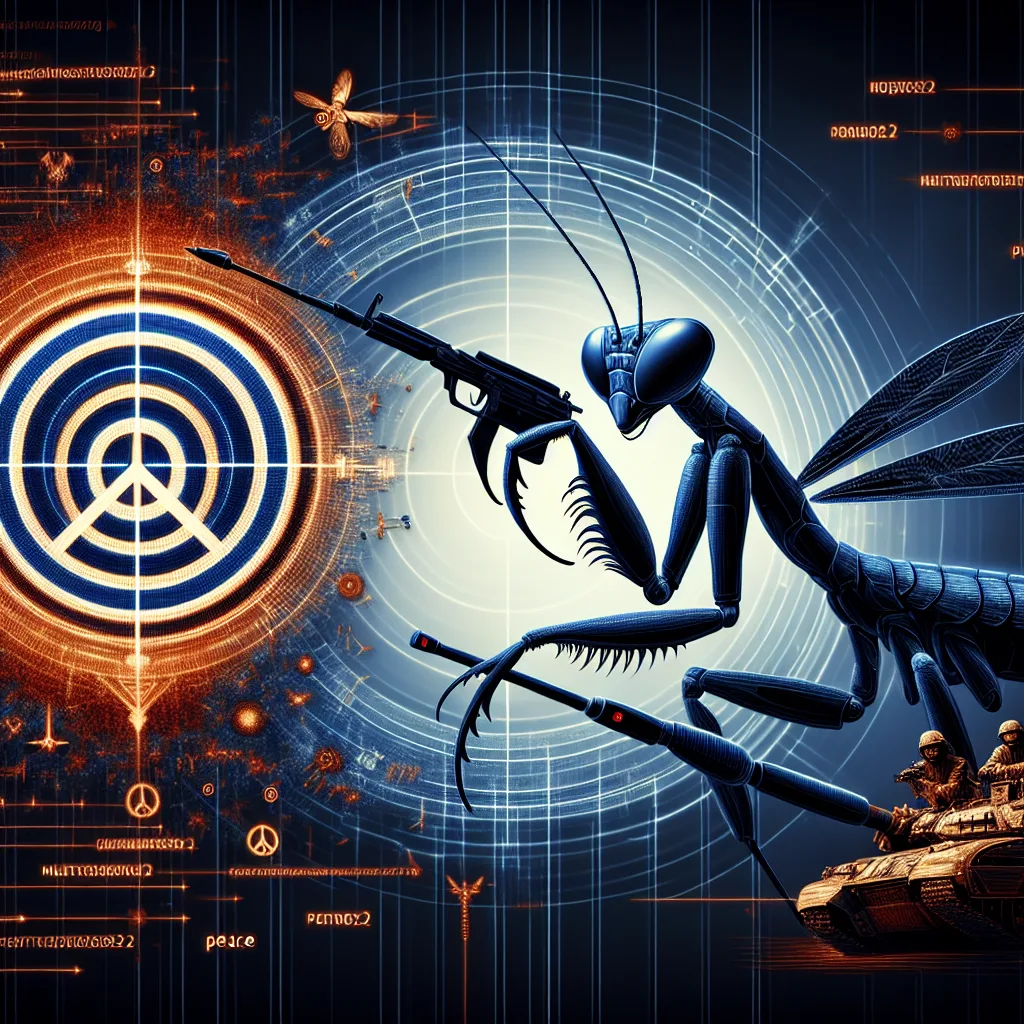
Nebulous Mantis: The New Frontier in Cyber Intrusions Against NATO Assets
The digital battlefield is evolving. In an unfolding story affecting international security, a group known only as Nebulous Mantis has reportedly deployed a sophisticated multi-stage malware campaign targeting systems affiliated with the North Atlantic Treaty Organization (NATO). This incident, emblematic of modern cyber warfare, underscores the vulnerability of identity systems in an era where deception is as potent a tool as any exploit.
In an age when attackers rarely “hack” their way past defenses through brute force, they instead rely on a mixture of social engineering tactics including deepfakes, impersonation scams, and AI-powered manipulations. This new modus operandi not only challenges conventional cybersecurity measures but also raises probing questions about the integrity of personal and institutional identity systems.
Historically, cyber intrusions often began at the perimeter of a network—penetrating systems by exploiting software vulnerabilities or misconfigured firewalls. However, the current campaign pivots on an ingenious blend of both digital and human manipulation. While NATO and its allied nations have incrementally hardened their technical defenses over years of persistent cyber threats, adversaries are now leveraging the art of deception—an age-old tactic refreshed by modern technology.
The malware, acting in a multi-stage process, initially gains entry by masquerading as legitimate access requests. According to the NATO Communications and Information Agency (NCIA), early indicators suggest that attackers used advanced impersonation techniques supported by deepfake technology to establish credible identities. Once the malware infiltrates the network, it transitions into stage two: lateral movement, account takeover, and data exfiltration. In this complex sequence, the malware’s design allows it to hide from many of today’s cutting-edge detection systems.
Why should the international community be concerned? For one, the very foundation of trust in digital systems—the identity authentication process—is under threat. As Alex Stamos, the former Chief Security Officer at Facebook and a recognized voice on cybersecurity matters, has noted in past discussions, “When adversaries can convincingly impersonate trusted entities, the digital trust framework unravels.” While Stamos did not comment on this current incident, his earlier warnings resonate deeply in light of Nebulous Mantis’s tactics.
At its core, the intrusion exemplifies both an age-old human vulnerability and a digital design flaw. Modern authentication strategies have often relied on the assumption that once a user’s credentials are validated, they can be trusted implicitly. But today’s adversaries illustrate that identity is not defined solely by passwords or two-factor tokens—it is also defined by behavior, context, and increasingly, digital appearance.
Bullets underscore the multifaceted implications of this breach:
- Security Vulnerability: Traditional defenses are being outmoded by techniques that manipulate human trust and digital appearances.
- Policy Implications: Governments and organizations must rethink regulatory frameworks and cybersecurity standards in light of technologies that can convincingly fabricate identity.
- Economic Impact: Security breaches that compromise identity systems can inflict long-term financial damage, from immediate recovery costs to prolonged erosion of public confidence.
- International Stability: With NATO and its affiliates involved, the repercussions extend well beyond individual organizations, touching on diplomatic and military spheres as adversaries exploit weaknesses in strategic systems.
The current intrusion is more than an isolated incident. It signals that cybersecurity strategies need to be as agile and multifaceted as the methods employed by adversaries. It is essential to note that, according to cybersecurity companies such as FireEye and CrowdStrike, while structural defenses have advanced considerably in recent years, a gap remains in addressing the human element of authentication. Modern identity systems need a redesign that integrates behavioral analysis and AI-backed verification mechanisms to effectively counter the emerging risks.
In conversations with officials from the European Union Agency for Cybersecurity (ENISA), experts have emphasized the increasing sophistication of attackers who no longer rely solely on technical breaches. “We see a convergence of cybersecurity and social engineering,” explained a senior ENISA analyst. “Deepfake technology, for instance, is no longer confined to PR stunts or entertainment—it has real implications on security protocols when adversaries use it to impersonate key personnel.” While specific individual attributions remain confidential due to ongoing investigations, the repeated sentiment among international cybersecurity circles remains clear: traditional identity safeguards have become insufficient.
Moving forward, what does this mean for global cybersecurity and the defense framework of organizations like NATO? The answer lies in a recalibration of how identity is verified. Current efforts include adopting multi-factor authentication that incorporates biometric data alongside behavioral analytics. However, industry experts argue that even these measures must evolve. For example, the deployment of AI systems that can detect subtle discrepancies in communication patterns or digital signatures might be crucial in mitigating risks posed by deepfake and impersonation scams.
In addition to technological responses, there is a pressing need for comprehensive policy reforms aimed at enhancing digital verification processes. Initiatives such as mandatory cybersecurity training, tighter controls over credential issuance, and international cooperation frameworks for information sharing are emerging as necessary strategies. Such approaches must foster a synergy between technical and human-focused security measures.
Observing these trends, cybersecurity strategist Nicole Perlroth, author of “This Is How They Tell Me the World Ends,” has often highlighted the interplay between technical vulnerability and the human element in cyber conflict. Her analysis supports the notion that breaches of identity systems are as much about technological exploitation as they are about eroding confidence in digital trust mechanisms. Although Perlroth has not directly commented on Nebulous Mantis, her previous work provides a framework for understanding the broader implications.
Looking ahead, the immediate challenge is to enhance detection capabilities across both technical and social dimensions. One promising development is the integration of machine learning techniques that analyze user behavior in real time. Such systems, while not infallible, can provide early warnings about potential anomalies that might indicate an ongoing deception-based attack. Moreover, international partnerships will be vital in standardizing these new methods. For instance, information sharing agreements among NATO members have already been ramped up following the initial reports of this campaign, suggesting that collaborative responses are imminent.
The shadow of Nebulous Mantis looms large as today’s cyberattacks grow ever more integrated, blending human ingenuity with machine capability. As policymakers, defense strategists, and cybersecurity leaders come together in response, the battle is as much about bolstering digital infrastructures as it is about restoring public confidence in these systems.
Ultimately, the challenge extends beyond technical resilience. It questions the very foundation of modern digital trust. When an adversary can manipulate identity itself—through deepfakes and intricate impersonation—the issue is not merely one of stolen credentials, but of a corrupted trust network. As we navigate these uncharted waters, one critical question remains: In a world where even the human element of security is under siege, how do we rebuild trust in the very systems that underpin our daily lives?
In this unfolding drama of technological innovation and cyber subterfuge, Nebulous Mantis has not only demonstrated an advanced capability to circumvent traditional defenses but has also exposed a deep and systemic vulnerability. The incident serves as a wake-up call for NATO, its allies, and indeed, for all who depend on digital infrastructures for their security, economic stability, and personal privacy. The time for rethinking identity systems—and the policies that support them—is now.



