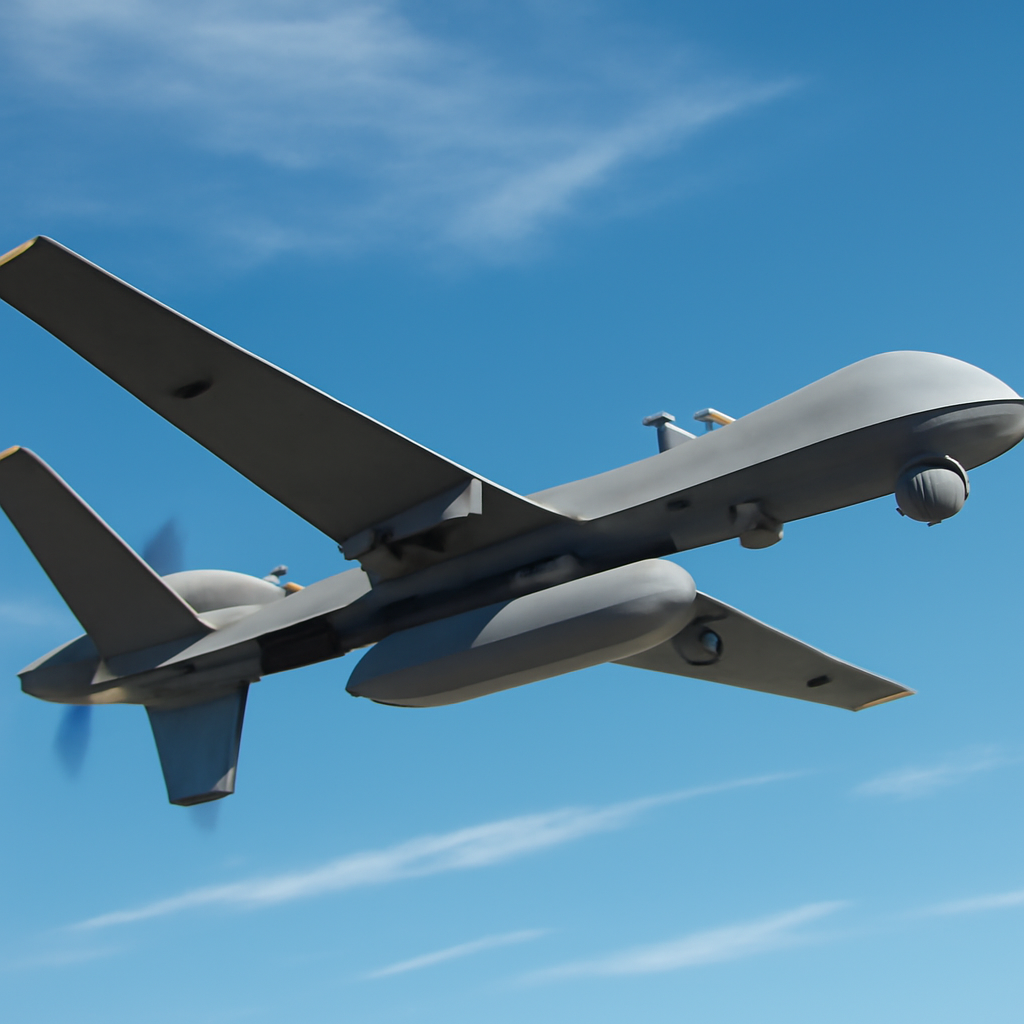
“AEW for MQ-9B will offer critical aloft sensing to defend against tactical air munitions, guided missiles, drones, fighter and bomber aircraft, and other threats,” said General Atomics–Aeronautical Systems President David R. Alexander after the first MQ-9 equipped with an airborne early warning (AEW) pod flew on May 19, 2026.
Saab’s LoyalEye and the May 19 test flight
The initial sortie was the product of a partnership between General Atomics and Saab, with Saab supplying the podded radar system named LoyalEye. The May 19 flight proved the concept of mating a medium-altitude, long-endurance MQ-9 variant with an AMTI-capable radar pod; a full demonstration of the pairing’s capabilities is planned for next year. General Atomics presented imagery of MQ-9s outfitted with AEW pods and short-takeoff-and-landing (STOL) kits intended to broaden basing options.
How an AEW MQ-9 differs from crewed AEW&C platforms (E-3, E-7, E-2D)
The source frames the AEW MQ-9 as a lower-cost, higher-persistence complement to crewed AEW&C aircraft. It notes the U.S. Air Force’s E-3 Sentry fleet as “geriatric,” with dwindling numbers, and the E-7 procurement only moving forward reluctantly. The Navy operates the E-2D Hawkeye, which the source says is more modern in some respects but limited in numbers and tasked to carrier air wings. The piece argues that while a pod-equipped MQ-9 cannot replace crewed platforms for high-end command-and-control work, it can supply persistent, high-fidelity look-down radar where gaps exist or where risking crewed assets is undesirable.

Audit-ready is a season. It shouldn't be.
Evidence in spreadsheets, controls drifting between audits, frameworks multiplying on flat headcount. Nubivance runs continuous compliance on Rapid7 Cyber GRC - SOC 2, HIPAA, ISO 27001, PCI, CMMC.
End the scrambleDetecting long-range one-way attack munitions and low-altitude threats
The article highlights a pressing sensing challenge: one-way attack munitions and low-end cruise missiles—objects with small radar signatures, low-altitude flight profiles, and slow speeds—are difficult to detect with aging airborne sensors or some ground-based systems. An airborne look-down radar on an MQ-9 can spot such objects from above, separate them from ground clutter, and maintain long-duration orbits to provide warning. The author contends AEW MQ-9s could create radar picket lines—over the Persian Gulf, Gulf of Oman, or eastern Iraq in the example offered—without putting aircrews at risk.
Naval, Marine, and expeditionary use cases: carriers, LHAs/LHDs, and EABO
General Atomics is modifying MQ-9 variants for operation from large-deck amphibious assault ships and carriers, creating an option for organic, fixed-wing AEW aboard LHA/LHDs. The source argues this is significant for littoral operations where surface combatants and a limited number of fighters may be the only air-defense assets. The U.S. Marine Corps already operates the MQ-9, and an AEW-configured MQ-9 could integrate into a shipboard Air Combat Element or support Expeditionary Advanced Base Operations (EABO). For supercarriers, the article suggests an AEW MQ-9 could augment E-2D coverage, extending look-down radar reach and assisting Aegis ships and fighters with targeting data.
What this means for the U.S. Air Force, the Navy, and partner air arms
- U.S. Air Force: An AEW MQ-9 could fill persistent surveillance gaps while the service fields E-7s and pursues an orbital sensing layer; the MQ-9 offers higher operational availability and lower crew risk for forward orbits.
- U.S. Navy and U.S. Marine Corps: Shipboard-capable MQ-9s with STOL enhancements could provide organic AEW coverage for amphibious ships and augment carrier strike group sensors when E-2s are not airborne.
- Allied and partner air arms (including Japan and NATO members): The MQ-9 AEW concept offers a lower-cost, more accessible AEW capability for nations without dedicated crewed AEW fleets, enabling wider coalition sensor coverage.
Integration, persistence, and force design tradeoffs
The article lays out several operational and technical tradeoffs inherent in the approach. An AEW MQ-9 would not substitute for crewed platforms’ command-and-control capabilities but could supply continuous AMTI tracks and feed targeting data to surface-to-air missile systems and fighters. General Atomics also envisions coordinated roles—an AEW MQ-9 spotting threats and a weaponized MQ-9 armed with laser-guided rockets intercepting them. The MQ-9’s MTS electro-optical turret can provide non-cooperative identification when objects approach close enough for visual confirmation. The piece also highlights the U.S. Air Force’s parallel effort to migrate AMTI sensing into an orbital layer, describing that path as promising but distant and inadequate on its own for near-term needs.
The May 19 flight marked the first practical step toward fielding a podded-AEW MQ-9 that can loiter persistently, operate from austere fields with STOL kits, and potentially operate from large-deck ships—an approach the source says could “democratize” AEW and relieve pressure on scarce crewed assets. The next concrete milestones are the planned full demonstration next year and further integration work to tie LoyalEye and similar pods into datalinks and the command networks that would use their tracks.
Original story: https://www.twz.com/air/mq-9-getting-airborne-early-warning-radar-is-a-huge-deal