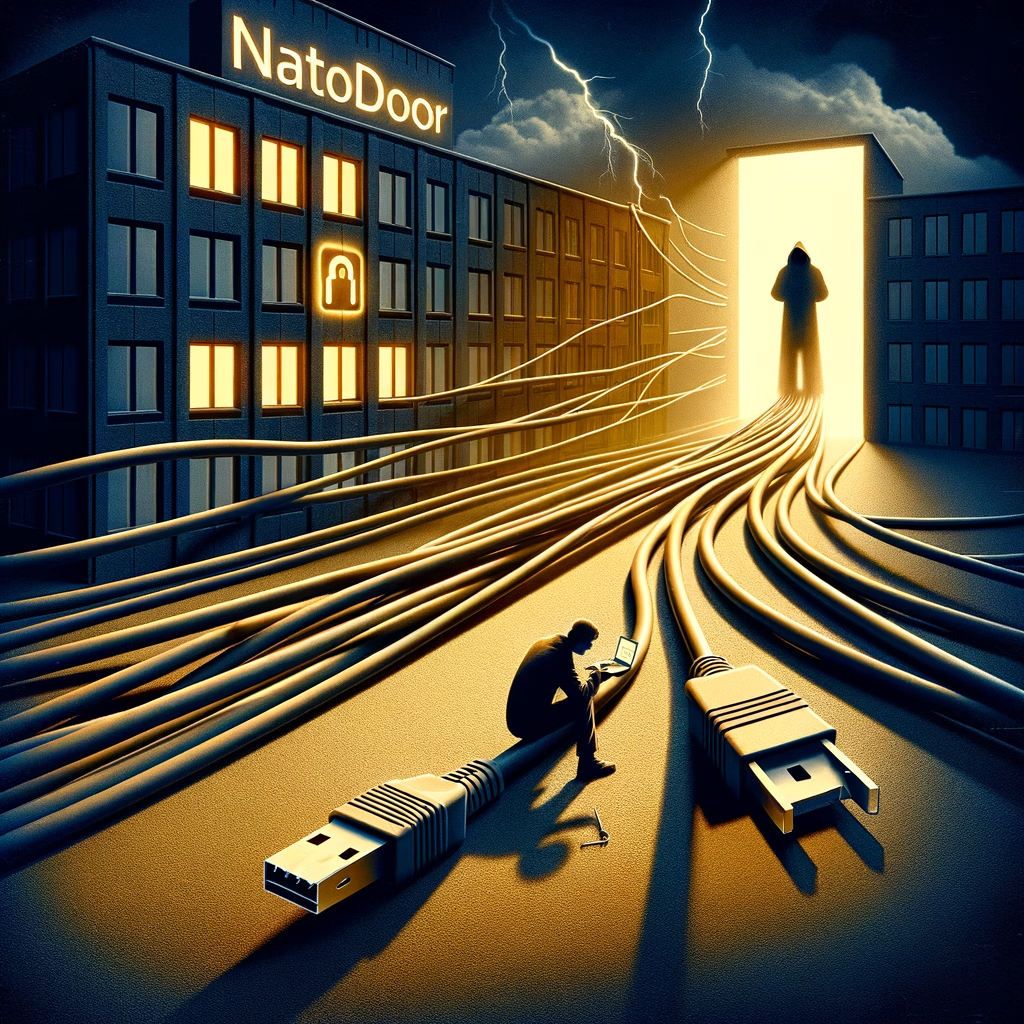
When a single sentence pauses with an ellipsis, the threat often begins. S2 Grupo’s LAB52 report ends one such sentence—“When such an email is…”—and that trailing pause perfectly captures the modern espionage dilemma: how do democracies defend against attacks concealed inside the very messages meant to keep organizations informed? Security researchers now say the Russian state-sponsored group APT28 has introduced a new Microsoft Outlook backdoor called NotDoor, targeting companies across multiple sectors in NATO countries. The choice of Outlook as a vector, and of a VBA macro as the delivery mechanism, changes the calculus for detection, response, and policy.
What NotDoor does and why it matters
Analysts describe NotDoor as a VBA macro for Outlook designed to monitor incoming emails for a specific trigger word or pattern. Instead of noisy scans or mass phishing campaigns, NotDoor waits inside the mail client, watching for carefully crafted messages that activate follow-on behavior. Once a trigger condition is met, the macro can execute actions that allow operators to collect data, exfiltrate information, or establish further access.
The stealth of this approach is significant. Outlook’s Visual Basic for Applications has long been abused in document-based attacks—but embedding a macro directly in the mail client converts Outlook from a passive tool to an active agent. That shift makes traditional defenses less effective: many security systems look for malicious attachments, suspicious links, or unusual network traffic. A Microsoft Outlook backdoor that operates within the trusted application undermines those assumptions and raises the bar for detection.
How this changes the threat model
NotDoor demonstrates a strategic preference for discrimination over disruption. APT28’s playbook—targeted intrusions into government, defense, and private-sector entities—remains constant, but the tactics emphasize long-term, context-aware access rather than immediate impact. By triggering on specific, contextual email content, operators can harvest conversations and documents that matter to national security and corporate strategy, while avoiding the noisy indicators that attract rapid attention.
For defenders, the implications are clear: endpoint protection must be complemented with application control and behavior-based analytics that monitor automation inside client software. Inventorying Outlook add-ins, auditing macros, and enforcing script-blocking policies become essential. Traditional email filtering and attachment scanning are necessary but insufficient when a threat lives inside the mail client itself.
Technical and operational defenses
Many of the recommended mitigations are familiar but now require renewed urgency and expanded scope:
– Disable VBA macros in Outlook where they are not needed, and enforce this via group policy.
– Apply least privilege to user accounts; restrict administrative rights to reduce the damage any client-side compromise can cause.
– Implement multifactor authentication to make account-based lateral movement harder.
– Harden endpoints with application control solutions that can block unauthorized scripts and executables.
– Use behavioral analytics to detect unusual automation or rule changes within mail clients.
– Maintain an inventory of Outlook add-ins and monitor changes to macro-enabled settings.
These steps reduce risk, but they must be paired with operational practices: continuous patching, rapid incident-sharing, and drills that assume subtle, targeted implants rather than loud, obvious intrusions.
Policy, diplomacy, and the limits of attribution
APT28 has long been tied to Russian military intelligence (GRU) by both governments and private-sector analysts. Attribution can trigger sanctions, public condemnations, and diplomatic protest, but it rarely stops the technical evolution of adversary tradecraft. NATO members and allies will need coordinated incident response playbooks and near-real-time threat sharing to respond effectively to implants like NotDoor.
Policymakers face a balancing act. Aggressive, escalatory responses carry political risk and may not always be proportional; yet measured cyber diplomacy without robust defensive investments leaves infrastructures exposed. Some experts argue that reducing the attack surface of ubiquitous platforms—through vendor cooperation, secure defaults, and platform-level mitigations—is the most sustainable path. Others emphasize mandatory reporting of nation-state intrusions and tighter controls on productivity software supply chains.
Operational realities for organizations
For corporate leaders and IT teams, the arrival of NotDoor reinforces basic cybersecurity hygiene but also demands deeper scrutiny of trusted workflows. Train staff to question unusual internal messages—even those that look legitimate. Review and restrict automation capabilities in client applications. Combine technical controls with a culture that treats convenience and habit with appropriate suspicion.
The broader lesson
NotDoor’s modular, low-profile design suggests a preference for persistent, low-noise access: long-term intelligence collection rather than short-term disruption. That approach fits APT28’s historical goals and highlights a persistent truth in cyber defense: convenience and trust—what people accept as normal—can become the weakest link.
Conclusion: defending against a Microsoft Outlook backdoor
The discovery of NotDoor underscores the need to rethink defenses around trusted applications. A Microsoft Outlook backdoor that triggers on context-aware messages makes detection harder and the stakes higher. The fix is not a single tool or policy but layered defenses: improved telemetry, cross-border threat-sharing, vendor cooperation, hardened endpoints, and disciplined operational hygiene. Democracies must learn to treat convenience with the same seriousness as security before subtle, targeted implants like NotDoor become routine tools of strategic espionage.



