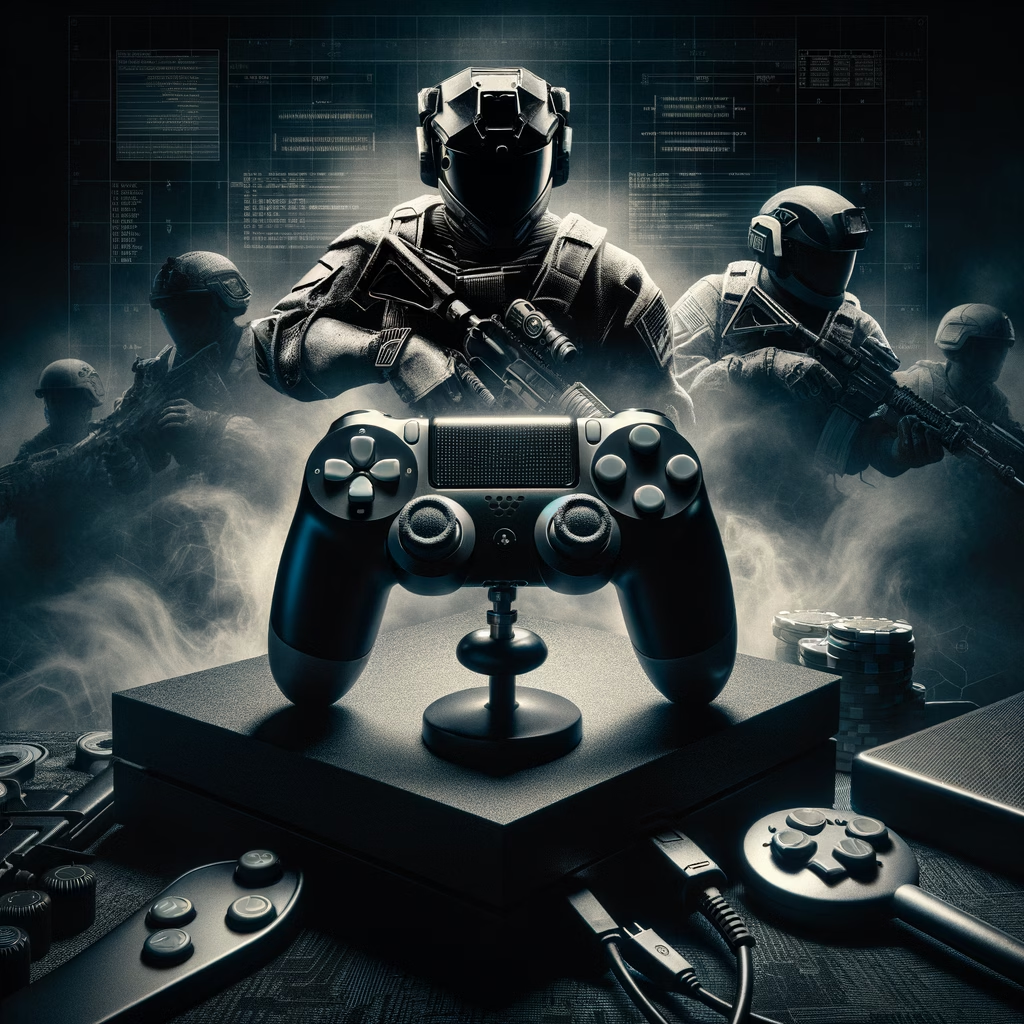
Can a videogame sharpen the skills that decide life and death on modern battlefields — or does turning war into sport risk trivializing the very real stakes involved? That is the dilemma the Ministry of Defence and its allies now confront as they roll out the International Defence Esports Games (IDEG), a pioneering effort the MoD says is designed to hone both cyber and battlefield competencies among allied soldiers.
Background matters. Militaries have for years layered live exercises with simulators and computer-generated training to rehearse complex missions without burning platforms or munitions. The IDEG extends that logic into competitive, networked esports: organized contests in which service members and defense personnel compete in military-themed simulations and cyber challenges intended to stress decision-making, teamwork and technical skills at speed and scale. Proponents argue the format leverages engagement and repeatability — familiar advantages of commercial gaming — while exposing trainees to contested digital environments they will face in the field.
The MoD frames the IDEG as more than a publicity stunt. By bringing allied teams together in a structured tournament environment, organizers aim to sharpen tactics for distributed operations, improve interoperability across nations, and surface cyber-defence practices under pressure. Those objectives mirror long-standing training priorities that emphasize Live-Virtual-Constructive (LVC) integration — the federation of live units, high-fidelity simulators and large-scale computer-generated forces that modern training doctrine prizes for realism and scalability .
What the IDEG is reportedly designed to do
- Stress test cyber-defence and incident response through timed competitions and capture-the-flag style challenges.
- Rehearse tactical decision-making in virtualized battlefield scenarios that combine sensor data, comms constraints and adversary actions.
- Promote interoperability by having multinational teams operate under common rules, systems and communications protocols.
- Encourage innovation and recruitment by linking military training pipelines with the wider gaming and tech communities.
Why this matters: capability, culture and cost
From a capability perspective, the IDEG addresses a simple fact of contemporary conflict: the electromagnetic and cyber domains are now fused with conventional operations. Training that isolates kinetic skills from cyber and electronic warfare risks preparing forces for yesterday’s fights. Federated training tools — the same category that underpins NAVPLAN-style modernization efforts — enable complex mission threads to be exercised without the operational cost of live-range time, and esports-style tournaments can increase the tempo and variety of those rehearsals .
Culturally, the IDEG is a bet that competition and gamified learning accelerate skill acquisition and foster communities of practice across services and nations. Technologists point out that commercial game engines and synthetic environments now deliver levels of fidelity and networking scale that were unimaginable a decade ago; these tools can generate thousands of permutations of a scenario for after-action review and data-driven assessment.
But policymakers face trade-offs. Investment in virtual and esports training must be balanced against procurement for sensors, munitions and logistics. Esports cannot substitute for live-fire practice, nor can it alone replicate stresses such as weather, fatigue, and the political friction of operations in contested spaces. There is also a reputational dimension: opponents and some publics may view the melding of “games” and warfare with skepticism, worrying that a tournament frame sanitizes lethal decision-making.
Different perspectives
Technologists: They see IDEG as an efficient vector for rapid iterative learning. Modern LVC frameworks and synthetic training environments can scale scenarios and instrument human performance, producing measurable metrics for decision quality, communication, and cyber hygiene .
Policymakers and military leaders: They must weigh the strategic upside of more frequent, low-cost rehearsal against risks of over-reliance on simulation fidelity and the political optics of “gaming” war. Some will welcome a standardized multinational pipeline for tactics and procedures; others will argue for safeguards that preserve human judgment and legal compliance in targeting and escalation-sensitive contexts.
Users — the soldiers, sailors and aircrew who will compete: Many welcome realistic, repeatable training that is engaging and transferable. Competitive formats can sharpen teamwork under stress. Yet experienced commanders caution that simulation success does not automatically translate to performance in the fog, friction and moral complexity of live operations.
Adversaries: For potential opponents, IDEG-style exercises offer both a signal and a challenge. They reveal training priorities and areas of emphasis; at the same time, they raise the bar for cyber and electronic resilience, potentially prompting adversaries to harden their own systems or invest in asymmetric counters such as jamming, deception, or cyber-attack vectors.
Limitations and risks
Simulation gap: No virtual environment can perfectly reproduce sensor noise, platform maintenance realities, or the consequences of kinetic effects on civilians and infrastructure. Overconfidence born of simulated success can be dangerous.
Security and deception: Networked tournaments themselves are attractive targets for espionage and manipulation. If adversaries gain access to scenario templates, exercise data or communications, they could exploit predictable tactics. That risk makes secure architecture and rigorous operational security essential.
Escalation and norms: Institutionalizing competitive, multinational military gaming may complicate diplomatic messaging about defensive versus offensive intent. Policymakers should consider transparency measures and rules of engagement for training activities that involve simulated strikes or offensive cyber effects.
Analysis: pragmatic innovation, not panacea
The IDEG represents a pragmatic synthesis of two trends: the professionalization and democratization of advanced simulation tools, and the military’s imperative to rehearse multi-domain operations at scale. Its potential lies in creating high-tempo, instrumented learning loops that compress experience and surface lessons rapidly. But success will depend on integration with doctrine, robust security, and honest after-action assessment that links simulated performance to measurable changes in readiness.
To maximize value, organizers should:
- Ensure scenarios map to documented operational tasks and include live-virtual linkages that feed back into live training cycles.
- Protect exercise data and scenario libraries as classified or controlled information when they reflect sensitive tactics or capabilities.
- Incorporate legal, ethical and escalation-control training into tournament rules and adjudication so that simulated choices reflect real-world constraints.
- Use metrics from competitions to inform procurement and doctrine — not as a substitute for independent evaluation.
Conclusion
Bringing esports-style competition into defense training is an idea whose time has likely come; technology now makes it affordable, scalable and analytically rich. Yet the central question remains: will the IDEG be a rigorous instrument that sharpens allied readiness, or will it become an attractive but incomplete proxy for the messy reality of war? The answer will be written not in headlines but in the after-action reports, policy choices and operational outcomes that follow the tournament arena.
Source: https://www.infosecurity-magazine.com/news/mod-worlds-first-military-gaming/