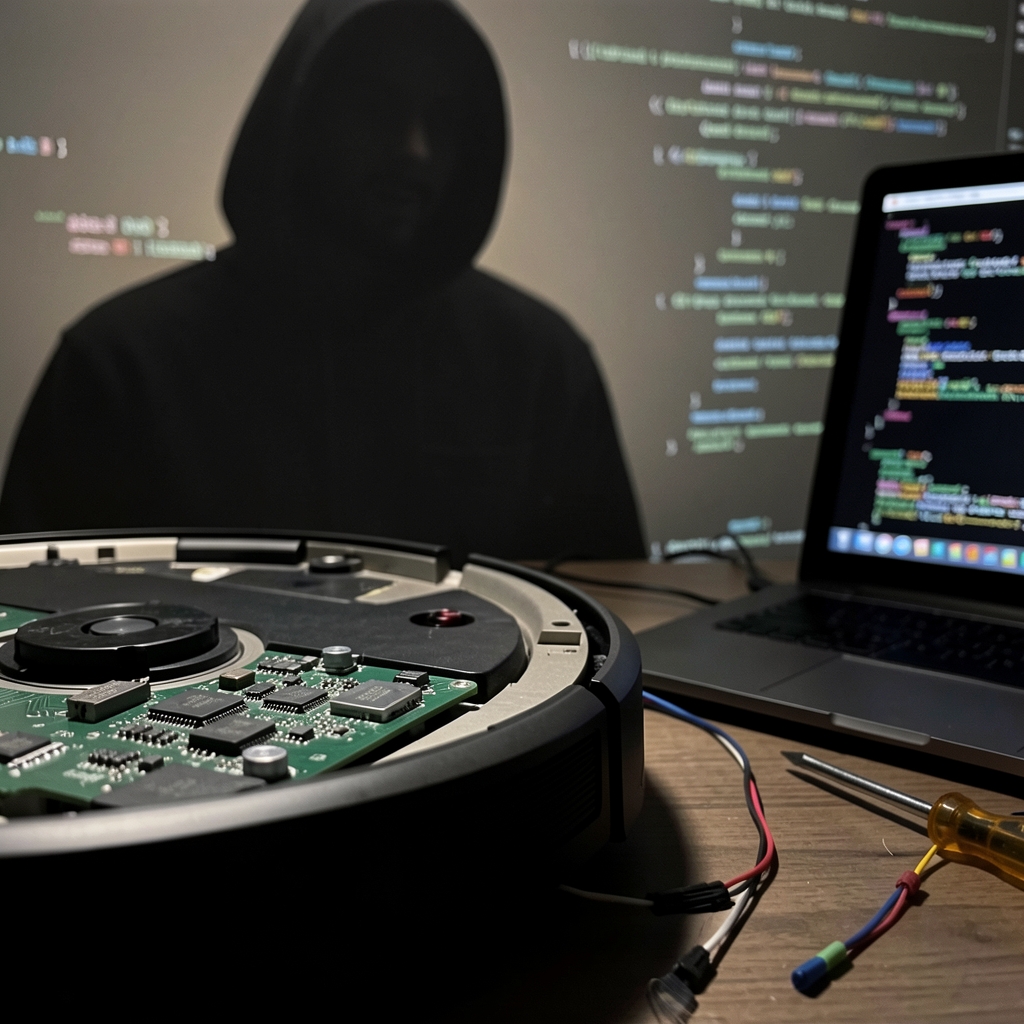
What happens when a hobbyist tries to remote-control his own robot vacuum and, by accident, finds himself driving thousands more around the world? That unlikely conundrum turned up the volume on a problem security researchers have warned about for years: the Internet of Things (IoT) is full of devices whose convenience outstrips their security.
In a widely read account, a user attempting to control a DJI Romo vacuum remotely discovered that a misconfigured or insecure control channel let him issue commands not just to his unit but to roughly 7,000 devices scattered across the globe. The episode — reported and analyzed by independent observers — is less a freak show than a case study in systemic weaknesses: default or exposed credentials, insufficient authentication, and networks of devices that accept remote instructions without robust checks.
The basic mechanics are straightforward and familiar to anyone who follows cybersecurity. Many consumer IoT devices ship with minimal, or developer-friendly, security for the sake of ease: simple pairing, unauthenticated control endpoints, or cloud APIs that trust device-supplied identifiers. When those conveniences intersect with scale — millions of inexpensive devices deployed in houses, offices, and public spaces — a single oversight can become a global joystick.
Why this matters goes beyond a stranded Roomba. Insecure IoT devices create several cascading risks:
- Privacy erosion: cameras, microphones, and sensors can leak intimate details of homes and workplaces.
- Network footholds: compromised devices provide stepping stones into local networks, where more valuable targets live.
- Distributed abuse: large groups of takable devices can be co-opted into botnets, denial-of-service campaigns, or spread misinformation through sensors and actuators.
- Supply-chain and trust damage: vendor compromises or sloppy development practices can undermine confidence in entire product classes.
Technologists hear this and nod because the warning is familiar. Security researchers have repeatedly demonstrated how weaknesses in embedded components or remote management systems can yield outsized effects. For example, researchers who examined vulnerabilities in eSIM and embedded UICC technologies have warned that flaws at foundational connectivity layers can threaten billions of endpoints, underscoring how deep and widely shared some attack surfaces have become .
Policy makers and regulators face a harder calculus. Mandating minimum security standards — unique default credentials, mandatory secure boot, authenticated firmware updates, and incident reporting — would raise the bar, but implementation is messy. Standards must be internationally interoperable, commercially feasible for low-cost manufacturers, and enforceable without stifling innovation. Some jurisdictions have begun issuing baseline security rules for consumer devices; others lag behind.
Vendors and platform operators confront both technical and reputational burdens. The modern software supply chain is fragile: secrets embedded in code or exposed in CI/CD systems lift the attacker’s reward for relatively little effort. Recent guidance for development teams emphasizes short-lived credentials, centralized secrets management, and hardened build pipelines to reduce the likelihood that a single slip leads to broad compromise . Fixing device firmware after the fact is costly; preventing insecure practices during development is cheaper and more reliable.
Users, meanwhile, face a mix of apathy and practical constraints. Many device buyers prioritize functionality, price, and ease of setup over security. For older devices that lack vendor support, updating or replacing hardware can be expensive. That leaves consumers with difficult choices: keep a vulnerable convenience device, isolate it on a separate network, or discard it and pay again for a more secure alternative.
Adversaries — criminal, political, or prank-minded — will naturally view insecure IoT as an opportunity. A single misconfigured API or an unprotected control port can let an actor move from curiosity to large-scale disruption. The ROI for attackers is clear: low cost, high impact. Security teams know this calculus well; the public scene of a few thousand vacuums rolling in unison is simply a visible demonstration of the same forces that enable far graver campaigns.
There are practical steps that reduce risk without requiring heroic expenditure:
- For manufacturers: ship devices with unique initial credentials, enable secure update channels, and minimize exposed management interfaces.
- For platform operators: adopt the principle of least privilege for device control APIs, require mutual authentication, and monitor anomalous traffic patterns that suggest bulk control attempts.
- For developers: eliminate embedded long-lived secrets, use vaulting and short-lived tokens, and harden CI/CD pipelines to avoid credential leakage .
- For consumers: place IoT devices on segmented networks, change defaults, apply patches promptly, and consider a lifecycle plan for devices that will no longer receive updates.
Not every misstep should be treated as an existential crisis. Many incidents are the product of overlapping human and economic incentives rather than malicious design. Yet the frequency of these stories suggests the problem is structural: a mismatch between rapid IoT adoption and the incentives to secure it. As Adam Gowdiak, founder of Security Explorations, argued in his work on embedded SIM risks, “our findings show that the security assumptions around embedded technologies need to be re-evaluated” — a reminder that convenience-driven design decisions can have far-reaching consequences when scaled across billions of devices .
What should we expect going forward? Incremental change: better defaults from reputable vendors, stronger procurement language from large buyers, and targeted regulation in places that move faster. But absent a wholesale rethinking of consumer incentives and manufacturing economics, many insecure devices will persist in the field. The recurring image — thousands of vacuums obediently following a single flawed command stream — is less an anomaly than a snapshot of how systemic weaknesses play out in public.
The episode is a warning, plain and simple. If a curious user can, by accident, steer 7,000 robots into motion, what can a determined adversary do when they aim to cause harm? We already knew the IoT was insecure; that knowledge is no comfort. It should be a prompt to act — for engineers to design more defensively, for vendors to accept some cost of security, for regulators to set enforceable baselines, and for users to demand better. Otherwise, the next large-scale demonstration may be far less amusing and far more consequential.
Source: https://www.schneier.com/blog/archives/2026/03/hacking-a-robot-vacuum.html