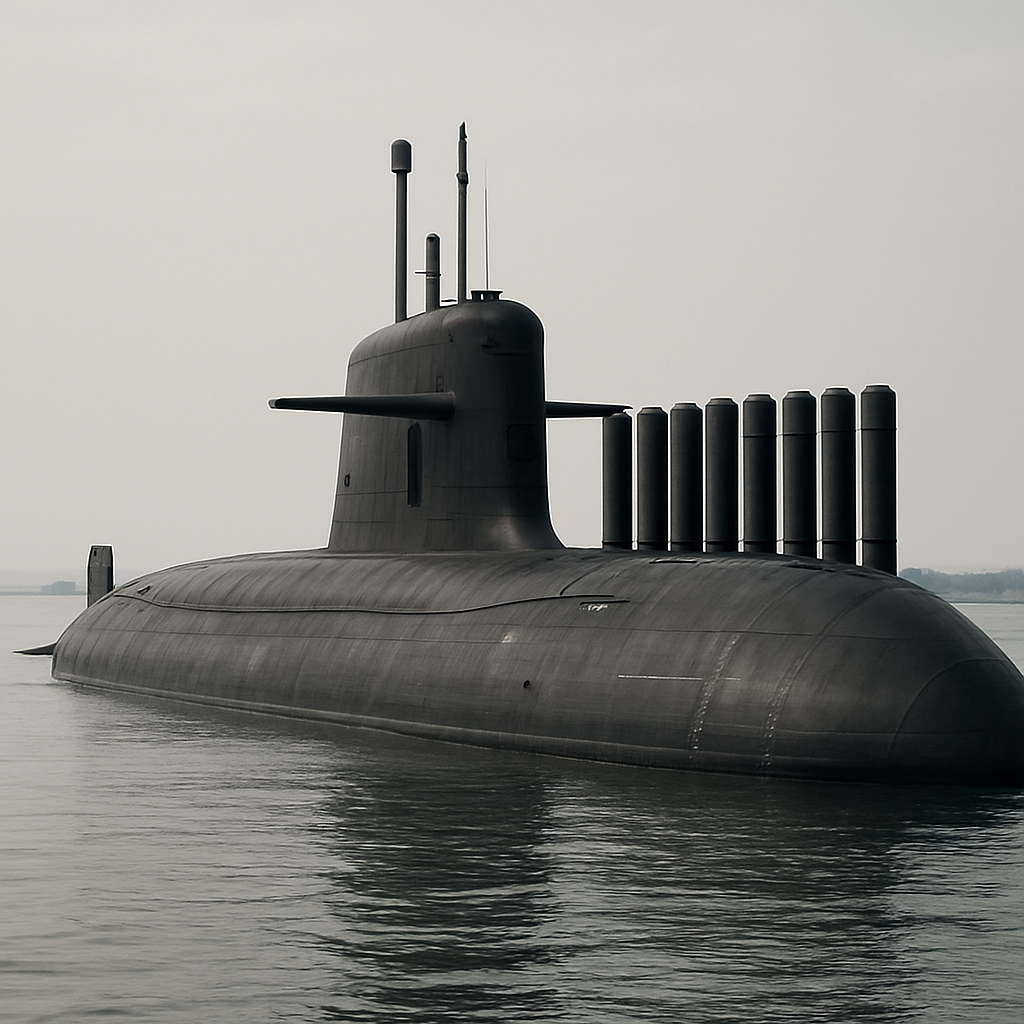
Aridhaman has eight vertical launch tubes rather than the four fitted on the older boats — a doubling of missile capacity that alters how India can patrol and project its sea-based nuclear deterrent.
Aridhaman's missile and size upgrade
The newly commissioned INS Aridhaman represents a measurable step up in India’s SSBN force. The boat displaces around 7,000 tonnes submerged, compared with about 6,000 tonnes for the first two Indian SSBNs, INS Arihant and INS Arighaat. Most consequentially, Aridhaman carries eight vertical launch tubes rather than the four found on the earlier boats. That permits either eight K-4 submarine-launched ballistic missiles with a range of around 3,500 km or 24 K-15 missiles with a range of around 750 km.
In operational terms, those choices matter: the shorter-range K-15 is most useful for deterrence against targets reachable from patrol areas close to potential targets, while the K-4’s roughly 3,500 km reach gives India much greater stand-off capability and the potential to extend coverage to major targets in south-eastern China from suitable patrol areas. Aridhaman therefore brings a more substantial missile load, wider geographic reach and greater operational flexibility to India’s undersea force.
Continuous at-sea deterrence (CASD) and what it delivers
Continuous at-sea deterrence rests on a simple but demanding idea: an adversary must always consider that an SSBN is hidden at sea and capable of a retaliatory strike even after a devastating first strike. The commissioning of a third SSBN brings India closer to keeping “one SSBN or another at sea at all times,” making the country’s sea-based leg of its nuclear triad less purely aspirational and more operationally credible.
That credibility is especially significant for India because it sits between two hostile nuclear-armed neighbours, China and Pakistan, each of which shapes Indian deterrence calculations in different ways. A persistent, survivable patrol presence complicates an adversary’s planning by raising the prospect of assured retaliation from underwater platforms that are difficult to locate and neutralize.

Audit-ready is a season. It shouldn't be.
Evidence in spreadsheets, controls drifting between audits, frameworks multiplying on flat headcount. Nubivance runs continuous compliance on Rapid7 Cyber GRC - SOC 2, HIPAA, ISO 27001, PCI, CMMC.
End the scrambleThree boats: closer, but not yet sufficient
Three SSBNs materially change the discussion about undersea deterrence, yet the source is explicit that three boats do not guarantee continuous patrols. Submarines require rotation through patrols, maintenance, rearming, crew changes and repairs; a three-boat fleet leaves little operational slack and only a narrow margin for disruption. A prolonged repair period, a systems fault or an unforeseen setback such as a grounding could create a gap in deterrent coverage.
British and French practice, consistent with that operational logic, suggests that four SSBNs are essential to have complete confidence in maintaining continuous patrols. A 2014 British inquiry into nuclear policy explored three-boat postures and found that three boats allowed only “near-CASD.” The typical operational cycle envisaged for a four-boat force — one on deterrent patrol, another preparing to deploy, a third returning from patrol and a fourth in deeper refit or overhaul — still leaves slack to absorb unexpected unavailability. That schedule represents the minimum force structure that gives CASD operational elasticity.
S4 in trials and the planned S5 class
The fleet expansion does not stop at Aridhaman. India’s unnamed fourth SSBN, currently called S4 in reporting, is reportedly in sea trials and is likely almost identical to Aridhaman. Beyond S4, media reporting indicates a larger S5 class is planned, with a much more powerful reactor and the ability to carry K-6 missiles with intercontinental range. Those S5 boats are expected in service in the mid-2030s and would be quieter, longer-ranging and more credible from deeper Indian Ocean patrol areas.
The S5s, according to the reporting, would likely begin relieving Arihant and Arighaat as those boats enter deeper maintenance and eventual replacement cycles, creating the conditions for a more durable four-boat CASD structure by the mid-2030s.
What this means for India, Pakistan, and China
- India: The induction of Aridhaman and the reported S4 sea trials bring India measurably closer to an operational CASD posture, adding missile load and reach. But three boats leave limited slack; commissioning S4 and then fielding S5s remain critical to move from near-CASD toward a resilient, continuous patrol regime.
- Pakistan: The continued availability of K-15 missiles and patrols from closer waters means Pakistan’s deterrence calculations remain sensitive to near-field SSBN patrols. The K-4’s extended reach changes the geometry of risk by enabling strikes from farther offshore.
- China: The prospect of S5 boats armed with K-6 missiles of intercontinental reach — reported to be expected in the mid-2030s — would extend India’s undersea coverage into deeper Indian Ocean patrol areas, increasing the potential to hold targets in China at risk from sea-based platforms.
The commissioning of INS Aridhaman marks a clear technological and operational advance for India’s sea-based deterrent: bigger displacement, doubled launch tubes and greater missile flexibility. Yet the strategic payoff depends on what follows — the timely commissioning of S4 and the arrival of the larger S5 class in the mid-2030s — if India is to move beyond near-CASD to a continuously assured at-sea deterrent with operational resilience.
Source: The Strategist — “With its third SSBN, India edges closer to continuous at-sea deterrence”