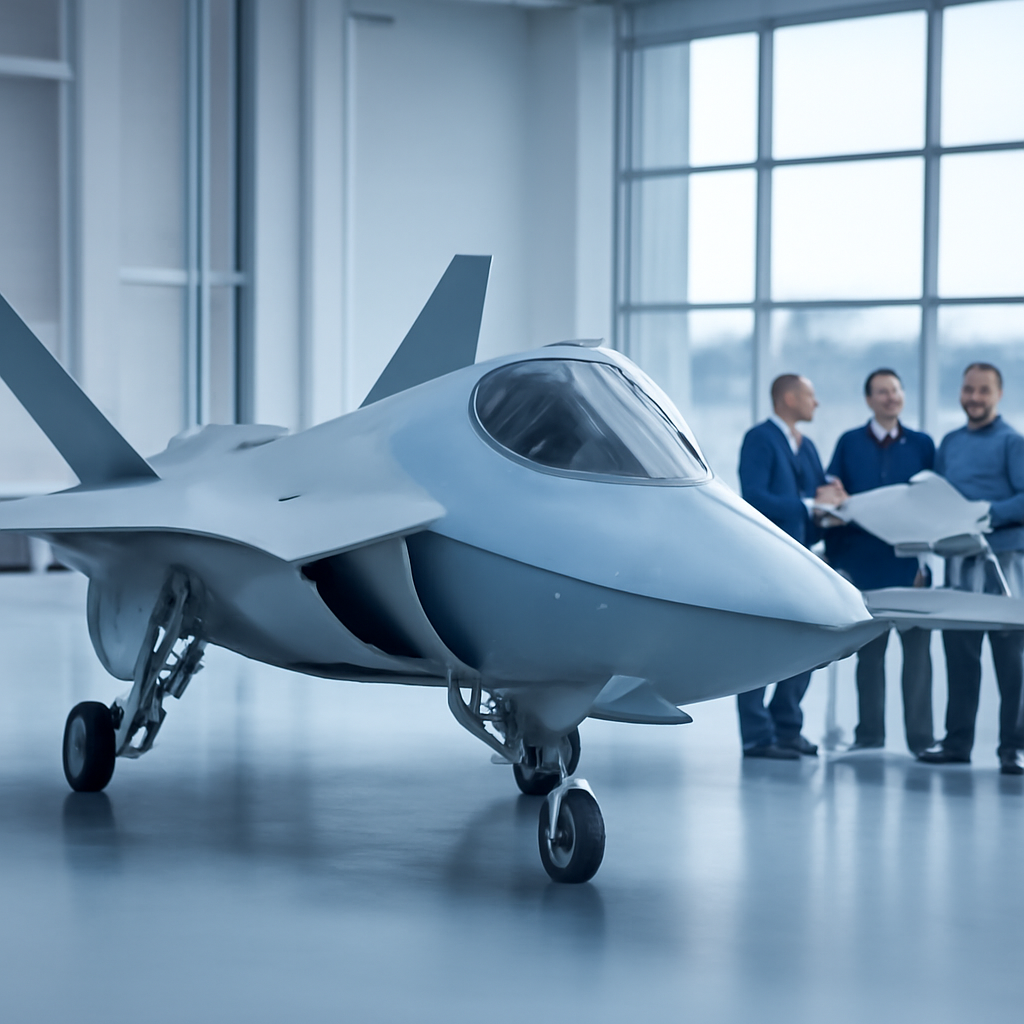
The United Kingdom has pledged £8.6 billion ($11.5 billion) to the Global Combat Air Programme over four years — a headline figure that underlines how GCAP has become the central multinational effort to build a next-generation fighter after the collapse of an alternative European project.
Canada joins as an observer; potential for fuller membership
At Farnborough the most immediate headline was Ottawa’s new “observer” status in GCAP. Observer status carries no financial commitment but allows Canada to “hold a working understanding of the effort” and keeps open the possibility of discussions about joining as a full partner — which would entail industrial contributions, the source reports. Masami Oka, chief executive at the GCAP Agency, said partners had “highlighted [an] openness to that kind of possibility” from the program’s start, conditioned on what is best for the program and mutually beneficial.
Industrial partnerships: Leonardo, Airbus, and the one‑third workshare
The industrial architecture remains a core preoccupation. Marco Zoff, CEO of Edgewing — the BAE Systems, Leonardo and JAIEC consortium leading GCAP industrial activity — said the program’s architecture is built on an “underpinning map of technologies and workshare” that aims for a roughly one‑third, one‑third, one‑third national split while preserving “versatility” to leverage each partner’s strengths. Leonardo CEO Lorenzo Mariani said Germany would make a “strong industrial partner” but warned that adding a nation risks “disruption” and possible delays to the stated 2035 service entry date. Mariani also suggested France would not join for the “same reasons” that helped sink the rival FCAS effort, naming IP rights, workshare and design requirements as sticking points.

This site is the portfolio.
OSINTSights runs on Cloudflare Workers, D1, R2, and Vectorize, with an AI pipeline on Hetzner ARM. Nubivance designed, built, and operates it. We do the same for clients.
See what we buildAirbus signals conditional interest; questions of leadership and scope
Airbus Defence and Space CEO Michael Schoellhorn told reporters that Airbus is “feeling out” a potential GCAP role but set a clear condition: the company expects a “significant portion of the work and the leadership” before committing. That stance echoes the broader tension at the show between keeping the program compact to protect schedule and the temptation — from some quarters — to bring in additional industrial capacity following the collapse of the Franco‑German‑Spanish FCAS project.
Funding, program phase and unresolved industrial decisions
Program costs are still largely under wraps because GCAP remains at concept phase, executives at a GCAP panel said. Zoff said it is “premature” to pin a full program cost and that a detailed figure will likely come at the end of the conceptual assessment phase, though he asserted the consortium has “a clear projection.” Public investments to date include the UK’s £8.6 billion commitment over four years, and a joint £4.6 billion contribution from the three partners to support the concept and assessment phase, following a £686 million contract awarded in April for design and engineering. Canada’s observer status does not include contributions for now. Zoff also said no decision has yet been taken on where final assembly will occur and that the consortium expects to decide “in the next few months.”
BAE Systems’ bridge demonstrator and the Brontanax wingman
GCAP is being developed with uncrewed “wingmen” in mind. At Farnborough BAE revealed the Brontanax CCA demonstrator — a Combat Collaborative Aircraft due to fly in 2027 — framed as the company’s entry in the RAF’s Storm Fighter drone wingman effort. Air Chief Marshall Harv Smyth called the Brontanax launch a “historic moment” and linked it to a wider RAF strategy to become “Europe’s first sixth‑generation air force.”
Separately, BAE plans the first flight of the UK Combat Air Flying Demonstrator — a crewed, supersonic “bridge” aircraft — in the “early part” of 2028, Tony Godbold, FCAS delivery director at BAE Systems, told Breaking Defense. Built to de‑risk critical technologies for GCAP, the demonstrator is well into production: Godbold said almost 90 percent of parts are in manufacture across roughly 11,500 components, and major units have been in manufacture for over 18 months. Final assembly is due to start in “weeks,” with a year‑end target to transfer fuselage sections to a Eurofighter production site at Warton. The demonstrator is covered by a £2 billion UK investment in the combat air strategy. Though Italy and Japan are not involved in building the demonstrator, Godbold said they will be able to access information through Edgewing under controlled data releases.
What this means for the UK, Japan, and Italy
- For the United Kingdom: the large UK investment, the funded demonstrator, and the launch of Brontanax reinforce a national strategy to sustain industrial readiness and validate six‑generation features ahead of GCAP.
- For Japan: participation through JAIEC in Edgewing and the engine consortium keeps access to design decisions and technology pathways, while leaving room to influence workshare in the coming conceptual assessment phase.
- For Italy: Leonardo’s vocal advocacy for careful expansion and Avio Aero’s role in the power and propulsion consortium underline Italy’s active industrial stake as decisions on assembly, workshare and engine demonstrators progress.
Farnborough left GCAP both consolidating and unfinished: the program now stands as the primary multinational sixth‑generation fighter effort with Canada watching from the sidelines, Airbus and Germany contemplating possible roles, and assembly, costs and certain partnerships still to be decided. The next concrete milestones are the completion of the conceptual assessment (when full costs will be detailed), final assembly decisions “in the next few months,” and the demonstrator flight schedules in 2027 and early 2028 — all of which will shape whether GCAP meets its current 2035 target.
Source: Breaking Defense — What we learned about GCAP at the Farnborough Airshow