"We’re [used to] doing everything on a really tiny processor," co-founder Lee Ritholz said.
General Dynamics Land Systems and Primordial Labs announce a pairing
General Dynamics Land Systems (GDLS) has partnered with Primordial Labs to add voice-controlled AI assistance to combat vehicles, the companies said in an announcement planned for later this morning. The effort spans legacy platforms such as the M1 tank and the Stryker troop carrier, and aims to reach next-generation designs including the XM30. The announcement comes days ahead of the massive annual AUSA trade shadow in DC.
Anura: a platform-agnostic voice assistant for crews and aircraft
Primordial’s voice-control system, named Anura, is described by the company as platform-agnostic. Primordial is best known for demonstrations with small drones, but co-founder Lee Ritholz said the company is also developing Anura for Army helicopter crews and other vehicles. Ritholz emphasized that Primordial’s prior experience focused on constrained hardware — “tiny” processors — and that adapting to larger combat-vehicle platforms presents different engineering trade-offs.

Audit-ready is a season. It shouldn't be.
Evidence in spreadsheets, controls drifting between audits, frameworks multiplying on flat headcount. Nubivance runs continuous compliance on Rapid7 Cyber GRC - SOC 2, HIPAA, ISO 27001, PCI, CMMC.
End the scrambleCapabilities pitched: a virtual crew member, not a weapons controller
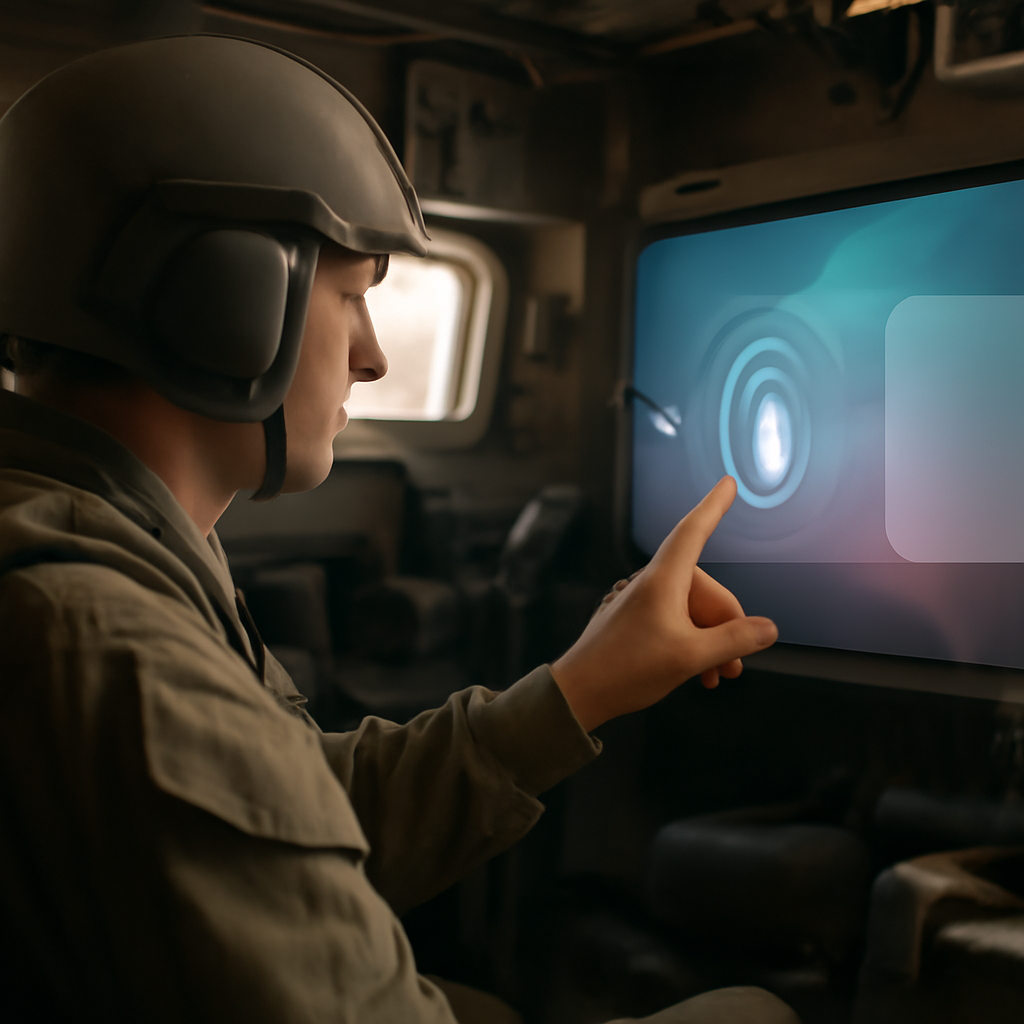
Company officials described Anura as designed to act like “an additional, virtual crew member” to which soldiers can delegate time-consuming or technically complex tasks. Examples given by GDLS and Primordial include performing communications tasks, adjusting which radio net a crew is on, sending reports that otherwise would be typed, and changing camera views for situational awareness. The companies said Anura can also coordinate other automated systems — for instance, by directing an AI threat-detection tool to scan for flank attacks while the crew focuses elsewhere.
XM30 program context and the human workload problem
GDLS executives framed the partnership against the operational demands of new vehicles. Salem Auclair, identified as a 20‑year Army veteran who helped write the official requirements for the XM30 before joining Primordial, said the XM30 program calls for shrinking the crew from three soldiers on today’s M2 Bradley to two on the XM30 while adding more technology. Geoff Norman, GDLS’s director of strategy and a retired Army general who worked on the next‑gen vehicle program, warned that requiring soldiers to "flip switches and push buttons and type on keyboards" while on the move, in the dark or in bad weather will be a rising challenge for smaller crews. The companies position voice control as a way to let soldiers issue a verbal order and have software execute predictable follow‑up actions so the humans can remain focused on mission tasks.
Safety, verification, and the non‑lethality design choice
Both companies were explicit that Anura will not control weapon firing. “We’re not talking to the fire control system and doing … lethality tasks,” Geoff Norman said. The design choices, company officials said, deliberately focus on functions that are “easy to verify and validate for a safety case” — communications, reporting, camera adjustments and similar tasks — rather than direct control over lethality.
On the AI architecture, Primordial drew a clear line between Anura and so‑called generative AI. Ritholz described the product as using narrower, more predictable forms of machine learning that act as translators between spoken commands and complex system interfaces. He said the system “doesn’t generate things” and framed that behavior as a guard against hallucination.
What this means for soldiers, procurement officials, and system integrators
- Soldiers: The companies present Anura as a tool to reduce hands‑on workload for younger crews now expected to manage more complex systems; officials say Anura will handle administrative and sensor‑management tasks so humans can concentrate on immediate tactical decisions.
- Procurement officials (GDLS/Ambler programs): GDLS said Anura is not installed on current XM30 prototypes now in testing by the Army, but the company aims to offer the capability as an option on future upgrades to XM30 and on legacy platforms such as the M1 and Stryker.
- System integrators and safety teams: The partners emphasize predictable, verifiable behaviors over open generative models and have scoped Anura away from lethality functions to simplify safety and validation requirements.
GDLS and Primordial have framed Anura as a practical tool for shrinking crews and growing electronic complexity — but Anura is not part of the XM30 prototypes in Army testing today, and the companies say it will be offered on future upgrades. The immediate next public moment is the companies’ planned announcement this morning, days before the AUSA event in DC; beyond that, GDLS’s aim to field Anura on future upgrades will dictate whether the system moves from a vendor offering to an operational capability.