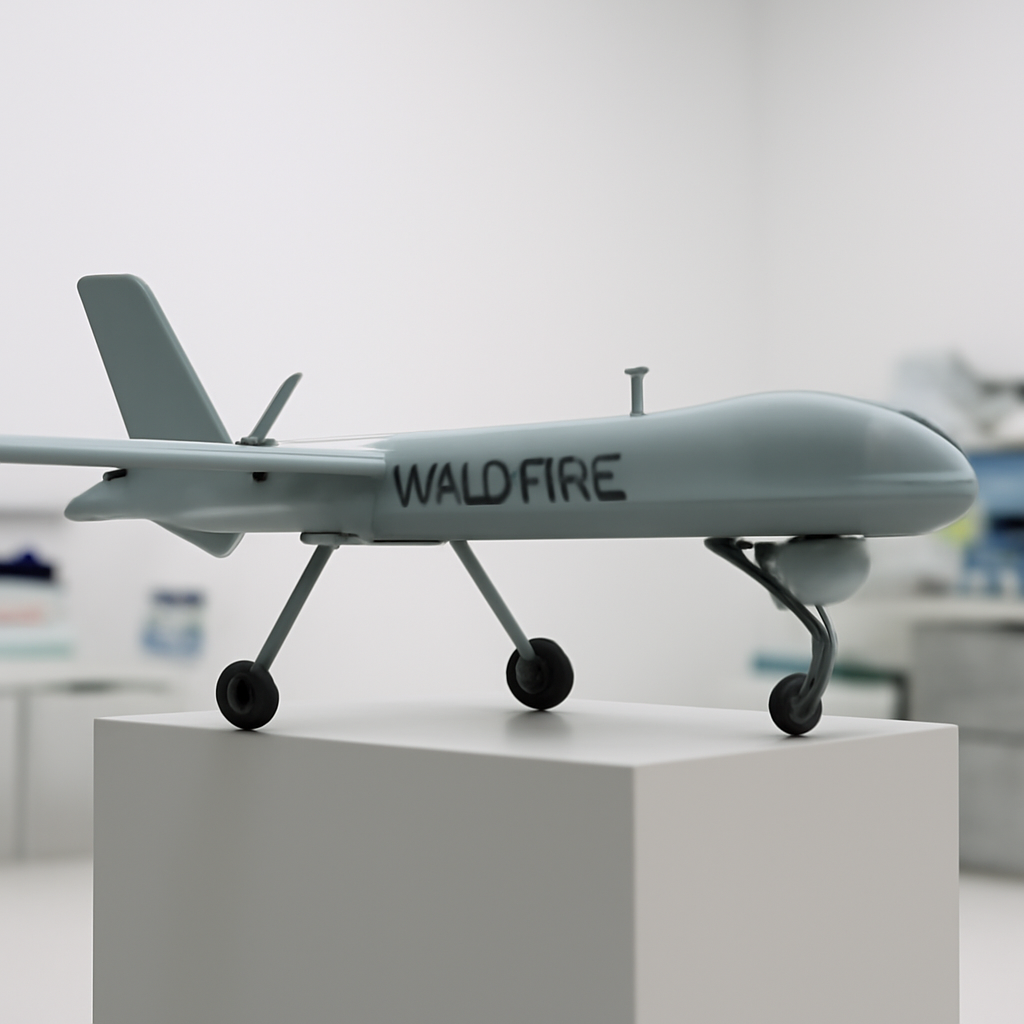
"That thing is a beast, and no one who actually does this for a living, and is honestly concerned about America’s warfighting edge, can look at it and not want 100 of them as fast as we can make them." — C. Mark Brinkley, GA-ASI spokesperson.
GA-ASI spokesperson C. Mark Brinkley on Wildfire
General Atomics Aeronautical Systems, Inc. (GA-ASI) publicly unveiled a rendering of its new Wildfire unmanned aircraft on September 9, 2026, and spokespeople have framed the design as a direct answer to the U.S. Air Force’s call for a lower-cost successor to the MQ-9A Reaper. GA-ASI’s C. Mark Brinkley described Wildfire as the result of engineers “sharpen[ing] their pencils” against an aggressive assignment: long ferry range, heavy weapons loads, swarm-capable autonomy, and lower unit cost. Brinkley said the company expects to exceed the Air Force’s ferry-range target and to meet stated price targets while leveraging GA-ASI’s production base, noting the company’s record of “nearly 10 million flight hours and more than 1,600 aircraft delivered.”
Wildfire's design and control architecture
The published rendering shows a pusher-prop, medium-altitude, long-endurance (MALE) planform that extends the MQ-9 family’s basic layout: a nose-mounted sensor turret and a large blade antenna beneath the rear fuselage. Notably, the Wildfire image lacks the MQ-9’s distinctive dorsal hump, which on the Reaper houses the SATCOM terminal. The absence of the hump in the rendering was described by Brinkley as a deliberate move to “push proliferated low-earth orbit controls onto many of our existing aircraft” and to “bring that into Wildfire.”
Brinkley further said Wildfire will “leverage ongoing advancements in autonomy on Day One” and that GA-ASI envisions “networking dozens of Wildfires for true combat mass,” describing the approach as proven through work on the FQ-42A program and use of the MQ-20 Avenger as a Collaborative Combat Aircraft (CCA) surrogate connected to other platforms.

This site is the portfolio.
OSINTSights runs on Cloudflare Workers, D1, R2, and Vectorize, with an AI pipeline on Hetzner ARM. Nubivance designed, built, and operates it. We do the same for clients.
See what we buildWeapons and payload: JSMs, LRASMs, and hardpoint capacity
The rendering depicts Wildfire armed with four Joint Strike Missiles (JSMs), with two appearing on a single pylon under each wing; GA-ASI has shown similar loadouts for MQ-9 variants in the past. The stealthy JSM can be used against ships or land targets. Brinkley emphasized hardpoint and takeoff-weight capacity in public remarks: GA-ASI had “concepted four JSMs on MQ-9B before” and stated that Wildfire “can absolutely do that, from a hardpoint capacity and also an overall MGTOW perspective.”
Brinkley also said Wildfire can carry two LRASMs (AGM-158C Long-Range Anti-Ship Missiles), describing that as “twice as much as the DIU solicitation asked for” and stressing the operational value of longer-range standoff weapons. The Air Force already buys JSMs primarily for F-35A aircraft; the service and GA-ASI have both framed stand-off munitions as a way to keep non-stealth drones farther from threats.
Air Force MMA requirements, cost targets, and schedule
The Air Force and the Pentagon’s Defense Innovation Unit (DIU) kicked off the Massed Modular Aircraft (MMA) effort in July. Stated MMA requirements include: a speed of at least 200 knots true airspeed; a payload capacity (munitions and sensors) of at least 2,800 pounds; an unrefueled combat radius of at least 2,300 nautical miles with payload; one-way self-deploy capability of at least 8,000 nautical miles; and operation from runways no longer than 6,000 feet. The service is seeking highly modular systems with open architecture mission systems.
Crucially, the Air Force is targeting a roughly $10 million unit cost for MMAs, excluding sensors and certain other systems. By contrast, the fully equipped Reaper has been referenced by the service and reported elsewhere in the market as having a price point in the $30–$50 million range. GA-ASI contends it can deliver Wildfire “years earlier” than originally planned and at scale; the original MMA timeline targeted initial operational capability in fiscal year 2031 after 20 aircraft, a schedule the Air Force is now seeking to accelerate. The service expects to acquire around 180 MMAs overall.
What this means for the Air Force, General Atomics, and MQ-9 operators
- Air Force: The service is pursuing MMAs because of attrition pressure on the MQ-9 fleet. Lt. Gen. Christopher Niemi, the Air Force’s Chief Modernization Officer, told reporters the service is “going through [MQ-9As] at a rate that is concerning to us,” and said there are “not a lot of good options to immediately replace those aircraft.”
- General Atomics (GA-ASI): The company is leveraging existing MQ-9 heritage, pLEO-enabled SATCOM concepts, autonomy work (including FQ-42A/Dark Merlin test programs), and its production base to position Wildfire as a rapid, affordable response to the MMA solicitation.
- Other MQ-9 users (USMC, CIA, CBP, and allied services): GA-ASI pitched Wildfire as an aircraft with modularity and affordability that could be attractive to a range of existing MQ-9 operators; GA-ASI also highlighted the potential for higher sortie mass and extended ferry range.
Wildfire’s public debut is a clear signal that GA-ASI wants to defend and extend the MQ-9 lineage under new, tighter cost and survivability pressures. The rendering and accompanying company claims place emphasis on pLEO-enabled communications, autonomy for massed employment, and heavier standoff loadouts — all answers to the Air Force’s stated MMA requirements and to recent operational attrition concerns. The next steps are practical and concrete: the Air Force will evaluate competing designs under the MMA/DIU process, while GA-ASI refines technical specifics and production planning that it says will meet the service’s accelerated needs.