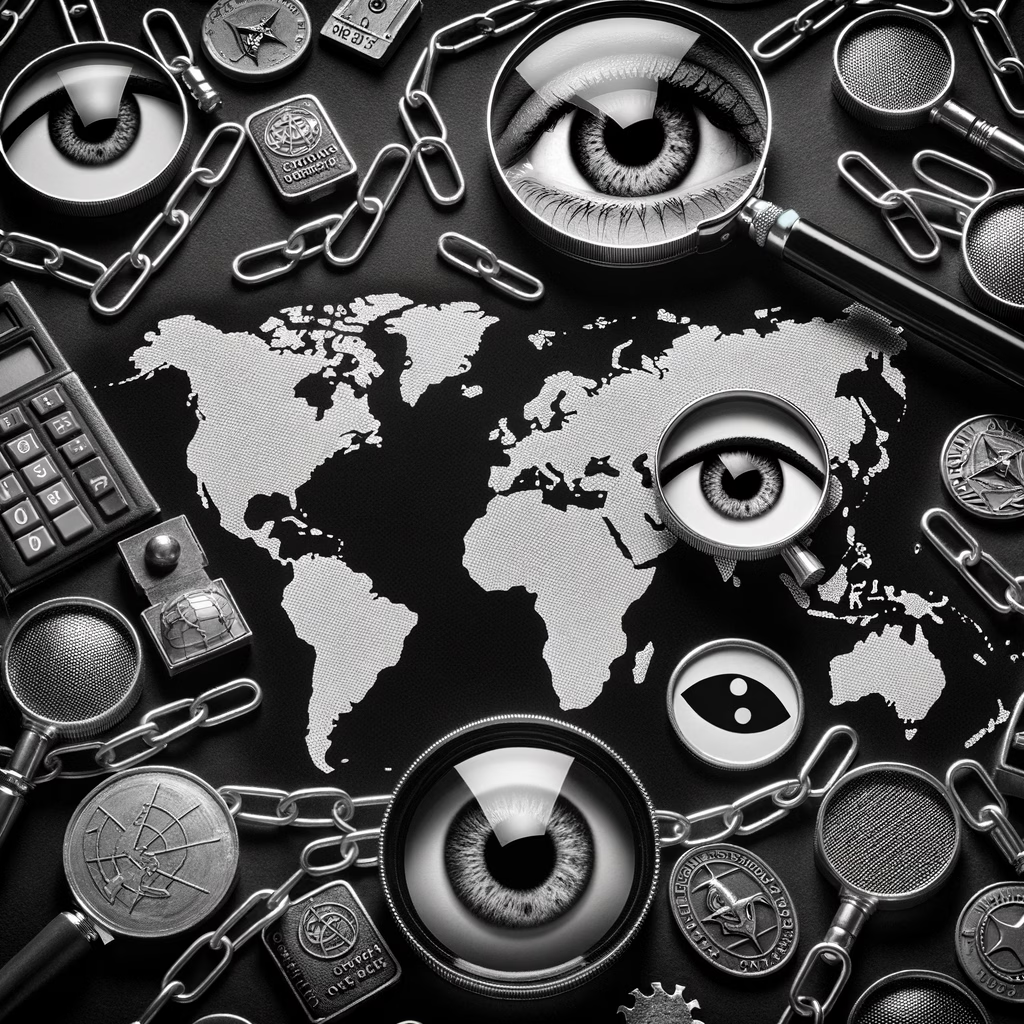
What happens when one of the world’s most influential policing coalitions turns its attention to a single corner of the internet? That practical question now matters to investigators, policymakers, tech companies and everyday users after the UK’s National Crime Agency (NCA) took the chair of the Five Eyes Law Enforcement Group and reportedly “singled out” the .com space, according to reporting by Infosecurity Magazine. The implications are large: targeting .com—still the largest generic top-level domain (gTLD)—would touch a vast swath of global web infrastructure and raise hard questions about law, policy and collateral impact.
Five Eyes: what it is and why it matters
Five Eyes is not a loose alliance for informal conversation. It is a formal intelligence and law enforcement cooperation framework linking Australia, Canada, New Zealand, the United Kingdom and the United States. Its law enforcement arm coordinates cross-border investigation and disruption of serious organized crime, child exploitation, terrorism and cyber threats. Leadership rotates among members; with the NCA now chairing, London is positioned to shape operational priorities across jurisdictions that together host a large share of the world’s internet infrastructure and much of the criminal activity that exploits it.
For decades Five Eyes partners have pooled capabilities to tackle transnational problems that ignore borders. But the rise of ransomware, state-sponsored intrusion campaigns, and systemic abuse of domain name systems has pushed the law enforcement agenda toward the architecture of the internet itself. Criminals exploit registries, registrars, hosting services and registrant anonymity to hide operations, orchestrate fraud, and launder proceeds—often spanning multiple countries and legal regimes.
Why the NCA’s focus on .com matters
Targeting chokepoints delivers operational leverage. Law enforcement can achieve outsized effects by disrupting the platforms and services that criminals depend on at scale. If the NCA’s chairmanship prioritises engagement with commercial registries and registrars, coordinated takedowns, evidence preservation and registrant tracing could accelerate investigations that often stall because of jurisdictional complexity.
Still, the legal and practical terrain is thorny. The .com registry and many domain services operate under a mix of commercial contracts, national laws and international agreements. Cross-border enforcement raises questions about due process, mutual legal assistance treaties (MLATs), and the legal thresholds for emergency action. Parliamentarians, courts and civil-society groups will rightly scrutinise any attempts to streamline these powers without robust oversight.
Operational and commercial resilience is another concern. Domain registries and registrars host millions of legitimate websites and services. Broad or blunt enforcement risks collateral damage—disrupting businesses, critical services and legitimate speech. Technical countermeasures such as takedowns, DNS blocking or sinkholing can be effective, but they also carry risks: fragmentation of name resolution, the inadvertent blocking of lawful content, and incentives for adversaries to decentralise or migrate to alternative infrastructures.
Perspectives to consider
– Technologists: Network operators and cybersecurity professionals generally favour targeted, measurable interventions that preserve service integrity. Many in the tech community warn against wholesale seizures or blanket blocking of entire registries, which could create single points of failure or spur migration to harder‑to‑monitor platforms.
– Policymakers: For governments, focusing on large infrastructures can be politically appealing because it produces visible results—phishing hubs taken offline, malware domains disrupted. However, policy leaders must balance national security priorities with trade and economic interests, and ensure international legal norms are respected.
– Users and civil society: Privacy and digital-rights organisations caution that increased enforcement can erode anonymity and due process online. They call for transparency, proportionality, and redress mechanisms when domains are seized or blocked, to protect legitimate users who rely on stable global domain services.
– Adversaries: Criminal networks adapt. Pressure on one infrastructure often produces displacement effects: moving to different TLDs, abusing content-delivery networks, or building more resilient command-and-control channels. Enforcement must therefore be part of broader strategies that anticipate and counter adaptation.
Operational and strategic implications
The NCA’s chairmanship could improve practical cooperation across Five Eyes by aligning investigative priorities and standardising evidence-sharing practices. It may also accelerate policy harmonisation around cross-border legal tools—streamlined MLAT processes, emergency removal frameworks, or protocols for rapid collaboration with private-sector operators. But such initiatives require parliamentary oversight and public buy‑in to maintain legitimacy.
Critical to success are enduring public‑private relationships. Effective disruption depends on trusted channels with registries, registrars, cloud providers and hosting companies. Cooperation works best when legal boundaries are clear, requests are transparent and actions are proportionate and accountable.
What remains uncertain
Infosecurity’s reporting frames the NCA’s approach as a deliberate focus on centralised internet infrastructure, but many tactical and legal details are not public. Key questions remain: which specific authorities will be used, what thresholds will trigger action, how will evidence preservation be coordinated across borders, and how will the coalition measure success beyond headline takedowns? Equally important is how Five Eyes partners will balance the speed of operational response with safeguards for lawful uses and civil liberties.
Conclusion
The NCA’s stewardship of the Five Eyes Law Enforcement Group signals a sharpened interest in targeting the infrastructure that enables much online crime. This focus on shared chokepoints—most notably the .com space—could deliver meaningful disruptions to criminal networks and protect victims, but it also exposes legal frameworks and public trust to new stresses. As Five Eyes pursues infrastructure-focused enforcement, the central question remains: will the gains from disruption outweigh the risks of collateral harm and adversary adaptation? The answer will shape enforcement outcomes and the future contours of a free and secure global internet.



