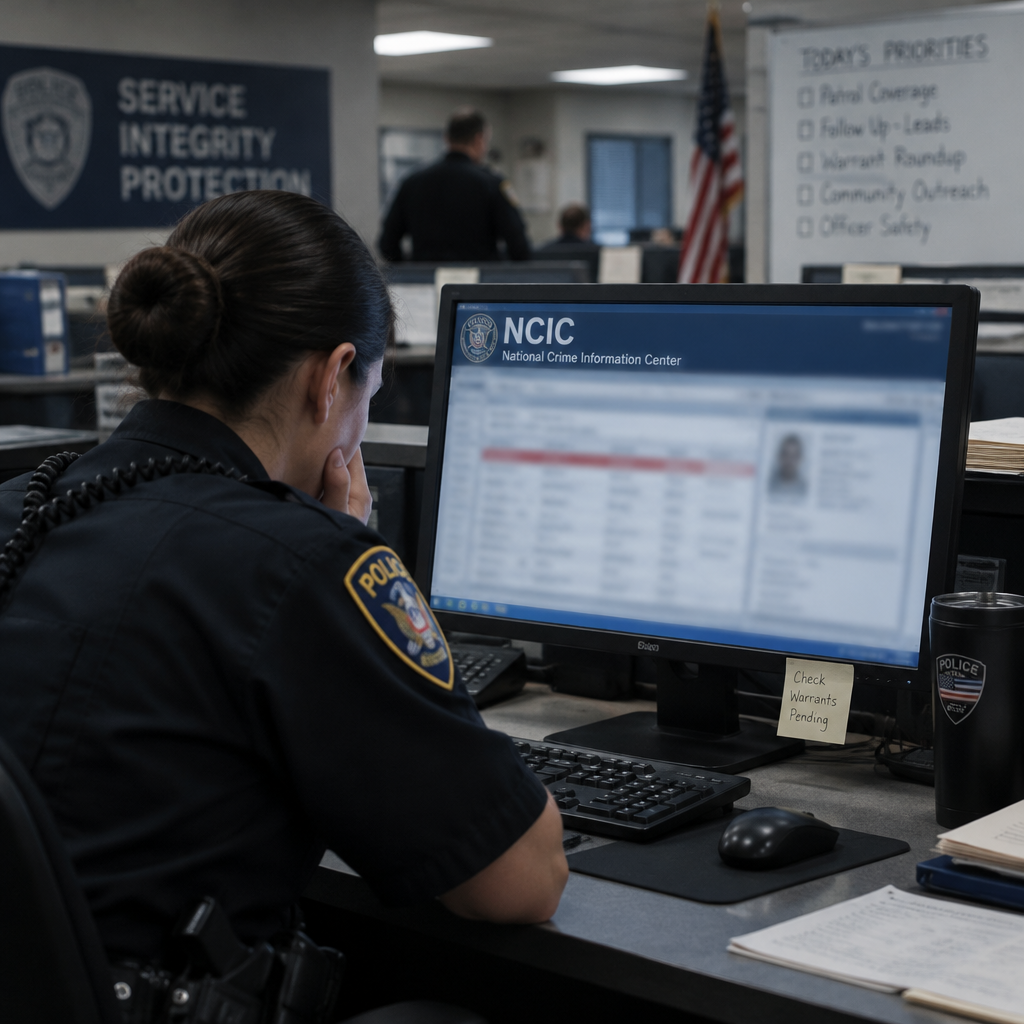
"The reported breach comes just two months after the ShinyHunters extortion group claimed to have breached the FBI's systems," CNN reported — a reminder that questions about the agency's external connections and internal protections have not faded.
The target: the National Crime Information Center (NCIC)
The system reportedly breached is the FBI-operated National Crime Information Center, commonly known by its acronym NCIC. According to the reporting, NCIC is used by local, state, and federal law enforcement agencies to share records about wanted and missing persons, outstanding arrest warrants, stolen vehicles and firearms, protection orders, and other criminal-justice records. Police officers routinely use the system during traffic stops, criminal investigations, and background checks.
What the reporting says investigators found so far
CNN, citing two people briefed on the investigation, reported that the FBI is investigating an apparent breach of NCIC. The intrusion was reportedly discovered in recent days, but the reporting emphasized that it is unclear when the breach occurred, how the attackers gained access, or whether any information was stolen. The FBI has not publicly confirmed the incident and did not respond to CNN's request for comment, the reporting said.

Audit-ready is a season. It shouldn't be.
Evidence in spreadsheets, controls drifting between audits, frameworks multiplying on flat headcount. Nubivance runs continuous compliance on Rapid7 Cyber GRC - SOC 2, HIPAA, ISO 27001, PCI, CMMC.
End the scrambleContact attempts and the public record
Independent outreach to the agency also met silence. BleepingComputer said it contacted the FBI on Friday evening with questions about the reported breach but had not received a response at the time of its posting. The available public accounts describe an active FBI inquiry but do not include a formal agency statement confirming the facts or scope of the incident.
Relation to the earlier ShinyHunters claim
The reported NCIC intrusion arrives roughly two months after a separate episode in which the ShinyHunters extortion group claimed to have breached FBI systems by exploiting an unpatched Oracle PeopleSoft vulnerability. That earlier incident, according to the reporting, targeted a third-party platform associated with the agency's recruitment website, FBIJobs.gov, and ShinyHunters claimed to have stolen sensitive information from the agency's systems.
The FBI subsequently launched an investigation into the earlier incident that led to arrests of suspected ShinyHunters members, including a Canadian cybersecurity executive reportedly linked to those attacks. The reporting makes clear there is currently no indication that the latest NCIC incident is connected to ShinyHunters or to the earlier breach.
What this means for police departments, the FBI, and cybersecurity teams
- Police departments: Local and state law enforcement agencies that rely on NCIC for traffic stops, investigations, and background checks will need to know whether the system's data integrity or availability was affected; the reporting says it remains unclear if records were accessed or if availability was impacted.
- The FBI: The agency is reported to be conducting an investigation but has not publicly confirmed the incident, according to CNN, and did not respond to outreach from both CNN and BleepingComputer as reported.
- Cybersecurity teams: For defenders and investigators, the sequence — an earlier claim of exploitation tied to an Oracle PeopleSoft vulnerability and now a reported NCIC intrusion — reinforces the operational need to determine intrusion vectors and whether third‑party platforms or unpatched systems played a role. The reporting, however, stops short of attributing the NCIC incident to any specific vulnerability or actor.
This remains a developing story. Public accounts so far establish that an FBI investigation is underway into an apparent intrusion affecting a database central to everyday law‑enforcement work, but they do not yet answer the crucial questions: when the intrusion happened, how access was obtained, whether sensitive law‑enforcement records were accessed, or whether system availability to officers was disrupted. Those answers will determine the scale of operational and privacy consequences for agencies and the public alike.
Source: BleepingComputer — FBI reportedly hacked again, this time targeting nationwide police database