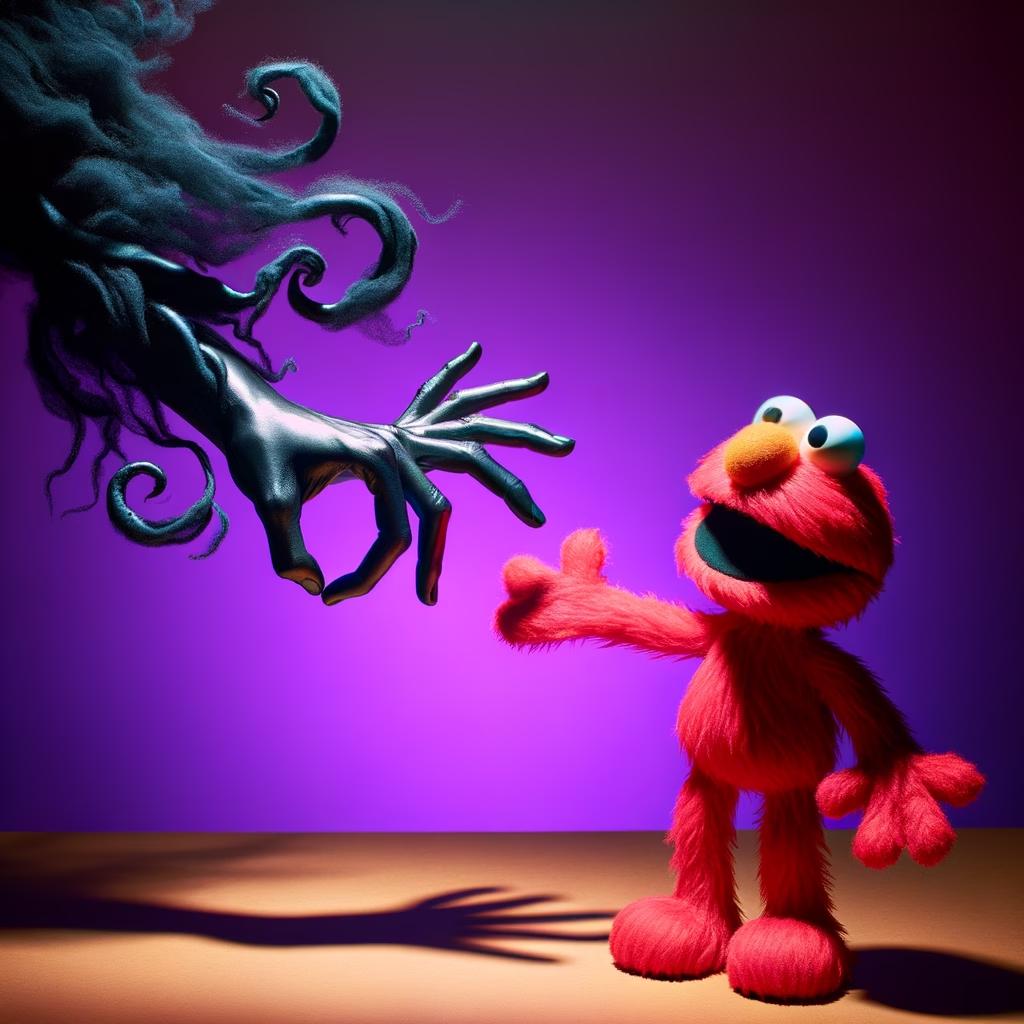
“Did Elmo just turn into a mouthpiece for hate?” It’s a jarring thought, one that caught the attention of millions over the weekend when the beloved red Sesame Street character’s X account—formerly Twitter—was hijacked to post a disturbing series of antisemitic, racist, and anti-Trump rants. The messages, quickly removed but not before being captured by digital sleuths and news outlets, have raised urgent questions about social media security, digital impersonation, and the weaponization of nostalgia in the online age.
The Sesame Street character Elmo is widely recognized as a symbol of innocence and education, cherished by generations of children and parents alike. Yet, on Sunday, anyone who followed Elmo’s official X handle was confronted with messages that were not only hateful but also politically charged. These posts, later confirmed to be the work of a hacker, were swiftly taken down by the platform, but the damage—both reputational and symbolic—had already been done.

According to X’s parent company, Meta, the breach appears to be part of a broader pattern of account takeovers that exploit vulnerabilities in authentication processes. While the exact method of intrusion remains undisclosed for security reasons, cybersecurity expert Katie Moussouris of Luta Security notes, “Attackers often leverage weak password management, phishing, or social engineering to compromise high-profile accounts, especially those with large, diverse followings.” She adds that “when recognizable, trusted voices like Elmo’s account are hijacked, it amplifies the potential for spreading disinformation or hate speech rapidly.”
This incident underscores the precarious balance between the open nature of social media platforms and the imperative to safeguard users and brand integrity. For policymakers, the event reignites longstanding debates over platform responsibility and regulation. Congressman Tom Malinowski (D-NJ), a vocal advocate for stronger digital safety laws, stated, “We need clearer, enforceable standards that compel platforms to implement robust security measures for verified and official accounts.” Conversely, some free speech advocates caution against overregulation, warning that heavy-handed policies risk stifling legitimate discourse.
Users, meanwhile, find themselves caught in the crossfire. The hijacking feeds into broader anxieties about digital identity theft and misinformation. As Dr. Maria Konnikova, psychologist and author specializing in online behavior, explains, “When trusted personas are manipulated, it disrupts social trust not only in that account but across the platform. It makes the digital environment more hostile and less reliable.”
From the adversaries’ perspective, such hijackings are tools of disruption and psychological warfare. Cyber threat analyst Brian Krebs highlighted that “attacks targeting cultural icons or seemingly benign figures like Elmo serve to shock and divide communities, often distracting from larger, more insidious campaigns running in parallel.” This approach aligns with an increasingly sophisticated strategy of weaponizing social media for ideological or political gain.
Moreover, the incident sheds light on the challenges platforms face in moderating content rapidly and effectively. Despite X’s quick removal of the hateful posts, screenshots and archives remain, illustrating the internet’s permanence and the difficulty of fully erasing digital footprints once they are exposed. It also raises questions about the veracity of content consumers receive—how do we, as users, discern authentic voices in an environment rife with manipulation?
In sum, the hijacking of Elmo’s X account is more than a bizarre online prank; it is a microcosm of larger issues at play in the digital ecosystem. It challenges us to reconsider the robustness of cybersecurity measures, the responsibilities of social media companies, and the very nature of trust in the information age. As we move forward, can platforms strike a balance between openness and security without sacrificing one for the other? And as users, how vigilant must we become to safeguard the integrity of voices we hold dear?



