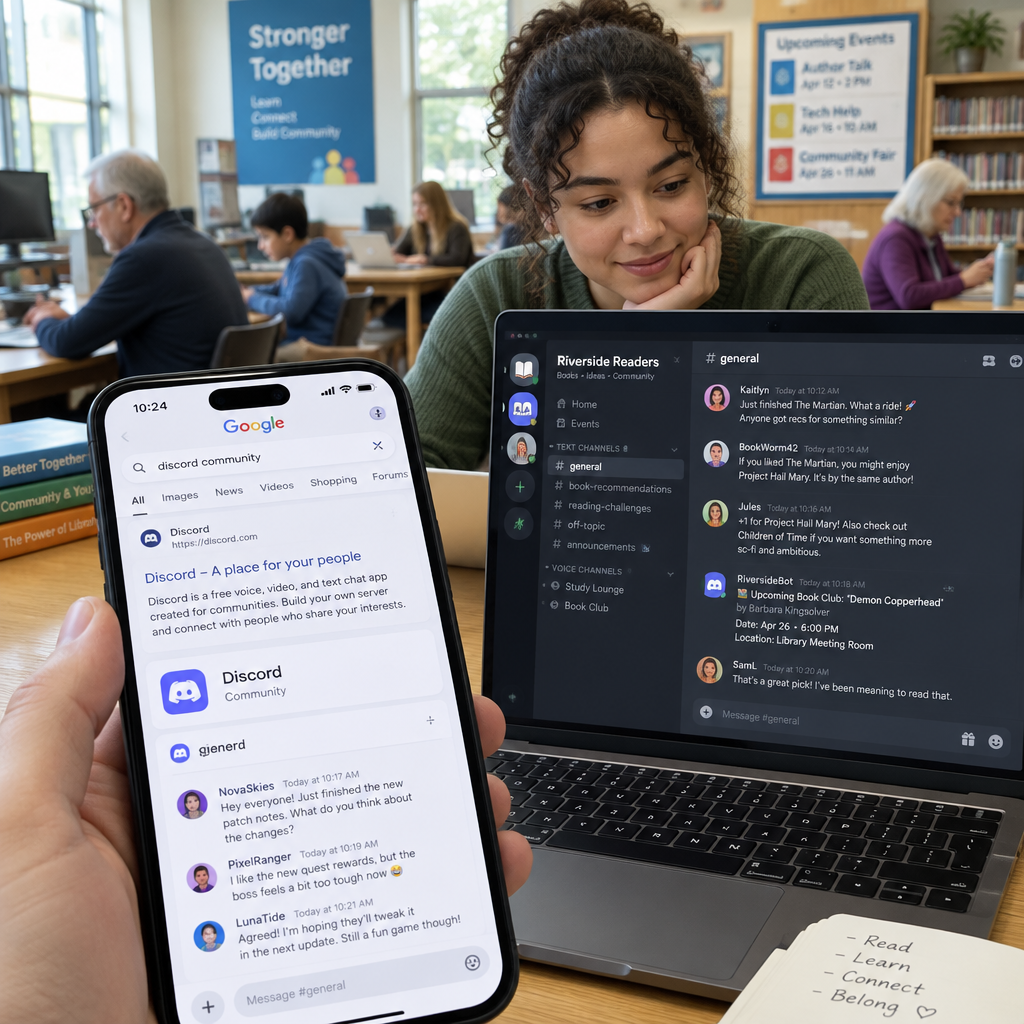
What Discord is changing and why
Discord will permit web search engines to index conversations taking place in its Discoverable Servers, making those discussions accessible on the public web to people who do not have a Discord account or an invitation. The company frames the move as an effort to “surface useful information to the wider internet community instead of keeping it buried in Discord conversations.” The change applies only to Discoverable Servers — publicly listed communities that meet Discord’s eligibility threshold of at least 1,000 members — and Discord says it currently hosts approximately 63,000 such servers.
Rollout schedule and automatic Server Web Pages
Discord’s deployment will run in two stages. On November 16, every Discoverable Server will receive a public Server Web Page that displays automatically generated summaries of active conversations from that date forward. If administrators have not created a Server Web Page by that date, Discord will create one automatically; the only way to prevent automatic creation is to change the server type to private before the cutoff.
Beginning in mid-December, Discord will begin a gradual rollout that will place every eligible message posted on Discoverable Servers onto the Server Web Page, where those messages may be indexed by web search engines. Messages posted before the December rollout date will be excluded from indexing; only messages written from the rollout forward are eligible.

Audit-ready is a season. It shouldn't be.
Evidence in spreadsheets, controls drifting between audits, frameworks multiplying on flat headcount. Nubivance runs continuous compliance on Rapid7 Cyber GRC - SOC 2, HIPAA, ISO 27001, PCI, CMMC.
End the scrambleScope: what is included and what is excluded
- Included: messages and automatically generated conversation summaries posted in Discoverable Servers (servers publicly listed and with at least 1,000 members).
- Excluded: private servers, direct messages between users, and group announcements on servers that do not meet the Discoverable Server requirements.
- Temporal exclusion: messages posted before the mid-December release will not be made public retrospectively.
Admin and user controls: where to opt out and the limits
Server administrators will be able to exclude individual channels or turn off all channel content sharing through controls under Server Settings > Web Presence. Individual community members can control whether their messages appear on the Server Web Page through User Settings > Data and Privacy, but any change at the user level affects only future messages; messages that have already been made public cannot be retracted. Discord also notes that if both admins and users leave settings at their defaults, content will be included automatically under the new scheme.
Geographic and age-based exceptions
Discord is keeping message sharing off by default in a set of named jurisdictions: all EU countries, the UK, Canada, Brazil, Australia, and South Korea. In those places, members must explicitly enable message sharing in their privacy settings. Separately, underage users are automatically excluded from the feature and cannot activate the setting until they turn 18.
What this means for technologists, policymakers, and server operators
- Technologists and security teams: expect a new surface of publicly indexable text tied to community discussions. Because prior messages are excluded and user-level opt-outs only affect future posts, monitoring and incident response playbooks will need to account for newly public content appearing after the stated rollout dates.
- Policymakers and regulators: the default-off approach in the EU, the UK, Canada, Brazil, Australia, and South Korea establishes a jurisdictional variance that regulators and privacy offices will likely evaluate against local data-protection rules and consent frameworks.
- Server administrators and end users: administrators who do not want a Server Web Page created must change the server to private before November 16; individual users who wish to avoid making future messages public must adjust User Settings > Data and Privacy, knowing that already-published messages cannot be withdrawn from public indexing.
The pivot makes a clear practical demand on communities: decide before November 16 whether a server remains public and, if it does, whether particular channels should be excluded. Discord’s mid-December step — when eligible messages themselves become subject to indexing — is the consequential second threshold. Those dates are the hard milestones on which privacy defaults, administrative action, and individual choices will converge.
Read the original announcement on Bleeping Computer: https://www.bleepingcomputer.com/news/security/discord-to-let-search-engines-index-public-server-messages/