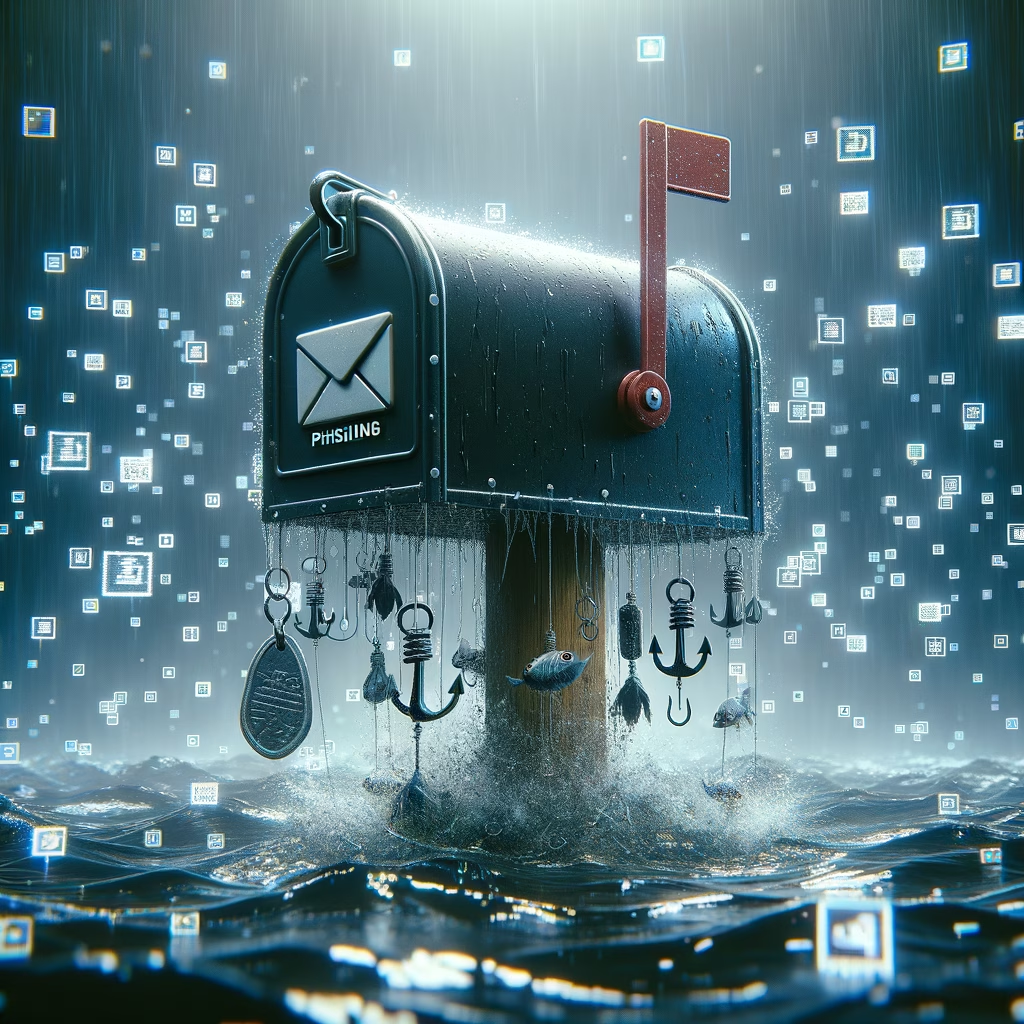
What happens when an ordinary inbox becomes a conduit for state-aligned espionage — and the messengers are people you thought you could trust? “Compromised mailboxes” sounds technical; the costs are not. They are lost secrets, manipulated decisions and a quieter kind of erosion in the institutions we rely on.
Researchers at Group-IB have uncovered a sophisticated phishing campaign linked to the Iran-associated threat actor MuddyWater that leverages compromised email accounts to harvest credentials, session tokens and persistent access for foreign intelligence collection. The campaign uses tailored spear-phishing lures and weaponized attachments to deliver credential-stealing and persistence tools, enabling attackers to move from one breached mailbox to many services and organizations over time, often with little detection at first.
Background: mailbox compromise as an intelligence tradecraft
Email remains the nervous system of modern organizations. Adversaries who control or monitor legitimate mailboxes can read correspondence, intercept attachments, reset passwords, and impersonate trusted contacts — all of which magnify the value of a single successful intrusion. MuddyWater’s recent actions fit a long arc in which relatively low-cost techniques (phishing, commodity stealers, and simple persistence mechanisms) are combined to produce outsized intelligence returns. Group-IB’s analysis describes attackers delivering malicious Office documents or compressed archives that, once opened, execute macros or exploit known vulnerabilities to drop payloads such as credential harvesters and loaders. The rapid theft of tokens and credentials allows immediate access; follow-on implants provide durable footholds for extended collection.
What the current campaign looks like, in practice
According to the technical report, the campaign’s sequence typically runs like this:
- Targets receive spear-phishing emails that mimic legitimate correspondence and include malicious attachments.
- When recipients open an attachment, embedded macros or exploit code deploy tools that quickly harvest credentials and session tokens (enabling immediate account takeover).
- Attackers then deploy persistence mechanisms to maintain covert access — allowing repeat visits and lateral movement across services.
- Compromised mailboxes are used to expand reach: sending further phishing messages from trusted senders, extracting intelligence from correspondence, and facilitating account recovery or impersonation.
Why this matters — beyond the jargon
For technologists, the lesson is clear: perimeter defenses alone are insufficient. Signature-based antivirus and basic gateway filters are helpful but brittle; behavior-based monitoring, endpoint detection and response (EDR), and rapid incident response are crucial to catching credential theft and anomalous mail activity early. Group-IB’s findings underscore common mitigation priorities: enforce multifactor authentication, apply least-privilege access, harden email gateways, disable risky features such as macros where possible, and maintain a disciplined patch cadence.
For policymakers, the dilemma is harder. Naming and attributing activity to state-linked groups can serve public warning and deterrence, but it also risks diplomatic escalation. The economics of phishing — low cost, high yield — means such campaigns will remain attractive to state and non-state actors alike. Investing in public–private threat-sharing, improving the cyber-defenses of allied and partner institutions, and building incident-response capacity in weaker states will reduce the global surface area that intelligence-focused operators can exploit.
For users and organizational leaders, the immediate takeaway is practical: assume phishing will succeed sometimes, and design for resilience. That includes enforcing MFA for remote and high-privilege accounts, training staff with realistic simulations, encouraging rapid reporting of suspicious mail, segmenting networks, and adopting an “assume breach” posture that prioritizes detection of exfiltration and lateral movement. The downstream impact of a single compromised official’s account can touch supply chains, citizen services and critical infrastructure.
How adversaries benefit and what they risk
From the adversary’s perspective, mailbox compromise is attractive because it reduces the need for complex zero-day exploits: social engineering, commodity malware and operational tradecraft can be enough to obtain persistent access and valuable intelligence. For defenders, however, these operations also leave traces — unusual login patterns, anomalous forwarding rules, and irregular mail-sending behavior — that, if monitored and acted upon, can contain damage. Public attribution (by private firms like Group-IB or by governments) can help defenders tune detection and remediation, but attribution rarely offers a definitive, court-proof chain to state sponsorship; it serves primarily to illuminate patterns and motivate response.
Recommendations distilled from the evidence
- Enforce multifactor authentication across all high-value and remote-access accounts.
- Adopt least-privilege access and limit administrative scope for mail systems and identity providers.
- Deploy EDR and behavior analytics to detect rapid token theft, new device enrollments and anomalous mailflows.
- Harden email gateways and scanning for weaponized attachments; treat macro-enabled documents with extreme caution.
- Run realistic phishing simulations and provide rapid, stigma-free reporting channels for suspicious items.
- Strengthen public–private threat sharing to accelerate detection and remedial action across sectors.
Final analysis
The MuddyWater mailbox campaign is a reminder that many modern security failures are social as much as technical. A single click — from a well-crafted, believable email — can open doors to months of covert intelligence collection. Defenders must shift from a mindset of absolute prevention to one that accepts compromise as possible and prioritizes rapid detection, containment and recovery. In a connected world where trust is often mediated by email, can institutions ever truly afford not to harden the most ordinary, and therefore most dangerous, of communications channels?
Source: https://www.infosecurity-magazine.com/news/muddywater-compromised-mailboxes/



