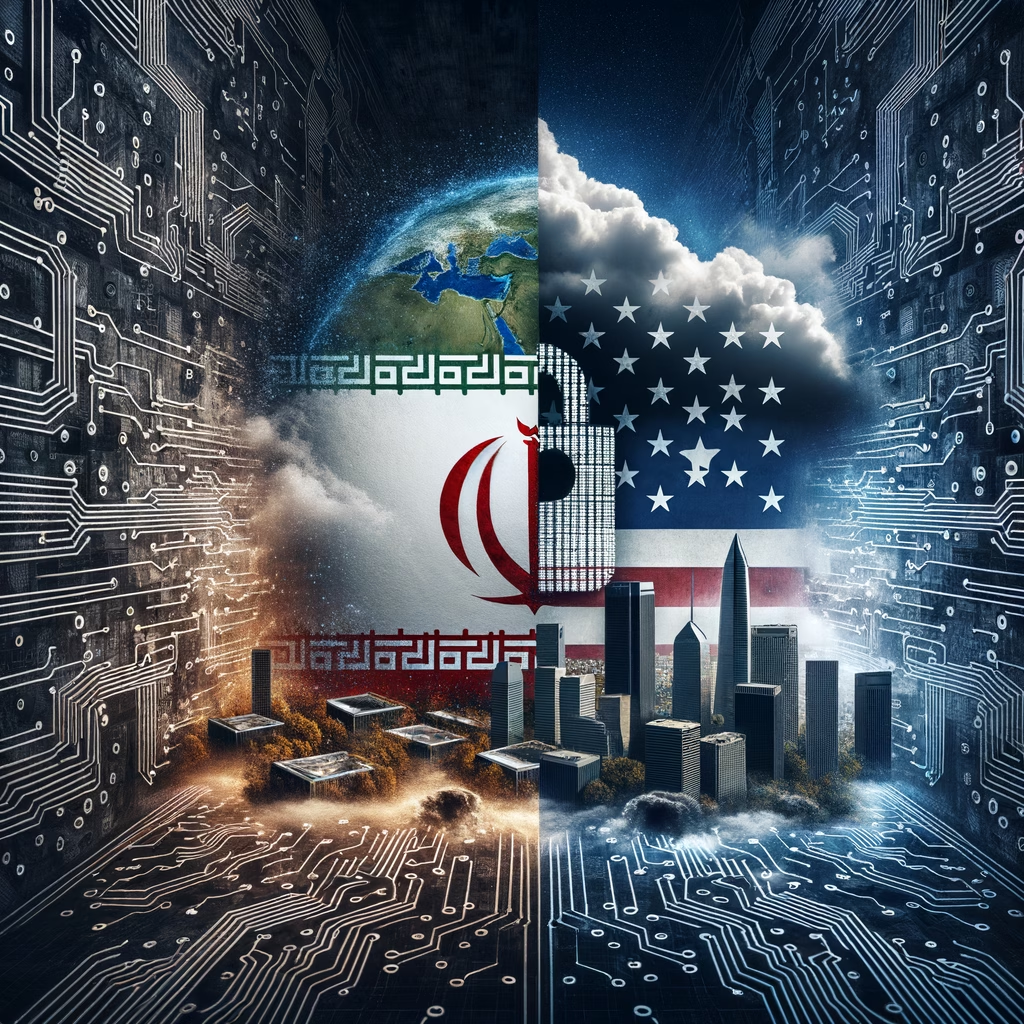
“Are we truly prepared for the invisible battlefield?” This question resonates with a growing urgency as the Cybersecurity and Infrastructure Security Agency (CISA) recently issued a warning about potential Iranian cyber attacks targeting critical infrastructure within the United States. As the digital frontier expands, so too does the realm of conflict, where adversaries strike not with bombs or bullets, but with lines of malicious code and stealthy intrusions.
In its advisory, CISA outlined that Iranian cyber actors have demonstrated an increased interest in penetrating the United States’ essential systems, including energy grids, transportation networks, and healthcare facilities. This warning is far from unprecedented; Tehran has long been associated with cyber espionage and disruptive campaigns globally. However, the current alert underscores an intensification of efforts, accompanied by evolving tactics that threaten not only data integrity but public safety and economic stability.

To understand the implications, it’s vital to recognize Iran’s cyber posture. According to a 2023 report from the Center for Strategic and International Studies (CSIS), Iranian cyber groups such as APT34 and APT39 have combined espionage with disruptive capabilities, leveraging tools like spear-phishing, ransomware, and zero-day exploits. Their motivations often blend political signaling, retaliation, and coercion—responses to sanctions, regional tensions, or perceived aggressions.
From the perspective of cybersecurity experts, this warning is a call to bolster defenses. “The targeting of critical infrastructure represents a shift from reconnaissance to potential kinetic impact,” noted John Hultquist, Senior Director of Analysis at Mandiant. “Organizations must not only fortify their perimeter but also improve incident response and collaboration with government agencies.” The technical community understands that adversaries today exploit supply chains and trust relationships, making traditional perimeter defense insufficient.
Policy makers face a complex dilemma in balancing deterrence, diplomacy, and defense. The U.S. government has historically responded to cyber threats with a mixture of sanctions, indictments, and covert countermeasures. Yet, as the lines between cyber and conventional warfare blur, the risk of miscalculation grows. “We must consider the potential for escalation, where cyber incidents trigger wider conflict,” warned Elizabeth Rosenberg, a senior fellow at the Center for a New American Security.
For the everyday user, the threat may seem abstract but is no less real. Disruptions in power or healthcare services caused by cyber intrusions would have direct, tangible consequences. Meanwhile, misinformation and panic can amplify the impact of even minor attacks. The public’s growing reliance on interconnected systems underscores the urgency of enhancing cybersecurity awareness and resilience.
Meanwhile, from the vantage point of Iranian cyber strategists, such operations serve multiple objectives: signaling strength, undermining adversaries, and crafting asymmetric responses to conventional military and economic pressures. A recent report by the Institute for National Security Studies (INSS) in Israel highlights that Tehran’s cyber doctrine views digital tools as force multipliers, enabling influence without crossing thresholds that might provoke direct military retaliation.
The current situation, marked by heightened geopolitical tensions and rapid technological advances, illuminates the precarious nature of national security in the digital age. CISA’s warning is not merely a technical bulletin but a reminder that the battlefields of tomorrow often lie beyond the radar, where a single exploit can cascade into systemic failure.
As the United States and its allies grapple with this evolving threat landscape, the question remains: will investments in cybersecurity, international cooperation, and strategic deterrence keep pace with adversaries who exploit the shadows of cyberspace? In a world where the next conflict might not be declared but downloaded, preparedness is not optional—it is imperative.