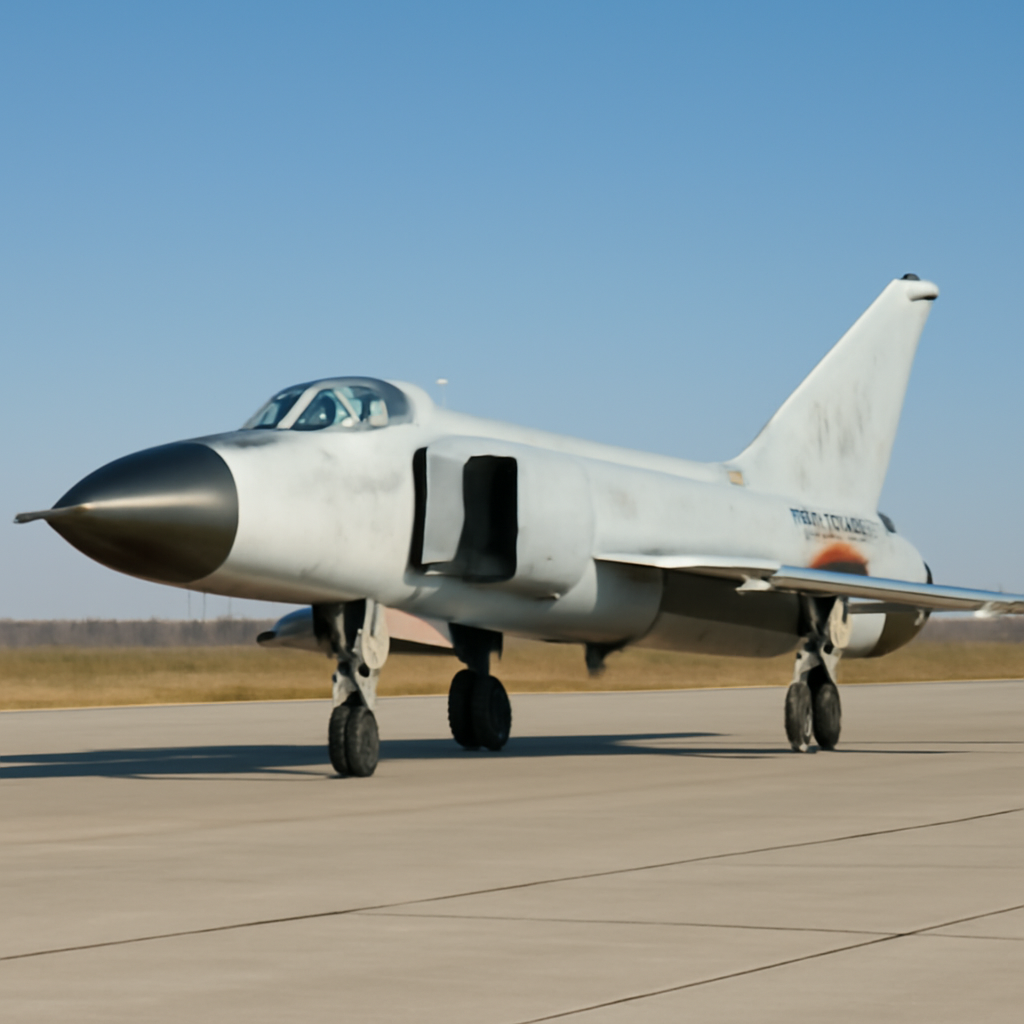
"A milestone moment for China’s interceptor program: the J‑8II taking to the air for the first time on June 12, 1984," China Defense Blog wrote, and the photograph that accompanies that sentence makes the claim plain: a visibly altered airframe, one that was meant to look and, by implication, behave differently than its predecessor.
The first flight — June 12, 1984
The J‑8II’s maiden flight on June 12, 1984, is presented as a milestone for "China’s interceptor program." The source frames the event as a clear turning point rather than an incremental update: the aircraft’s first day aloft is offered not simply as a test milestone but as evidence of a program taking a distinct new direction.
The J‑8II’s design changes: nose, side‑intakes, stretched fuselage
The defining physical details called out in the source are concrete and specific: a redesigned nose, side‑intakes, and a stretched fuselage. Those three elements are presented together as evidence that the J‑8II represented "a clean break from the original J‑8," not a modest modification. The photograph linked to the note underlines that visual shift.

Audit-ready is a season. It shouldn't be.
Evidence in spreadsheets, controls drifting between audits, frameworks multiplying on flat headcount. Nubivance runs continuous compliance on Rapid7 Cyber GRC - SOC 2, HIPAA, ISO 27001, PCI, CMMC.
End the scramblePeace Pearl, circa 1986: a U.S. visit and short‑lived cooperation
The source supplies a bonus photograph captioned to show the J‑8II in the United States, circa 1986, during what it calls the "short‑lived Peace Pearl program." That caption explicitly places the visit in a narrowly delimited diplomatic window "when Washington and Beijing were friendly enough for the U.S. to help modernize a Chinese fighter." The phrasing underscores two linked facts from the source: a U.S. role in modernization work and the brief, exceptional nature of the program.
J‑8DH cockpit: a close look inside
The source also includes a labeled image of the "J‑8DH Cockpit." Presented alongside the airframe photos, the cockpit photograph offers another axis of evidence for how the type was configured and presented during that era. The juxtaposition of airframe and cockpit images in the source highlights both outward design changes and the internal space from which crews would have operated.
What this means for military aviation historians, procurement leaders, and aviation enthusiasts
- Military aviation historians: the documented first flight date and the callout that the J‑8II "marked a clean break from the original J‑8" give historians a clear reference point for tracing design lineage and for placing the type in the evolution of China’s interceptor efforts.
- Procurement leaders and defense analysts: the caption about the Peace Pearl program — that the J‑8II was in the United States "circa 1986" and that the program was "short‑lived" — signals a narrow window of international technical cooperation that will matter when reconstructing procurement and technology-transfer histories tied to that period.
- Aviation enthusiasts and photographers: the paired images—the first‑flight airframe, the U.S. visit photo, and the J‑8DH cockpit—form a compact visual record that illustrates how the type looked in flight, abroad, and inside the cockpit during the mid‑1980s.
Two simple images and three short captions in the source combine to tell a compact story: on June 12, 1984, the J‑8II appeared as a deliberately new design for China’s interceptor program, and within a few years an example of that aircraft was visible in the United States under a brief cooperative banner called Peace Pearl. The photographs and captions capture a moment when design change and a fleeting diplomatic opening intersected — a visual record that invites deeper archival work for those who study Cold War aviation ties and the mechanics of aircraft modernization.
Original story: https://china-defense.blogspot.com/2026/06/historical-photo-of-day-first-flight-of.html