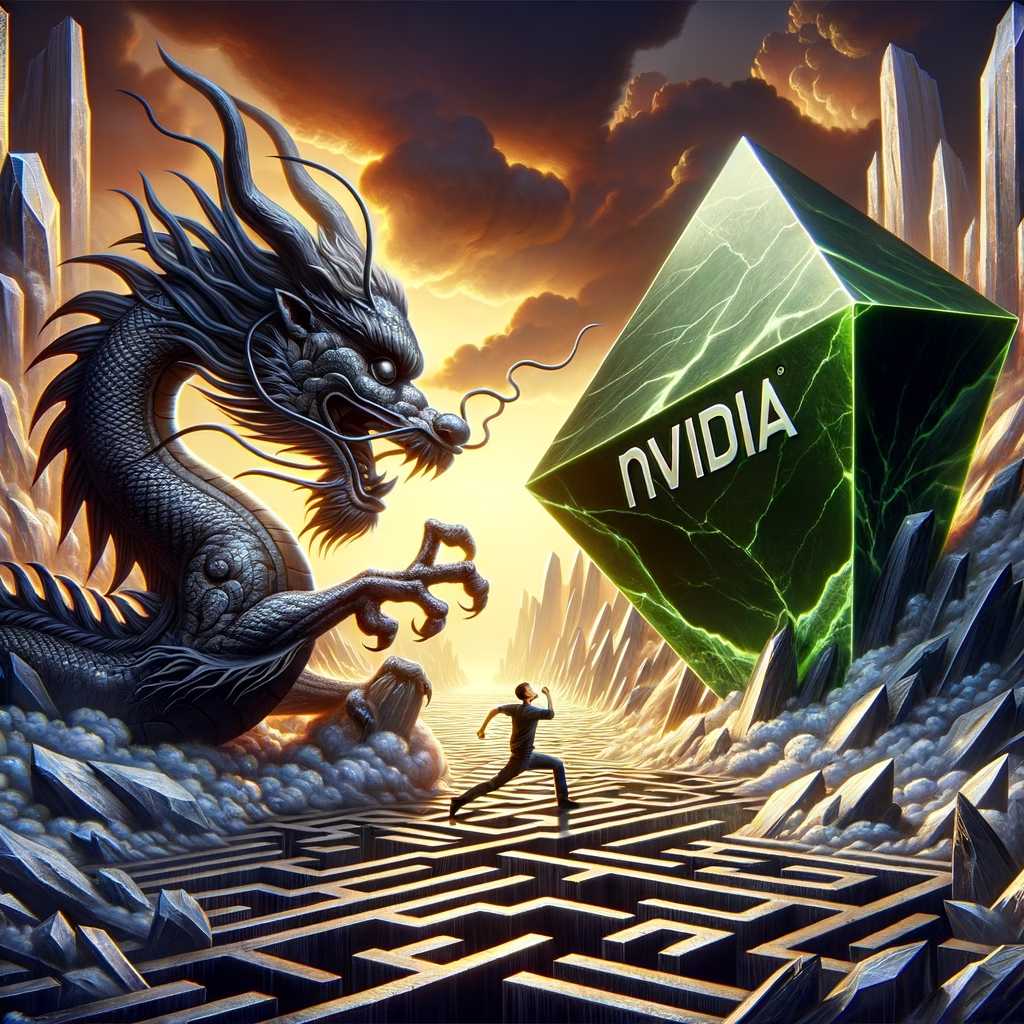
China Escalates Antitrust Pressure on Nvidia
Chinas antitrust authorities step up scrutiny of Nvidia
When the long-standing regulatory goal of protecting competition meets the accelerating race for artificial intelligence, the result can be more than an abstract policy debate — it becomes a formal enforcement action. Chinas antitrust authorities have taken that step, opening a formal investigation into Nvidia over alleged breaches of conditions tied to its 2019 acquisition of Mellanox Technologies. What began as conditional approval of a major merger has now escalated into a probe with potentially significant implications for AI supply chains, market dynamics and cross-border regulatory norms.
Why the Mellanox deal matters
Nvidia’s acquisition of Mellanox for $6.9 billion reshaped a slice of the data-center networking market by combining Nvidia’s market-leading GPUs and software with Mellanox’s high-performance interconnects. Together, the technologies support the compute- and data-movement demands of large-scale AI workloads: model training, inference and the orchestration that powers cloud and hyperscale services. Regulators often view such vertical combinations through a skeptical lens because they can create incentives to bundle products, foreclose rivals, or favor an acquirer’s downstream customers.
Beijing approved the deal under its anti-monopoly law but attached conditions designed to preserve competitive choices for customers and partners. According to reporting, Chinese regulators now allege Nvidia has not fully complied with those conditions, prompting a formal investigation. Moving from monitoring to an official probe signals that Chinese authorities are prepared to deploy the full weight of their enforcement powers — including fines, behavioral remedies, or even divestiture orders — against a major non-Chinese multinational.
Why China is acting now
Several converging trends help explain the timing. First, technological leadership in AI has been recast as a national-security and economic-priority issue for many governments, and China is no exception. Second, explosive global demand for AI infrastructure amplifies the market power of firms that control both specialized chips and the software stacks that make them effective. Third, China’s industrial strategy explicitly emphasizes building indigenous capabilities in semiconductors and AI, making regulators more sensitive to foreign dominance in critical supply chains.
Viewed through this lens, Chinas antitrust authorities are not only enforcing competition law; they are also signaling a broader intent to shape the domestic technology landscape in ways that align with national policy objectives.
Who is affected — and how
Technologists: Practical concerns center on product availability, interoperability and innovation. If enforcement limits how Nvidia bundles hardware and software or constrains the integration of Mellanox components, enterprises and cloud providers could face higher costs, fewer configuration options and longer procurement cycles.
Policymakers: Chinese officials can portray enforcement as an assertion of market sovereignty and a tool to cultivate domestic champions. International observers will watch for whether Beijing’s approach follows global antitrust norms or tilts toward protectionism that favors local firms.
Enterprise customers and cloud providers: These organizations must weigh short-term operational risks against long-term strategy. Some will diversify suppliers to hedge regulatory uncertainty; others, deeply invested in Nvidia ecosystems, will seek clarity and predictable outcomes to justify continued dependence.
Competitors and adversaries: Domestic networking and AI firms could gain advantage if regulatory outcomes constrain Nvidia’s market behavior. Conversely, U.S. and allied companies may press their governments for countervailing trade or investment measures if they see enforcement as unfairly disadvantaging foreign firms.
Possible outcomes and market impact
Regulators could resolve the probe with proportionate remedies designed to restore competition without undermining market functioning: fines, behavioral commitments (for example, rules about bundling or non-discrimination), or monitoring requirements. They might also impose strict structural or contractual conditions limiting how Nvidia packages products or prioritizes partners in China.
In a more disruptive scenario, prolonged uncertainty could chill investment or push major customers to diversify away from Nvidia’s architecture, accelerating development of alternative chips, interconnects and software ecosystems. That would reshape supplier relationships and could slow the adoption of some advanced AI systems in affected markets.
Strategic stakes for Nvidia and China
For Nvidia, the investigation carries commercial and reputational risk. China is a major market for data-center and AI deployments; regulatory limits there would have measurable financial consequences and could complicate Nvidia’s ability to offer integrated solutions globally. For China, enforcing its anti-monopoly law in a high-profile multinational case demonstrates a readiness to use competition policy as an instrument of industrial governance.
A wider pattern of regulatory pressure
China’s action is part of a broader trend: authorities from the U.S. to the EU are increasing antitrust scrutiny of Big Tech and key chipmakers. The Nvidia probe underscores a reality that global tech markets are shaped not only by commercial competition but by divergent regulatory philosophies and geopolitical priorities.
What businesses and policymakers should watch
Transparency, consistent legal standards and predictable enforcement will matter most to companies relying on cross-border supply chains. Policymakers face the challenge of balancing competition protection and national interests without undermining innovation or international cooperation. For market participants the near-term need is clear: assess exposure to potential remedies, diversify where necessary, and engage proactively with regulators to seek workable outcomes.
Conclusion: balancing competition and industrial policy
Chinas antitrust authorities’ escalation against Nvidia raises a broader question: can competition law be applied in ways that reconcile sovereign industrial goals with a global, interoperable technology ecosystem? The answer will determine not only how this case ends but who builds the future of AI infrastructure and on what terms.