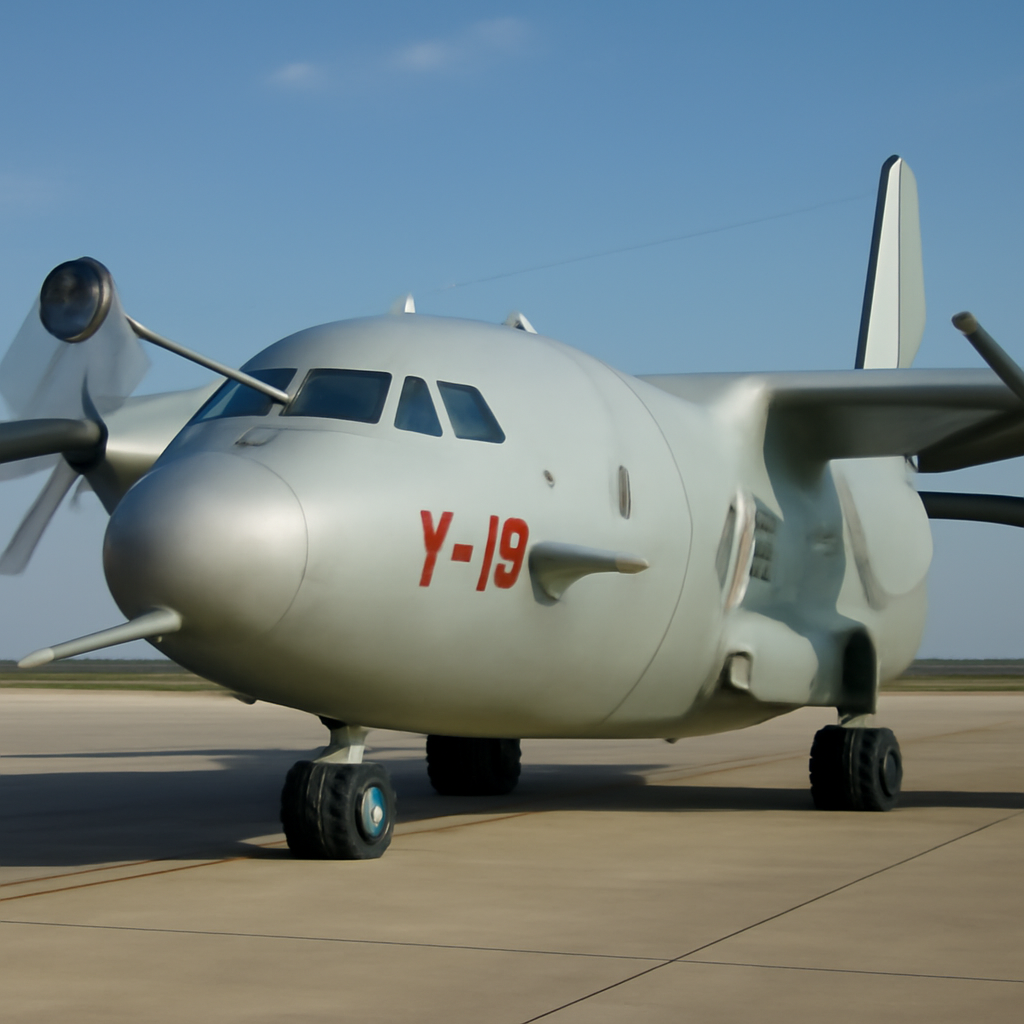
Tuesday, December 16, 2025 — a new Y‑15 military transport was photographed fitted with a mid‑air refueling probe.
Y‑15 photographed with a mid‑air refueling probe
The image circulating with the report shows the Y‑15 equipped with a probe for mid‑air refueling, a capability explicitly noted as absent from the older Y‑9. The presence of the probe is the clearest, most concrete datum in the item: a turboprop transport airframe being prepared or provisioned to take fuel while aloft rather than relying solely on runway-to-runway legs.
How the Y‑15 fits into the PLAAF transport picture: Y‑20, Y‑9, and priorities
The writeup places the Y‑15 against a broader contrast within the People’s Liberation Army Air Force (PLAAF): the rapid development and steady entry of Y‑20 four‑engine jets into service — described in the source as the “fat bird” — versus a more measured growth of the turboprop Y‑9 fleet. That contrast is presented as evidence the PLAAF places greater priority on the Y‑20 despite its higher cost and heavier maintenance burden. The source also notes the activity of Y‑20 units based at the PLAAF’s 13th and 4th Transport Aviation Divisions as reinforcing this strategic tilt.

The cyber insurance questionnaire just landed. Now what?
SOC 2, HIPAA, insurance renewals - someone has to own security strategy. Nubivance provides fractional CISO leadership without the full-time salary.
Get a security leadOperational doctrine: MOOTW deployments and reinforcement of Tibet
The account links the transport force composition to an evolving PLAAF strategic air‑transport doctrine. It points out recent demonstrations in military operations other than war (MOOTW) and the rapid reinforcement of remote regions such as Tibet as illustrations of doctrine in practice. The commentary also argues that China’s extensive high‑speed rail and modern highway networks reduce the urgency of maintaining a large tactical airlift force — a logistical context used to explain why strategic jet transports have risen in prominence.
Y‑9 and Y‑15 as specialized platforms rather than pure tactical airlifters
One interpretive thread in the piece is that the Y‑9’s most significant contribution has not been as a conventional tactical lifter but as a flexible base for specialized, cross‑service missions — characterized in the source as “high‑noon” missions. The Y‑15 is described as appearing to follow that same evolutionary pattern for the turboprop line: its primary value, the source argues, may lie less in raw transport endurance and more in adaptation to next‑generation specialized roles. The mid‑air refueling probe is cited as a concrete hint toward that trajectory.
How the PLAAF, transport divisions, and regional authorities might respond
- PLAAF: The air force is positioned to continue emphasizing high‑speed, long‑range jet transports while experimenting with specialized capabilities in turboprops; the probe suggests testing of extended-range or tanker‑integrated missions for turboprops.
- Transport divisions (13th and 4th): Units already associated with Y‑20 activity are presented as evidence of where the PLAAF’s strategic lift investments concentrate; those divisions’ operational tempo and deployments are cited as reinforcing the prioritization of the Y‑20.
- Regional authorities (remote regions such as Tibet): The writeup uses Tibet as an example of where rapid reinforcement has been demonstrated — an operational context in which longer‑range refuelable turboprops or a heavier reliance on Y‑20 jets could change deployment options and timelines.
The photographed Y‑15 probe is a small but telling detail. In the account’s framing, it signals a potential reframing of turboprop transports away from being purely short‑range tactical workhorses toward more specialized roles that benefit from extended reach. Whether the Y‑15’s refueling capability will translate into routine long‑range missions, new cross‑service roles, or simply greater flexibility for limited specialist tasks remains an open, practical question grounded in the single concrete change visible in the photograph: a probe where the Y‑9 has none.
Original story: https://china-defense.blogspot.com/2026/05/photo-of-day-new-y-15-military.html