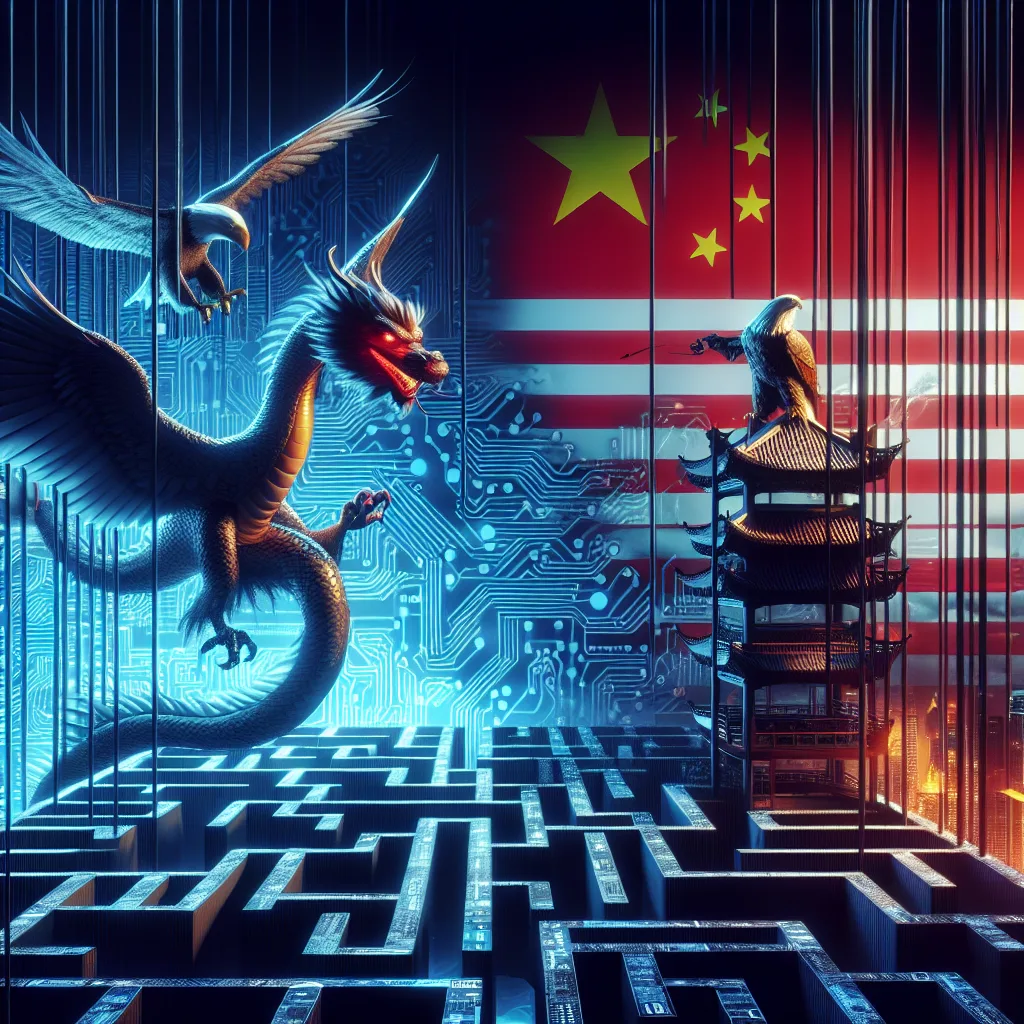
From Cyber Shadows to the Forefront: America’s Growing Digital Battle Against China
In a rapidly evolving digital arena, long dominated by concerns over Russian cyber operations, a new adversary now looms larger in the United States’ strategic calculations. At the recent RSA Conference (RSAC), voices from within America’s defense and intelligence communities underscored a stark warning: China has emerged as America’s number one cyber threat. The message was bolstered by a former Rear Admiral’s call for mobilizing the National Guard in cyberspace and enforcing greater corporate accountability. As cyber infrastructure becomes a pivotal site for economic, military, and political contestation, this development demands both robust analysis and immediate action.
Historically, cyber operations by Russia have commanded significant attention among U.S. policymakers, analysts, and security professionals. For years, strategies and countermeasures were largely honed against perceived Russian aggression—from election interference campaigns to sophisticated espionage operations. However, over the past few years, experts have observed a measurable shift. China’s cyber capabilities, refined through decades of strategic planning and state-sponsored initiatives, now pose threats ranging from intellectual property theft to coordinated attacks on critical infrastructure.
At the RSAC, one of the nation’s top former Navy officials, whose career spanned decades on the front lines of cyber defense, highlighted key vulnerabilities in current U.S. cybersecurity protocols. He warned that the United States must boost its operational tempo in cyberspace and extend its defensive perimeter to include the National Guard. His recommendations also pointed to a need to hold American corporations accountable for lapses in cyber hygiene. “We are in an era in which every company connected to the Internet is a potential gateway for espionage and sabotage,” he stated, emphasizing that national security intertwines with private sector resilience.
Understanding the significance of these developments requires historical context. U.S. cybersecurity doctrine has traditionally concentrated on external threats, primarily centering on Russian activities, which were most visible through discrete, high-profile cyber intrusions. Yet China’s approach diverges in scale and strategy. Rather than isolated incidents, China’s cyber efforts have been characterized by sustained, state-directed campaigns that penetrate multiple layers of industrial, academic, and governmental entities. These campaigns are part of a broader strategy aimed at long-term economic and technological ascendancy—one that blends cyber espionage, intellectual property theft, and covert manipulation of digital narratives.
Today’s digital battlefield is an arena where technological prowess meets geopolitical ambitions. In recent years, U.S. intelligence assessments have consistently pointed to China’s increased operational tempo in cyberspace. The Chinese government is not merely a reactive actor but a calculated strategist whose operations target vulnerabilities across industries fundamental to America’s economic security. Such activities have ramifications beyond corporate losses. They have the potential to disrupt public trust in democratic institutions, undermine legislative efforts to safeguard intellectual property, and even impair national defense systems.
Several facts underscore the urgency of this situation:
- Strategic Realignment: Once overshadowed by concerns over Russian cyber activities, China’s persistent cyber operations have now taken center stage as the primary digital adversary for the United States.
- Defense Mobilization: Former military officials, drawing on decades of cyber contest experiences, have proposed the integration of the National Guard into cyber defense operations—a move aimed at bolstering coordinated responses during major cyber incidents.
- Corporate Accountability: There is a growing consensus that American corporations, often targeted by sophisticated cyber incursions, must adopt rigorous security standards. Lax security measures not only invite breaches but also risk turning commercial networks into vectors for state-sponsored cyber activity.
Analysts from leading cybersecurity think tanks, including those with past affiliations to U.S. Cyber Command, have noted that China’s cyber strategy is a blend of soft power and hard-strike capabilities. Unlike traditional military confrontations, cyber conflicts are fought in a realm where attribution can be murky, and the lines between civilian and military targets blur. This complexity complicates both legal frameworks and policy responses designed to deter aggressive cyber behavior.
Experts caution that without immediate and sustained action, the digital divide between U.S. defenses and Chinese offensive capabilities will only widen. Emphasizing measured, fact-based analysis, cybersecurity strategist Dr. Eric Cole of Secure Pastures Cyber has remarked, “The principal challenge lies in adapting our civil infrastructure to meet the speed and sophistication of state-sponsored cyber operations.” His perspective, echoed by numerous officials, drives home the need for a new framework in public-private cybersecurity partnerships and regulatory oversight.
The implications for American society extend well beyond the realm of technical vulnerabilities. Cyberattacks that steal sensitive personal data, disrupt financial markets, or compromise government operations can erode public trust in institutions. Moreover, the economic costs of repeated cyber intrusions—from lost intellectual property to the expenses incurred in recovery and remediation—are staggering. China’s persistent targeting of American corporations, particularly those leading innovation in technology and finance, is not an abstract threat; it is a tangible risk that affects daily commerce and national competitiveness.
Looking ahead, policymakers face several critical decisions. Foremost is the question of how to integrate the National Guard and other civilian resources into a coordinated national cybersecurity strategy. Recent legislative proposals, which have attracted bipartisan support, also advocate for clearer guidelines on corporate cybersecurity standards. If enacted, these measures could not only reduce vulnerabilities but also recalibrate the dynamics of accountability between the state and the private sector.
Simultaneously, diplomatic dimensions remain a delicate aspect of this debate. While outright confrontation may not be in the interest of either superpower, the willingness to set clear limits and consequences on cyber operations is gaining traction internationally. As the United States revises its cyber doctrines, it must also engage with allies and industry leaders to develop unified responses to China’s cyber assertiveness.
For those on the front lines of cybersecurity—from government agencies to private firms—the evolving threat landscape is a call to action. The challenge is not merely defensive but also a test of innovation and resilience. How can the United States leverage emerging technologies, like artificial intelligence and quantum computing, to pre-empt and neutralize digital threats? The answer, experts suggest, lies in coordinated investment and a shared recognition that national security in the 21st century is inextricably linked to the cybersecurity practices of every corporation and institution.
In the final analysis, the ascendance of China as America’s foremost cyber adversary invites a realignment of strategies across multiple domains—defense, corporate governance, and international diplomacy. While the digital battleground is as much about bits and bytes as it is about national identity, the stakes are unmistakably concrete. With China’s multifaceted approach to cyber operations, tomorrow’s crisis may be a matter not of choice but of inevitability if the United States does not adapt swiftly.
As America recalibrates its cyber defenses, the larger lesson is one of preparedness. The digital domain, often characterized by unseen actors and uncharted tactics, now demands transparency, robust defenses, and a unified national response. In an era where the distinction between a corporate breach and a national security incident blurs, the ability to act decisively is not simply a matter of policy—it is a measure of our resilience for generations to come.
The evolving state of cybersecurity raises a critical question for policymakers and citizens alike: Can the United States adapt quickly enough to counter an adversary whose digital prowess is matched only by its strategic resolve?



