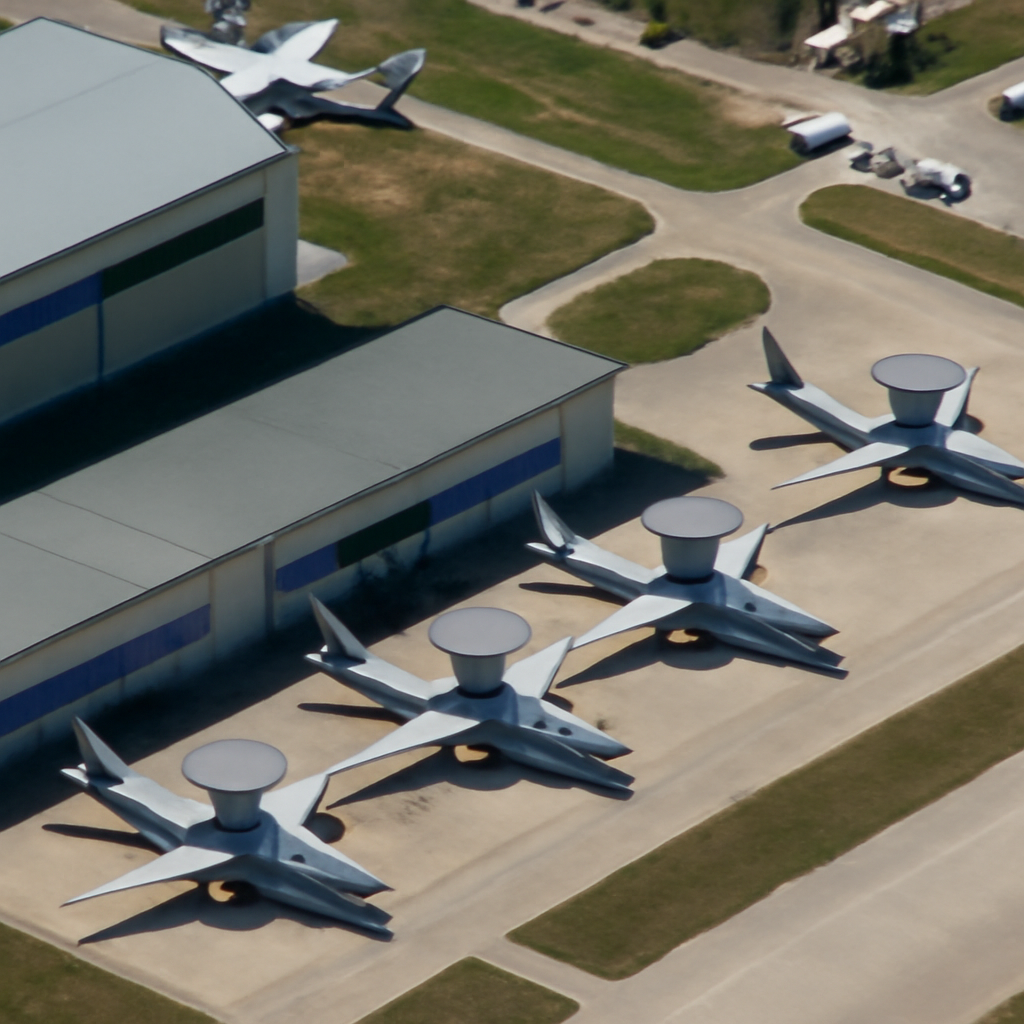
Satellite imagery captured October 5 shows four KJ-3000 airborne early warning and control (AEW&C) aircraft at two adjacent facilities in Xi’an, suggesting the type may be moving toward or has entered serial production.
Xi’an Aircraft Company and CFTE imagery
Images provided by Vantor and dated October 5 show three KJ-3000s positioned near the western part of the Xi’an Aircraft Company (XAC) facility at Xi’an-Yanliang, with a fourth example at the nearby China Flight Test Establishment (CFTE). The imagery, credited ©2026 Vantor, includes close views that place at least one KJ-3000 beside a pair of Y-20B transports on the apron.
Analyst assessments: serial production versus prototypes
Analysts cited in the reporting offered differing readings of the significance of four airframes being present. J. Michael Dahm, a senior fellow at the Mitchell Institute for Aerospace Studies, assessed that “the presence of four aircraft points to the type having entered serial production.” Andreas Rupprecht, a Chinese military aviation analyst and contributor to TWZ, gave a more cautious assessment: the imagery “could indicate that series production or low-rate initial production (LRIP) has begun,” but he noted that “all four previously identified prototypes could simply have been at the facility at the same time,” and identified the aircraft at CFTE as a prototype.

This site is the portfolio.
OSINTSights runs on Cloudflare Workers, D1, R2, and Vectorize, with an AI pipeline on Hetzner ARM. Nubivance designed, built, and operates it. We do the same for clients.
See what we buildKJ-3000 design features and recent sightings
The KJ-3000 (also referred to as the KJ-20) is built on the four-engine Y-20 transport, specifically the improved Y-20B variant powered by Chinese-made engines. Visible features in the October 5 imagery and earlier photos include a large circular radome mounted above the rear fuselage, a prominent series of forward-fuselage antennas, an aerial refueling probe above the cockpit, and a conspicuous intake at the base of the tailfin that is likely intended to provide cooling air for extensive onboard electronics.
Earlier public sightings trace the program’s visible development: low-quality photographs emerged in December 2024, and more detailed imagery in May 2025 showed an example at an undisclosed airfield bearing serial number 7821 and still in primer. That May 2025 example was assessed to be the first KJ-3000.
Operational role, radar questions, and the Pentagon’s view
The KJ-3000 is presented in reporting as intended to expand and modernize China’s large jet-powered AEW&C capability. The KJ-2000 Mainring fleet has produced only four aircraft to date; that program “was constrained by the limited availability of suitable airframes” and faces “reliance on Russian supply chains and aging aircraft,” the reporting states. A domestically produced Y-20-based AEW&C platform would provide a “more sustainable basis for a much larger AEW&C fleet,” with greater potential for upgrades, export, and operational reach.
The exact configuration of the KJ-3000’s primary radar has not been established. The report notes that China’s KJ-2000 and KJ-500 use fixed radomes containing three active electronically scanned array (AESA) antennas for 360-degree coverage, rather than rotating radomes. The October 2025 U.S. Department of Defense annual report — cited in the coverage — states: “The PLA conducted an initial flight with the KJ-3000 Airborne Early Warning and Control (AEW&C) aircraft, which will serve as a surveillance aircraft to monitor aircraft, ships, and other vehicles. The KJ-3000 will probably be the world’s first model to use digital radar and will be capable of anti-jamming, passive detection, and target identification.”
How the KJ-3000 fits with KJ-500, KJ-700, and Y-9 family aircraft
The KJ-3000 is described as part of a broader diversification and expansion of China’s AEW&C fleet. Smaller platforms based on the four-turboprop Y-9 family — including the KJ-500 and the newer KJ-700 — continue to be produced. The KJ-700 is believed to combine radar with electro-optical and infrared sensors, though its precise capabilities remain uncertain. Turboprop types are noted as better suited to dispersed, austere airfields and “regularly appear at Chinese island outposts and in the strategically important Taiwan Strait,” while a larger jet like the KJ-3000 would offer greater speed, range, endurance, and higher-altitude radar vantage.
The reporting also ties airborne radar and command-and-control aircraft to force-multiplying roles: they can network with combat aircraft — including uncrewed platforms — share targeting information, and enable fighters to prosecute targets without activating their own radars. The coverage references a 2022 remark by then-Pacific Air Forces commander Gen. Kenneth Wilsbach praising command and control associated with J-20 operations and the KJ-500’s role supporting long-range air-to-air missiles.
The October 5 imagery does not by itself confirm the start of serial production. The reporting observes that “further imagery showing additional airframes, activity around production facilities, or aircraft in new operational markings may provide a clearer indication of the program’s progress.” For now, the KJ-3000 appears poised to become a significant addition to China’s airborne surveillance and command-and-control architecture, but the available open-source imagery invites cautious interpretation rather than definitive production claims.