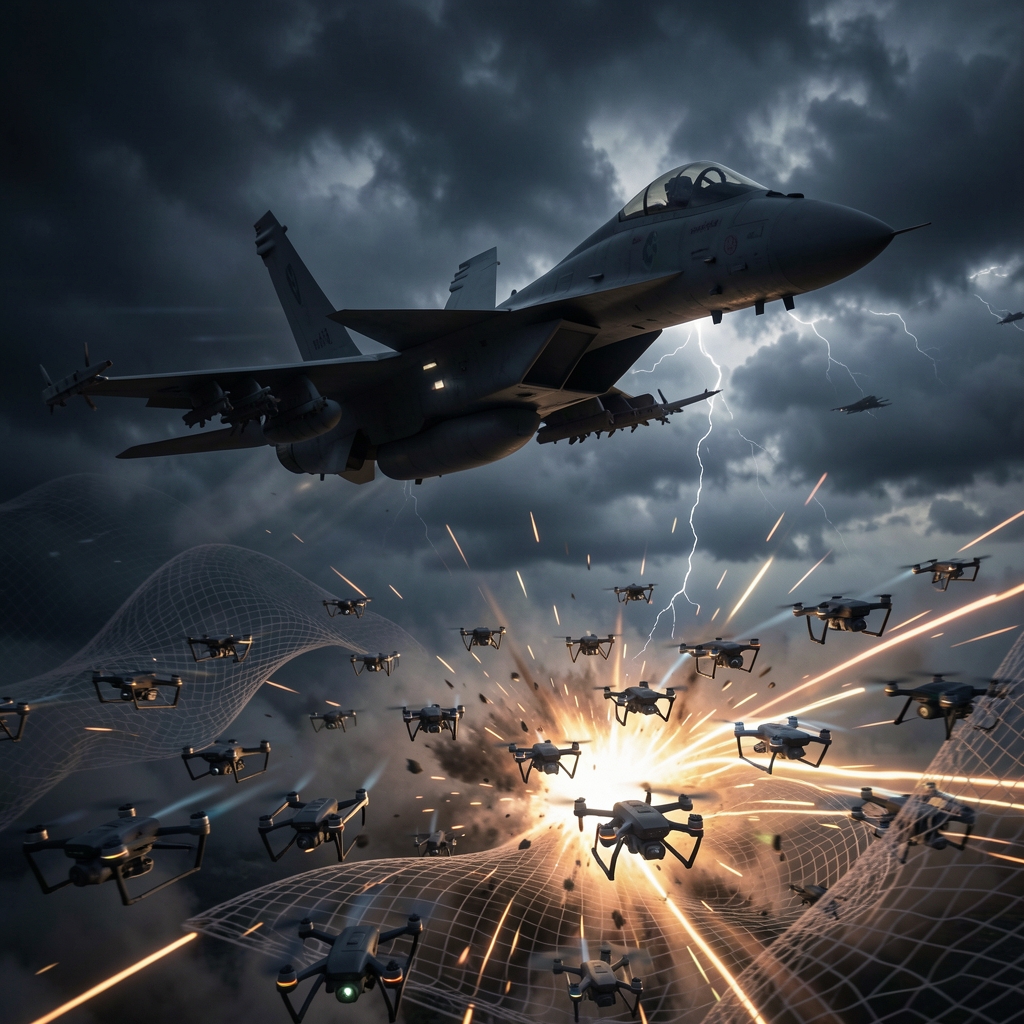
How does an advanced combat aircraft counter a swarm of small, inexpensive drones without adding staggering cost or complexity? That question sits at the heart of a recent BAE Systems effort, and the company has offered a terse but telling explanation of how it paid for an initial test.
What happened — and what was said
BAE Systems carried out an air-to-surface test tied to a low-cost counter-drone solution for the Eurofighter Typhoon, according to reporting in Breaking Defense. A BAE spokesperson told Breaking Defense that the air-to-surface test was internally funded, “as part of our commitment to invest in the advanced capabilities our customers require.” The comment framed the expenditure as a company-funded investment rather than an externally sponsored or government-financed trial.
Background and the narrow factual record
The public record provided here is limited: a company trial involving an air-to-surface demonstration and a confirmation from BAE that the test was funded from internal resources. Beyond that, the report does not detail the location, timing, technical specifications of the counter-drone solution, the scope of the trial, or its operational outcomes. The single direct quote available emphasizes corporate funding as an element of BAE’s strategic choices.

This site is the portfolio.
OSINTSights runs on Cloudflare Workers, D1, R2, and Vectorize, with an AI pipeline on Hetzner ARM. Nubivance designed, built, and operates it. We do the same for clients.
See what we buildWhy this matters
- Investment signaling: A company-funded test signals that BAE believes the capability has sufficient potential to merit bearing the upfront cost. That is an intentional message to customers and competitors alike.
- Cost and innovation dynamics: The phrase “low-cost counter-drone solution” suggests the company is pursuing approaches meant to be affordable alongside existing platforms. If accurate, that aim could affect trade-offs between capability, integration complexity, and procurement timelines.
- Procurement and partnership implications: When industry pays for early trials, responsibility for initial development risk shifts toward the vendor. For potential buyers, that can shorten decision cycles or change negotiation dynamics — but the record here does not say whether any procurement or formal partnerships followed the test.
Perspectives to consider
- Technologists: From an engineering perspective, pairing a fighter-class aircraft with a counter-drone capability raises integration and systems-of-systems questions. Engineers will focus on sensor fusion, discrimination of threats, and ensuring any new payloads do not unduly affect performance.
- Policymakers and budget stewards: For those responsible for capability acquisition and oversight, company-funded trials can present opportunities and dilemmas — opportunities to evaluate technologies more quickly; dilemmas about how to verify results, fund follow-on testing, and fit new capabilities into existing budgets.
- Operational users: Aircrews and mission planners would weigh the trade-offs of adding counter-drone functions to a Typhoon mission set — considering workload, rules of engagement, and interoperability — although the available report does not address those operational questions.
- Adversaries or competitors: Industry-funded demonstrations can be read as competitive posturing. Competitors may accelerate their own efforts; potential adversaries may note the trend even if the operational effectiveness remains unreported.
The limited factual record leaves unanswered but consequential questions: what exactly was tested, how effective was it, and what comes next in terms of joint trials, customer evaluations, or procurement decisions? BAE’s choice to fund the test internally is itself a strategic signal — but without further detail, the true impact of the trial remains opaque.
Is industry stepping into a leading role to derisk and accelerate defensive innovations on front-line platforms — and if so, who will decide whether those innovations move from company trials into operational service?