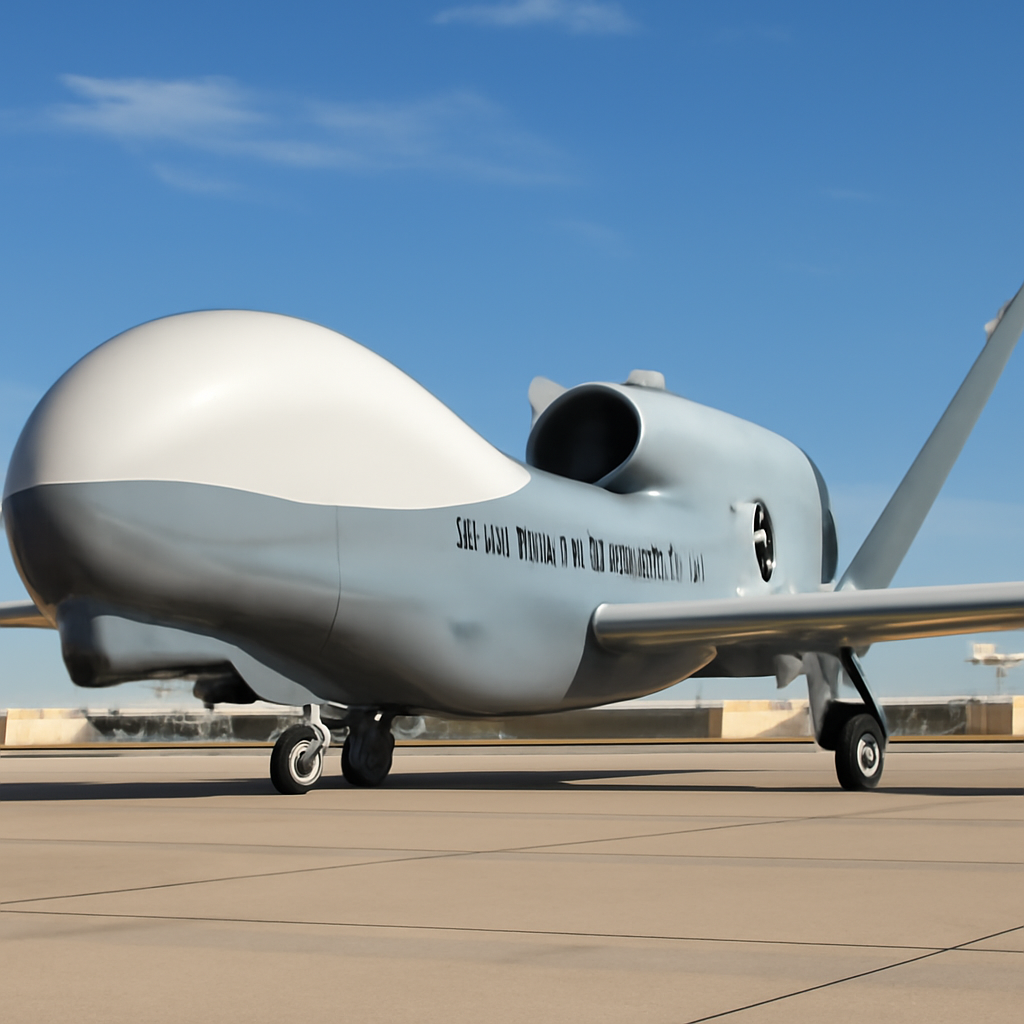
"Achieving Initial Operating Capability with the Royal Australian Air Force is a key step in strengthening the critical Intelligence, Surveillance and Reconnaissance capabilities MQ-4C Triton brings to the vast Indo-Pacific," Jane Bishop, Northrop Grumman Global Surveillance Division’s vice president and general manager, said in the company announcement.
What IOC means for the Royal Australian Air Force
The Australian Department of Defence announced that the Royal Australian Air Force (RAAF) has declared Initial Operational Capability (IOC) for its Northrop Grumman MQ-4C Triton High Altitude, Long Endurance (HALE) unmanned aircraft and its L3 Harris MC-55A Peregrine Intelligence Surveillance Reconnaissance and Electronic Warfare (ISREW) aircraft “following extensive operational testing and evaluation.” In the Australian context, the announcement defines IOC as meaning “the initial subset of a platform or a system, in this case part of the full complement of aircraft and their support elements, is ready to be deployed operationally.”
Fleet numbers and the near-term delivery timeline
The RAAF has received three MQ-4C Tritons and three MC-55A Peregrines; Canberra ordered four of each aircraft type. The announcement states the fourth MC-55A is set to arrive in Australia later this year. Those delivery and readiness figures frame the RAAF’s immediate operational posture: a partial but deployable set of assets available for missions while the final aircraft and supporting elements complete the full complement.

This site is the portfolio.
OSINTSights runs on Cloudflare Workers, D1, R2, and Vectorize, with an AI pipeline on Hetzner ARM. Nubivance designed, built, and operates it. We do the same for clients.
See what we buildOperational reach: Triton persistent surveillance and Peregrine ISREW missions
The department framed IOC as a capability multiplier for long-range, persistent surveillance across Australia’s area of military interest and the broader Indo-Pacific. Jane Bishop added that “commanders can now take full advantage of Triton’s ability to provide comprehensive surveillance data that strengthens regional security for joint decision makers, even in harsh and remote environments.”
Concrete mission activity has already begun. Since the first MC-55A arrived in Australia in February, those aircraft have been deployed overseas: in July, one MC-55A deployed to Clark Airbase in the Philippines and “flew several missions over the South China Sea,” the announcement said. Those sorties illustrate how the new platforms are being used to extend Australian surveillance and electronic warfare effects beyond national territory.
Boeing P-8A Increment 3 Block 2 upgrades and sustainment work
The announcement also confirmed a related sustainment development: the first of two Boeing P-8A Poseidon multi-mission aircraft upgraded to Increment 3 Block 2 standard has returned to Australia. Boeing was awarded a contract in 2024 to upgrade the RAAF’s fleet of 14 P-8As to that standard, which the announcement says includes improvements to the aircraft’s onboard software, systems and sensors. Work on the first two aircraft was carried out in Jacksonville, Fla.; the remainder are to be upgraded in Australia.
What this means for the RAAF, joint commanders, and regional partners
- Royal Australian Air Force: The RAAF now fields deployable subsets of MQ-4C Triton and MC-55A Peregrine platforms that are explicitly tasked to provide persistent ISR and integrated ISREW effects; the service will integrate the fourth MC-55A when it arrives later this year.
- Joint commanders and decision makers: With IOC declared, commanders can task Triton and Peregrine aircraft for long-range surveillance and electronic warfare support, leveraging Triton’s high-altitude persistence and the Peregrine’s ISR/ISREW capabilities to inform operations in remote or contested areas.
- Regional partners and operating bases: The July deployment of an MC-55A to Clark Airbase in the Philippines and missions over the South China Sea demonstrate that these platforms will be employed in forward or regional basing scenarios to extend surveillance reach.
The department’s IOC announcement marks a clear, measurable step in Canberra’s fielding of modern airborne intelligence and electronic warfare assets: fleets partially delivered and declared ready to deploy, overseas missions already flown, and a sustainment path for maritime patrol upgrades underway. With the fourth MC-55A due later this year and the P-8A upgrade program progressing, the immediate task is straightforward and concrete — integrate the remaining aircraft and support elements so the initial operational capability becomes a sustained operational baseline.
Source: Breaking Defense — Australian MQ-4C Tritons, MC-55A Peregrines reach Initial Operational Capability