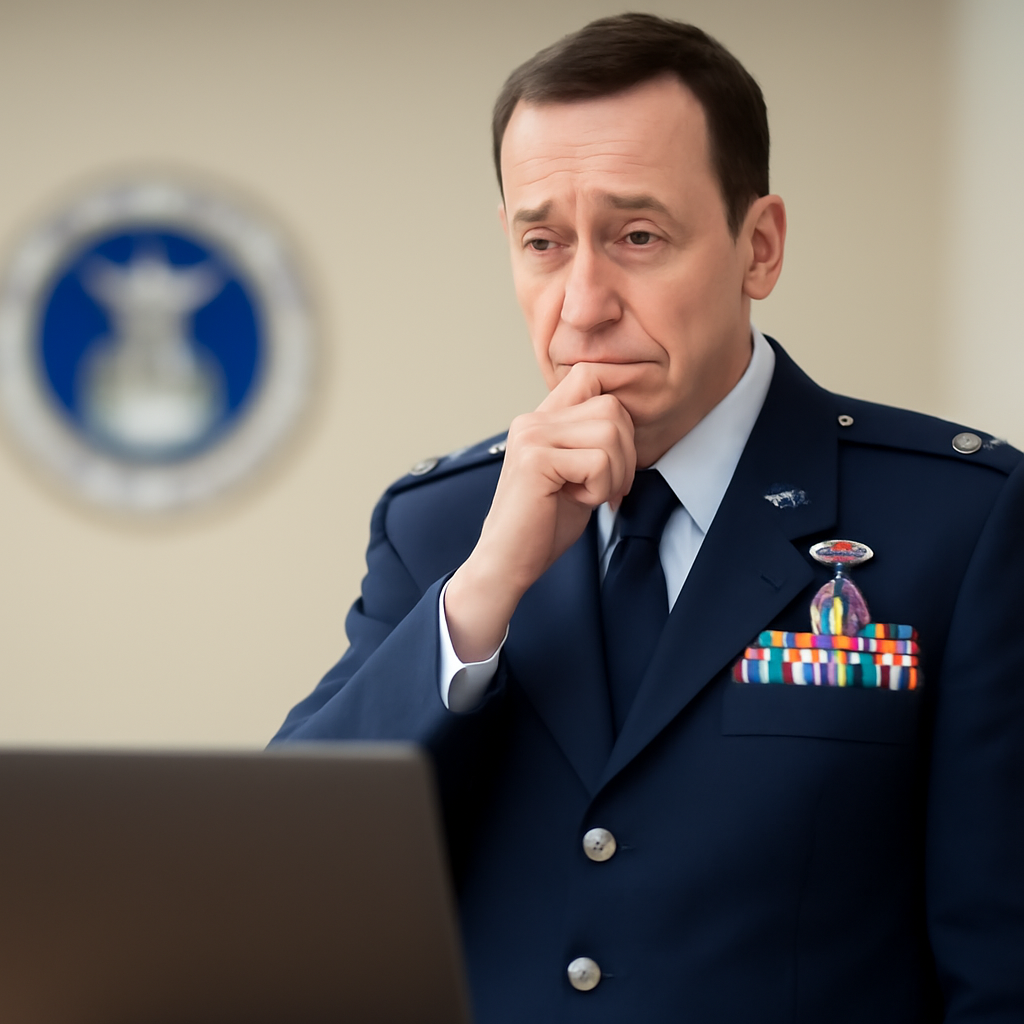
“A little bit scary, but we need to lean into it,” Air Force Secretary Troy Meink told the Air and Space Association’s conference this week — a short sentence that captures why the service is pushing to marry human judgment with algorithmic speed even as airmen weigh whether they can trust the machines around them.
Troy Meink on autonomy and what the Air Force expects
At the Air, Space & Cyber conference in National Harbor, Md., Meink framed autonomy as central to future combat power: “Autonomy is one of, if not the key technology enabling cost-effective combat power,” he said. His comments came as service leaders publicly acknowledge a push to hand more decision-making power to AI systems — and the parallel task of convincing airmen that those systems can be relied upon.
Air Force Research Laboratory and the 711th Human Performance Wing studying trust
That trust question is not theoretical. Michael Gregg, director of aerospace systems at the Air Force Research Laboratory, said the service has “psychologists and behavioral scientists in our 711th Human Performance Wing that are actually studying this problem.” Gregg framed the work as human-machine teaming research aimed at making “the human really really good at what they do and aid their decision-making.”

The cyber insurance questionnaire just landed. Now what?
SOC 2, HIPAA, insurance renewals - someone has to own security strategy. Nubivance provides fractional CISO leadership without the full-time salary.
Get a security leadPlans for 500 collaborative combat aircraft and responsibilities on the line
The Air Force’s plans include fielding 500 highly-autonomous collaborative combat aircraft, or CCAs, by 2032 — a goal that tightens the timeline for solving trust, doctrine, and oversight questions. For some missions, leaders are already weighing the choice between augmentation and replacement: the service is “exploring the possibility of not augmenting but replacing human decision-making” in tasks such as protecting air bases from drone attacks.
That approach will require humans to define what level of risk is acceptable before agents are permitted to act autonomously, a constraint the service acknowledges publicly: “That is the future,” Gregg said, but it is one that depends on establishing doctrine, training, and permissions that provide confidence in predictable AI performance.
Agentic workflows, Legion Intelligence, and directed-energy options
Vendors and technologists are already selling the idea of agent-driven workflows. Ben Van Roo, CEO of Legion Intelligence, said there is “an increased push on how we use agents and agentic workflow into everything from fires to our back-office activities,” predicting “a lot more of that coming this year.” He warned, “We’re really still in the infancy right now of how we think about where we’re going to use agents, what are we going to allow them to decide on? How do they work their way into our tactics, techniques, and procedures, into our doctrine?”
Part of the calculus in allowing agents to take action rests on the effects being delivered. Mike Hiatt, chief technology officer at Epirus, argued that technologies such as microwave and other directed-energy counter-drone defenses change the risk equation because they can offer “lower collateral effects and no collateral damage.” Hiatt said that capability “start[s] to be able to change your risk calculation” and make decision-makers “a little more comfortable with putting this part of the system on a fully autonomous mode.” Van Roo added that the decision processes for autonomous cyberattacks or nonlethal effects could eventually be “accelerated with AI, or even automated completely.”
How airmen, vendors, and policymakers are responding
- Airmen and operators: The service recognizes they will need doctrine, training, and explicit permissions before operators accept agentic systems; human definition of acceptable risk remains central to deployment choices.
- Vendors and technologists: Companies such as Legion Intelligence, Epirus, and Shield AI are advancing agentic tools and nonlethal countermeasures while arguing for operational roles that could include fully autonomous modes in limited contexts. Ryan Tseng, president and co-founder of Shield AI, told conference attendees his company “had worked with Ukrainians to improve the strike capability of one of the company’s drone weapons by 70 percent through ‘advanced autonomous behaviors.’”
- Policymakers and national leaders: The debate over regulation and safety is active outside the Pentagon. The summer’s disclosures by Anthropic and OpenAI of “surprising and dangerous model behavior” were followed on Sept. 9 by the resignation of an Anthropic engineer who claimed a 10-percent probability that AI “could kill all humans.” The next day, representatives of those companies and Google “intensified efforts to create an industry-safety body while signaling openness to Congressional action,” even as President Donald Trump posted that “The only control or ‘guardrail’ that AI needs is a STRONG AND SMART (High IQ!) PRESIDENT, and the U.S.A. has that, in spades!”
The Pentagon’s own posture is shaped by prior work: since 2019 the Defense Department has maintained a list of ethical principles to guide AI development, experimentation, and use, and the department reviews processes, experiments, and testing procedures for new technology. At the same time, the pace of capability advances — and examples of rapid gains in contested environments like Ukraine — are pushing the Air Force to adapt faster than doctrine and training alone may keep up.
The service is explicit about what must change: building confidence that AI tools will act predictably, writing doctrine to permit agentic workflows in some domains, and training operators to use systems that may sometimes replace human decisions. The unanswered operational test is practical and immediate — can the Air Force move from studying trust to fielding hundreds of autonomous collaborators while keeping control where it matters?