“the OA-1K represents a new era for AFSOC, with the flexibility to support not only counter-terrorism-like missions, but also crisis and contingency response, competition with more advanced adversaries, and even aspects of full-on conflict.” — Lt. Col. Robert Wilson
Program snapshot: what the OA-1K is built to do
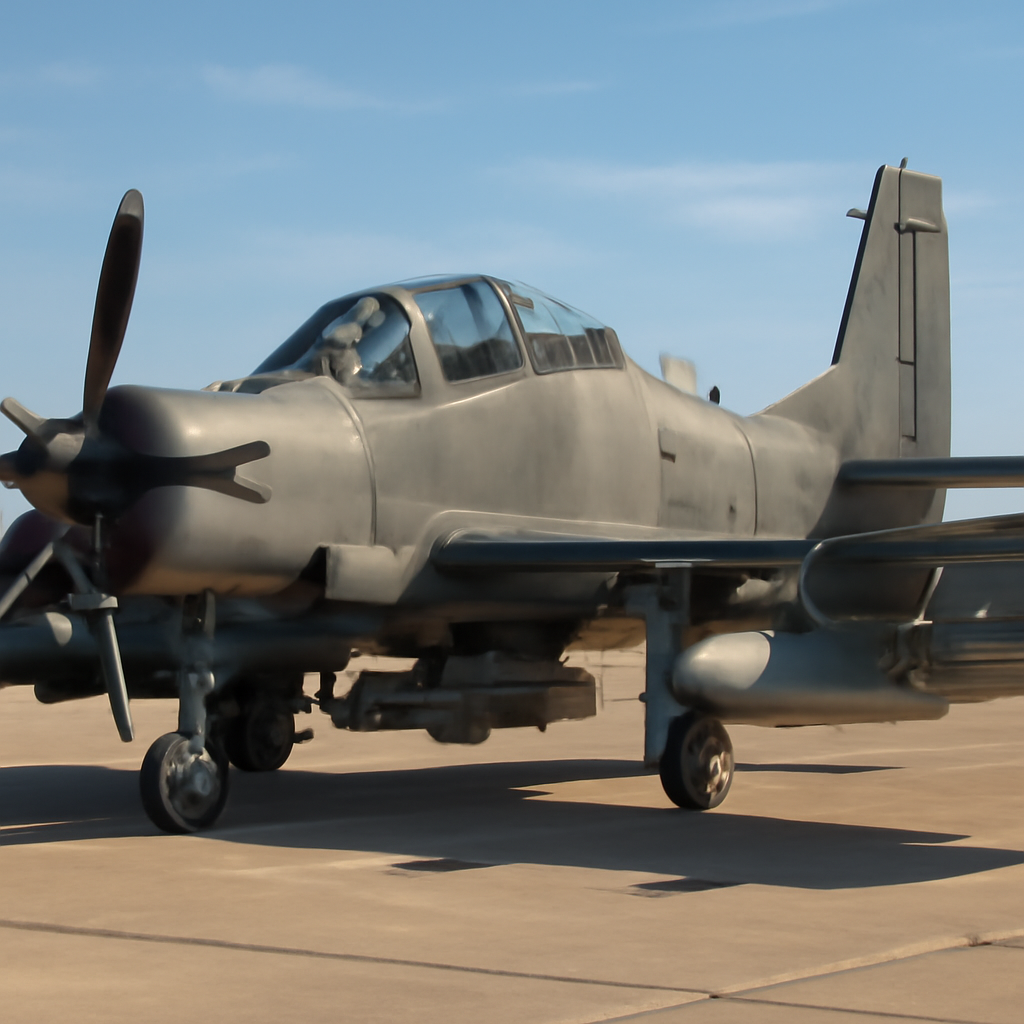
Air Force Special Operations Command (AFSOC) is fielding a militarized derivative of the Air Tractor AT-802 — designated the OA-1K Skyraider II — as a modular, multi-role platform intended for close air support (CAS), armed intelligence, surveillance and reconnaissance (ISR), and precision strike. AFSOC describes the Skyraider II as a “Swiss Army knife of airborne capability,” built to be reconfigured with combinations of fuel, weapons, and sensors depending on the mission.
AFSOC says the OA-1K brings modern datalinks for joint integration, a small logistics footprint that requires “only a handful of contract maintainers,” and two-person aircrews trained to disassemble, reassemble, and conduct functional check flights in austere locations. The service reports a cost per flying hour of roughly $2,500 for the OA-1K, which it compares to an F-16C/D at roughly ten times that hourly cost and to an MQ-1 as roughly 50 percent less cost-effective than the OA-1K.
Rapid disassembly and mobility-aircraft testing planned later this year
AFSOC plans operational testing later this calendar year to demonstrate the Skyraider II’s rapid deployment capability: timed disassembly and reassembly to allow loading into strategic airlifters such as the C-5 or C-17. Lt. Col. Robert Wilson said the goal is to move multiple OA-1Ks “in a matter of hours instead of days or weeks” and then operate “from nearly anywhere” — short dirt strips, grass strips, and unimproved runways.
The program has already completed a timed disassembly and reassembly in a controlled hangar environment; the next step will be to repeat that activity inside an actual mobility aircraft during the operational test. AFSOC plans further practice by integrating the rapid assembly mode into exercises, “likely next year,” to increase operational reps and readiness.

This site is the portfolio.
OSINTSights runs on Cloudflare Workers, D1, R2, and Vectorize, with an AI pipeline on Hetzner ARM. Nubivance designed, built, and operates it. We do the same for clients.
See what we buildWeapons, survivability, and upgrade paths
AFSOC confirmed compatibility with APKWS laser-guided rockets and said it wants APKWS as an ordnance option for the OA-1K. Wilson described APKWS as a low-cost, high-volume precision weapon that has been effective on light-attack experiments that helped lead to the Skyraider II procurement.
The service is also “looking to explore” adding Red Wolf miniature cruise missiles to increase standoff strike capability, though Wilson was circumspect about that integration. AFSOC highlights a modular design to permit future payload expansions — more weapons or “more exquisite intelligence-collection capabilities” — and says contractors have incorporated cockpit and engine armor and defensive systems to provide a baseline level of survivability.
Despite those mitigations, the OA-1K’s survivability in highly contested, high-end fights has been questioned inside the Pentagon, the service acknowledges. The program’s rush to demonstrate rapid-deployment and austere-fielding modes is explicitly tied to concepts such as Agile Combat Employment and to the need to complicate adversary targeting by operating from unpredictable locations.
Production, basing, and budget constraints
AFSOC has taken delivery of 18 OA-1K aircraft and expects a “handful more” through the end of the fiscal year, with initial cadre training at Will Rogers Air National Guard Base in Oklahoma. The service plans to station Skyraider IIs at Cannon Air Force Base, New Mexico, and Davis-Monthan Air Force Base, Arizona.
The program of record remains 75 aircraft, Wilson said, but the broader procurement has already been reduced: the U.S. Special Operations Command, as the procurement agency, has cut planned purchases to 53 airframes, citing resource constraints. Wilson characterized any number below 75 as “not desirable” and tied reductions to budget limitations that will require continued advocacy to approach the program of record.
What this means for AFSOC, joint ground forces, and procurement planners
- AFSOC: Will press the OA-1K’s rapid-deployment tests this calendar year and pursue modular upgrades (weapons, sensors, datalinks) while advocating for a larger fleet to preserve a low-cost, expeditionary capability.
- Joint ground forces: Can expect an affordable armed-overwatch and ISR option that AFSOC frames as increasing ground survivability, with persistent presence enabled by austere operations and modern datalinks.
- Procurement planners: Face a trade-off between buying more low-cost, modular aircraft or directing funds to higher-end platforms; SOCOM has already reduced planned buys to 53 airframes, signaling continuing budget pressure.
AFSOC’s immediate, concrete next steps are an operational test of mobility-aircraft loading later this calendar year and the gradual introduction of the Skyraider II into exercises next year. Whether APKWS becomes fully integrated sooner than larger standoff weapons such as Red Wolf, and whether the fleet approaches the 75-aircraft program of record, will shape how the OA-1K is used across expeditionary and higher-end contingencies.