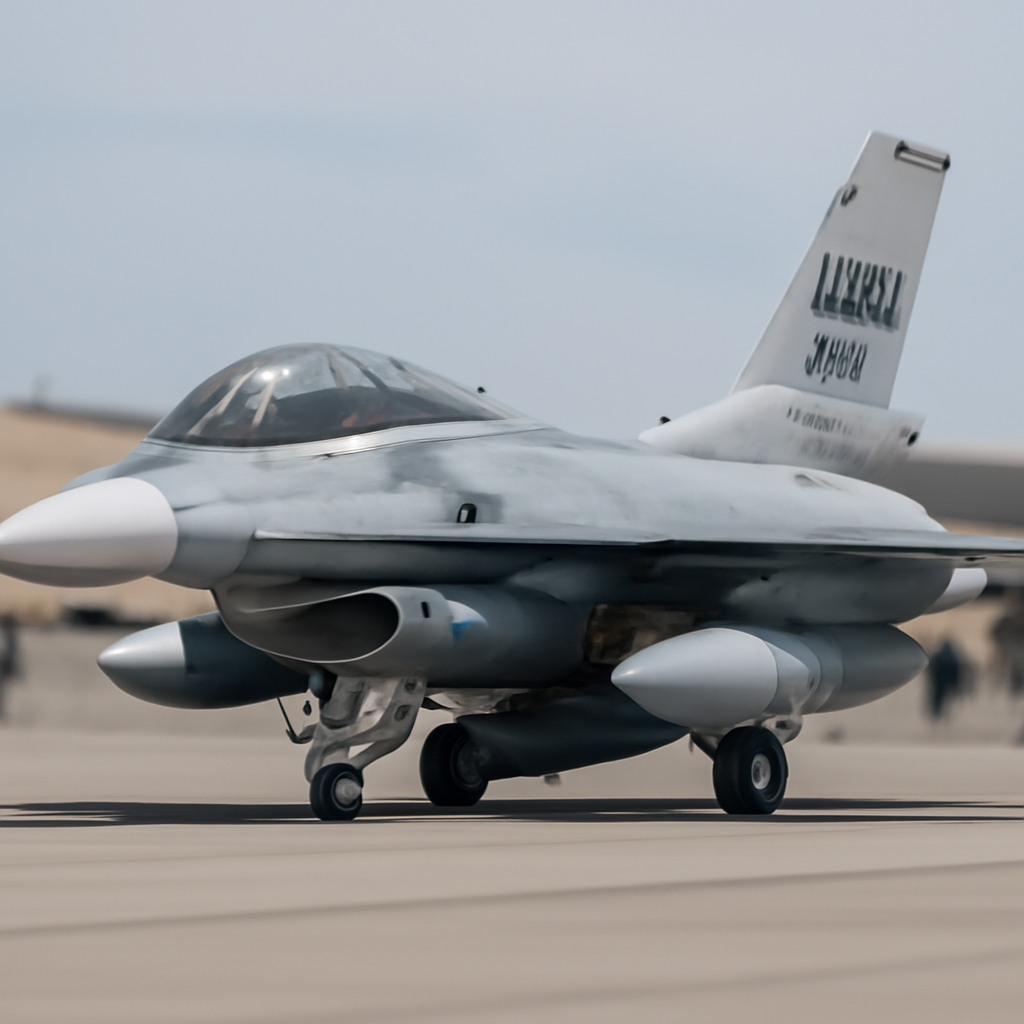
Across eight flights, the X-62 Variable In-flight Simulation Test Aircraft (VISTA) executed 27 AI-controlled intercepts, using live infrared sensor feeds to find, track and close with a physical airborne target in real time.
X-62A, VISTA, and the Have Heat demonstration
The X-62A — a uniquely modified F-16D Viper also known as VISTA and assigned to the U.S. Air Force Test Pilot School (USAF TPS) — participated in a program the Air Force nicknamed Have Heat. In testing conducted at Edwards Air Force Base, USAF 412th Test Wing said the platform “demonstrated the ability of AI agents to ingest live infrared sensor data, directing the X-62 to autonomously intercept an airborne target in real time.” Lockheed Martin described the event as a “closed‑loop AI combat test” and an “autonomous AI sensor-to-vehicle control” demonstration. A T-38 jet trainer served as the live target.
Legion Pod and infrared search-and-track (IRST) sensor data
The X-62 carried Lockheed Martin’s Legion infrared search and track (IRST) pod to supply the on‑board AI agent with targeting information. Lockheed Martin summarized the result succinctly: “An artificial intelligence (AI) agent used targeting information from an operational sensor to execute successful air intercepts against a live target.” The Legion Pod has also been used operationally on crewed Air Force fighters and previously equipped other platforms such as General Atomics’ MQ-20 Avenger in earlier autonomous detection and tracking demonstrations.

This site is the portfolio.
OSINTSights runs on Cloudflare Workers, D1, R2, and Vectorize, with an AI pipeline on Hetzner ARM. Nubivance designed, built, and operates it. We do the same for clients.
See what we buildClosed-loop autonomy, rapid integration, and Have Holidays
Have Heat was run in parallel with a complementary effort called Have Holidays, which focused on rapid integration of modular technologies into the X-62’s Enterprise Open Mission System Architecture computer. The Air Force said Have Holidays included “the integration of a non-prime, third-party autonomous agent onto the X-62, testing of enhanced safety rules to prevent autonomous vehicles from violating user-established operational limits, and further chip integration for advanced sensor exploitation.”
Lockheed Martin added that it completed “full integration and ground test of the agents” used in Have Heat in three months using its “‘Supermassive’ AI agent generation capability.” The program moved AI testing “from simulated target data to real-time, on‑board sensor streams, mirroring the data environment pilots will face in future high-stakes engagements,” Lockheed Martin noted.
Project VENOM, Mission Systems Upgrades, and planned sensors
The Air Force is preparing the X-62 under a larger Mission Systems Upgrades (MSU) effort that will add new “sensor and computing capacity” and “modern network data communications.” The MSU program is working toward integration of Raytheon’s PhantomStrike radar onto the aircraft. Separately, the service has modified additional F-16s under Project Viper Experimentation and Next-Gen Operations Mode (VENOM) to support advanced autonomy testing and announced the start of their flight testing.
CCA programs, partners, and operational context
Have Heat is framed by the Air Force as a stepping stone toward the service’s Collaborative Combat Aircraft (CCA) concept. The initial CCA fleet is slated to include a mix of General Atomics FQ-42 Dark Merlin and Anduril FQ-44 Fury types; the Air Force is already using pre-production versions of those drones to develop concepts of operations, tactics, techniques and procedures. The service reported an operational test at Creech Air Force Base in July 2026 and displayed pre-production YFQ-44A and YFQ-42A drones during that testing. The Air Force said it hopes to begin fielding its first operational CCAs by 2030. The service also expects F-22 Raptors to be the first airborne controllers for operational CCA drones, and it said human operators will remain on the loop to authorize lethal attacks for the foreseeable future.
What this means for the Air Force, Lockheed Martin, and allied partners
- The Air Force: Have Heat demonstrates a closed on‑board sensor-to-action loop that the service can use to mature tactics and software for future CCA deployments and for integrating additional sensors like PhantomStrike under MSU.
- Lockheed Martin: The company emphasized rapid agent generation and the ability to pair operational sensor data with AI for autonomous action — “the real advantage comes when that data can connect seamlessly with AI to take action,” Stacy Kubicek said — positioning its Skunk Works and sensors groups as integrators for autonomous packages.
- Allied partners and joint services: The Air Force highlighted coordination with the U.S. Navy and U.S. Marine Corps on a common C2 architecture and has begun bringing in foreign partners, starting with the Netherlands, to participate in CCA testing and development.
Have Heat validated a practical capability: an autonomous agent consumed live IRST feeds and directed a crewed test jet to intercept a live target multiple times in flight. The event shifts testing further onto real-time, on‑board data and toward the sensor-driven autonomy the Air Force intends to field on early CCA drones — even as the service continues parallel work on safety rules, networked communications, and additional sensors that will shape how those systems operate together.