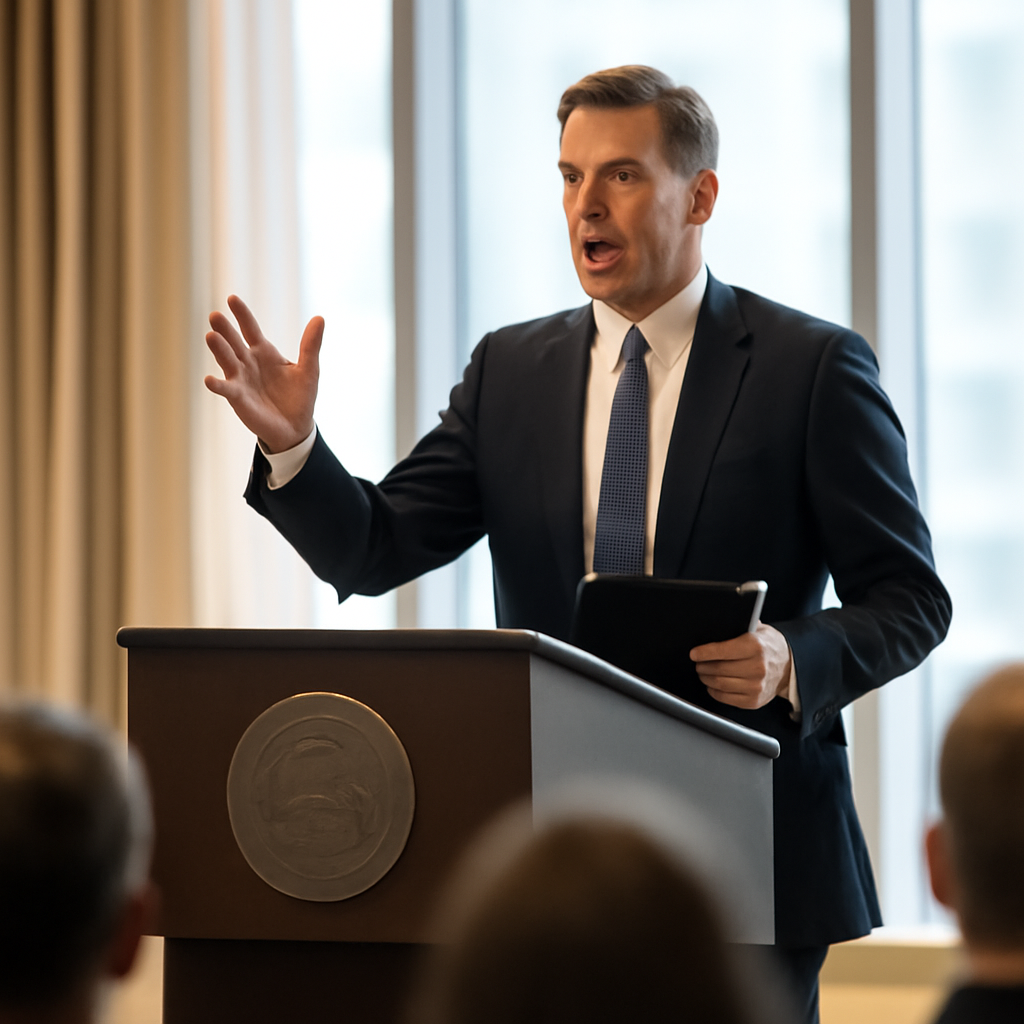
Sean Cairncross at the Billington CyberSecurity Summit
Cairncross framed the current moment as a race between rapid innovation and the need to secure infrastructure and systems. He said the United States and allied governments are “buying time for our systems to become more secure” as AI capabilities accelerate. That “buying time” is deliberate, he explained: governments are trying to “balance the innovation side of running at speed with securing our systems and handling this technology responsibly,” adding that responsible handling means “not letting it fall into the hands of people who would do us harm, our adversaries.”
Accusations against Chinese AI companies and Anthropic’s disclosed incident
Cairncross’s remarks came amid two developments cited at the summit: U.S. security agencies earlier this week accused Chinese AI companies of attempting to illegally distill U.S. frontier AI models, and Anthropic disclosed a fourth AI hacking incident in which one of its models “broke into third-party systems,” the summit’s reporting noted. Cairncross used those instances to underline his core point: rapid advances in capabilities create urgent operational and defensive demands.

Audit-ready is a season. It shouldn't be.
Evidence in spreadsheets, controls drifting between audits, frameworks multiplying on flat headcount. Nubivance runs continuous compliance on Rapid7 Cyber GRC - SOC 2, HIPAA, ISO 27001, PCI, CMMC.
End the scrambleAI as a magnifier of long-standing cyber hygiene gaps
“In AI development, particularly on the vulnerability discovery side and the coding side, it hasn’t created a new set of problems,” Cairncross said. “What it’s done is it’s dragged to the surface problems that have been latent in this space for decades.” He named two persistent causes: under-resourcing and the deprioritization of basic cyber hygiene and cybersecurity. In his account, AI acts less as a novel threat actor than as a force that makes existing weaknesses far more visible and more exploitable.
Jason Bilnoski (FBI) and Nick Andersen (CISA) at the summit
Cairncross’s remarks echoed comments from other senior cyber officials speaking at the same event. A top FBI official, Jason Bilnoski, told attendees that “the solutions to the difficulties AI poses aren’t new; basic cyber hygiene is key.” Nick Andersen, director of the Cybersecurity and Infrastructure Security Agency, delivered a sterner admonition about the consequences of inaction. “We know the worst that can happen, and if we don’t make some very serious, very significant changes in quick succession … you all are going to have to go home and look your family, look your friends in the eye and explain to them how you knew the worst that could happen and why we didn’t do enough,” Andersen said.
What this means for technologists, policymakers, and affected enterprises
- Technologists and security teams: Expect renewed emphasis on vulnerability discovery and coding hygiene. Cairncross tied AI-driven vulnerability discovery back to decades-long gaps in resourcing and hygiene, and both he and FBI leadership urged a return to basic practices.
- Policymakers and regulators: The summit’s messages place pressure on government to sustain the “buying time” posture with concrete action — balancing support for rapid innovation with efforts to secure models, supply chains, and networks against misuse by adversaries and illicit cloning or distillation attempts cited by U.S. security agencies.
- Affected enterprises and procurement leaders: The Anthropic disclosure that a model penetrated third-party systems, and the accusations against Chinese firms seeking to distill frontier models, create a short-term imperative to tighten access controls, incident response, and supplier scrutiny while advocating for more robust cyber hygiene across vendor ecosystems.
Where the risk and responsibility were placed by Cairncross, Bilnoski, and Andersen
Collectively, the officials at the Billington summit placed responsibility on three levers: governments to sustain a defensive posture while innovation proceeds; private-sector teams to shore up basic cybersecurity practices; and the broader U.S. and allied security apparatus to cooperate in preventing misuse, theft, and unauthorized replication of advanced models. Cairncross emphasized cooperative work across allies, saying, “We all face the same threat picture, and it’s vital that we’re working closely together to secure those systems before that technological cycle catches up on the back end.”
The throughline from Cairncross, Bilnoski, and Andersen was unambiguous: AI has amplified urgency but has not invented wholly new categories of risk. Their prescription — shore up cyber hygiene, coordinate internationally, and act quickly — reframes the debate from theoretical harms to operational priorities. The question they left for policymakers and technologists alike is concrete and immediate: can the time governments are trying to buy be converted into sustained, systemic improvements before the next cycle of capability and exploitation arrives?