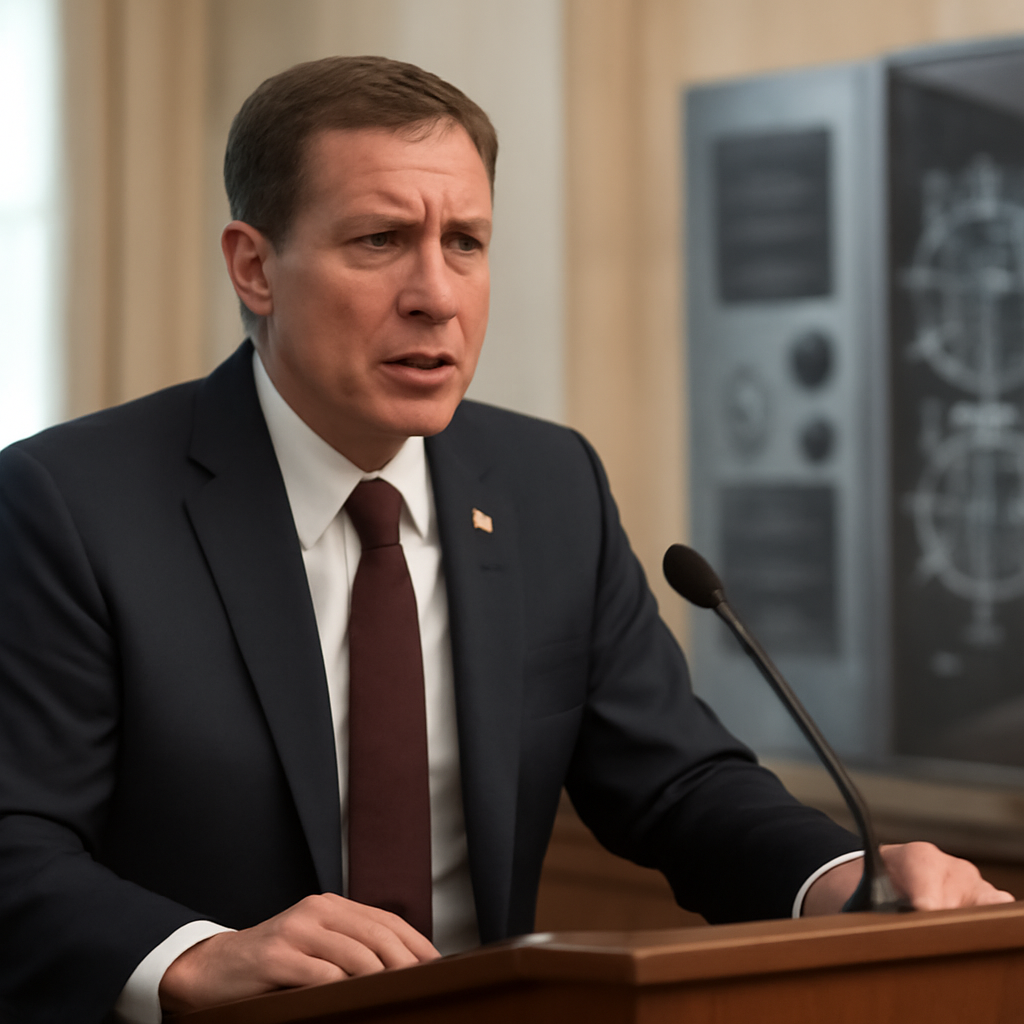
“Three months ago, @DeptofWar kicked @AnthropicAI out of our building—forever,” Defense Secretary Pete Hegseth wrote on X.com on Saturday, a declaration that landed amid a federal export-control action and a company shutdown that together have scrambled the Pentagon’s uneasy dealings with Anthropic.
Commerce Department classifies Mythos/Fable 5 as a cyber weapon
On Friday, the Commerce Department classified Anthropic’s Mythos/Fable 5 models as cyber weapons subject to export controls, a designation that, according to the department’s directive reported in the coverage, makes it illegal for Anthropic to provide those models to any foreign national, including its own employees. The classification followed reports that Amazon told the government it had found a way around Anthropic’s safeguards designed to prevent misuse of the models’ bug-hunting capabilities — the same capabilities that made Mythos attractive to hackers and to intelligence services.
Anthropic responded by shutting down public access to all users late on Friday, saying it had no practical way to exclude only foreign users. The company told reporters its safeguards “still largely hold” and that the breach could be easily repaired. By Monday, a delegation of senior Anthropic executives had reportedly flown to Washington to try to resolve the dispute with regulators.
Defense Department ban, a phased drawdown, and political rhetoric
The Commerce action landed on top of a contentious relationship between Anthropic and the Defense Department. Defense Secretary Pete Hegseth’s X.com post seized on the Commerce ruling as new evidence of what he cast as Anthropic’s unreliability. An X.com “community note” quickly asserted that “this official statement is not accurate or truthful.”
At the end of February, the president and Hegseth issued a ban on federal agencies using Anthropic, but that measure did not take immediate effect. Instead, the president allowed “a Six Month phase out period,” acknowledging that some defense agencies had come to rely on Anthropic’s earlier model, Claude, for rapid coding and — as reported — planning against Venezuela and Iran. Despite that ban, agencies and parts of the government had been carving out explicit exceptions for Mythos.

Audit-ready is a season. It shouldn't be.
Evidence in spreadsheets, controls drifting between audits, frameworks multiplying on flat headcount. Nubivance runs continuous compliance on Rapid7 Cyber GRC - SOC 2, HIPAA, ISO 27001, PCI, CMMC.
End the scrambleNSA’s reported use of Mythos and the distinction between public and preview versions
Mythos had already been under test inside parts of the U.S. government. The secretive National Security Agency reportedly started using Mythos in offensive operations at roughly the same time the administration was attempting a broader phaseout of Anthropic products. Experts and published reports indicate that the “preview” version of Mythos used by the NSA is not believed to be affected by Anthropic’s shutdown of the public model.
That split — a public shutdown alongside continued government access to a preview edition — underscores the complicated operational tradeoffs the government is navigating between constraining access and preserving mission-critical capabilities.
Legal consequences: lawsuits and new ammunition for both sides
Anthropic is already a party to two ongoing lawsuits. Jessica Tillipman, associate dean at the George Washington University Law School, told reporters that Commerce’s export-control declaration does not change the legal fundamentals of those cases because the suits challenge the government’s “supply chain risk” designations rather than export restrictions. Still, Tillipman said the Commerce action “provides legal ammunition in the lawsuits — potentially to either side.”
“Both of those [lawsuits] are under different authorities than the export control directive,” Tillipman said, “but I do think both sides may use this to support their cases — the government using this to suggest Anthropic is risky, while Anthropic may claim it is being singled out.”
Expert warnings: political perception, sector chill, and the open-source horizon
Former Project Maven and Joint AI Center head Jack Shanahan warned that the combination of the ban, the export controls, and the administration’s rhetoric risks being perceived as politically motivated persecution of Anthropic and its CEO, Dario Amodei. “Even if I take, at face value, the claim that Amazon found a way to jailbreak the latest Anthropic models and hence this is a legitimate national security concern, it still smacks of an ongoing vendetta against Anthropic and Dario personally,” Shanahan told reporters, adding that the order “will chill relations between the administration and the wider tech sector it has been wooing, especially for military use.”
Shanahan also warned of an operational gap: “It will be a few months, at most, before there are open-source versions of the kinds of capabilities these latest Anthropic models are offering,” he said. “We are not prepared for this. It’s going to happen. When it does, all the White House memos, directives, executive orders, and export control directives could be obsolete by the time they hit the street.”
Charlie Bullock of the Institute for Law & AI described the shutdown’s abruptness: “I was using it at five o’clock and then, at eight o’clock, it was offline.” Anthropic told reporters it received Commerce’s official notice at 5:21, and Bullock said the company likely had no practical way to satisfy the export-control condition without a total public shutdown.
The Commerce designation, the defense-phaseout with a six-month glide path, the continued NSA access to a preview model, and the arrival of executive-level Anthropic delegations in Washington together leave several concrete unresolved decisions: whether the waiver process embedded in the new National Security Presidential Memorandum will be invoked, how courts will treat the competing authorities in Anthropic’s suits, and how rapidly comparable capabilities will proliferate in open-source form. For the Pentagon, the immediate question is whether operational advantages tied to Mythos can be preserved without reopening the legal and political disputes that now surround the company.