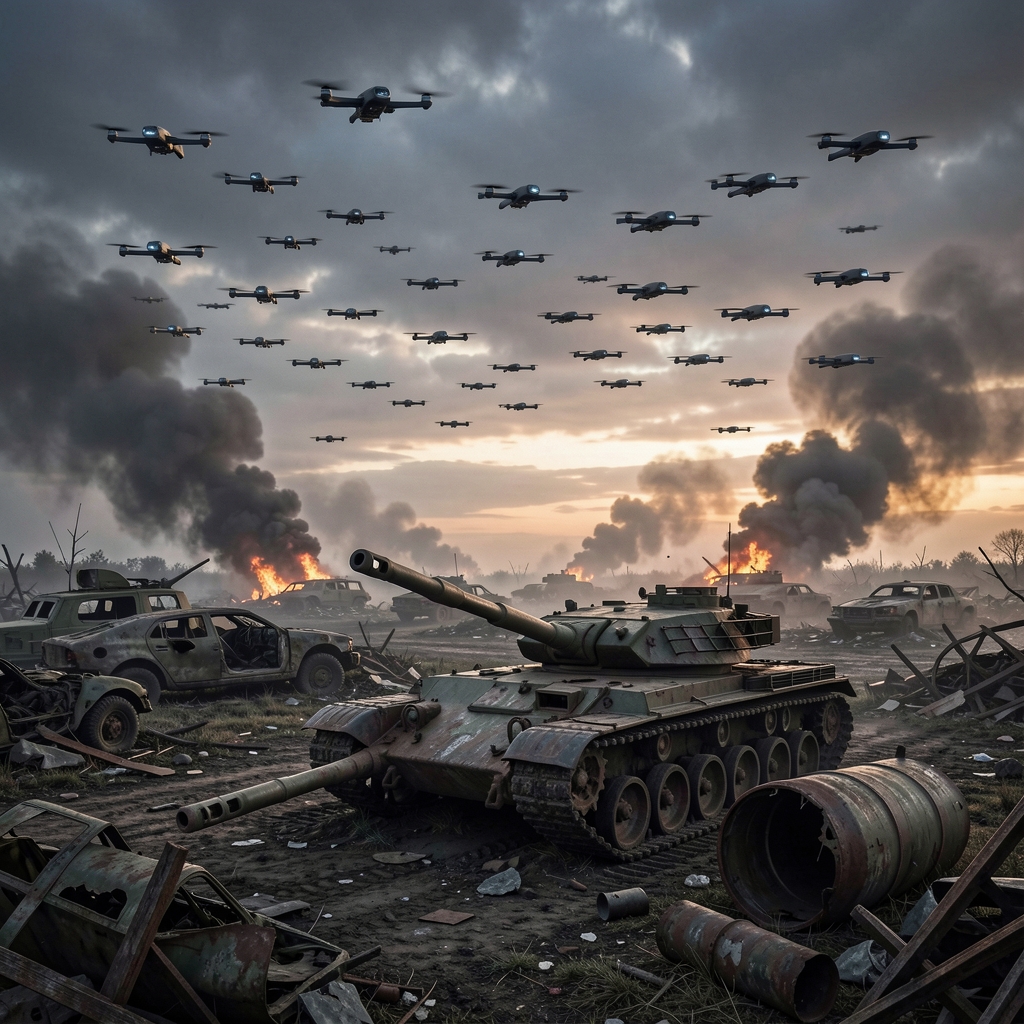
Swarming to Victory: How Ukrainian Drone Tactics Are Redefining Modern Warfare
In the relentless contest between traditional armored might and the swift efficiency of modern technology, Ukrainian forces have demonstrated a striking evolution in battlefield tactics. Over the course of a recent operation, Ukraine deployed 400 small unmanned aerial vehicles (UAVs) in a coordinated strike that reportedly destroyed more than 40 Russian combat vehicles. President Volodymyr Zelenskyy, addressing reporters shortly after the successful mission, remarked, “This was an interesting strike on them,” underscoring both the tactical ingenuity and audacity of the maneuver.
As the dust settles on this singular episode of aerial warfare, the incident provides a window into the future of military engagement. The success of the drone swarm is not merely a technical milestone; it is emblematic of an enduring shift in how conflicts are fought. With both sides adapting to new realities and leveraging emerging technologies, the dynamics of the ongoing conflict have far-reaching implications for global military strategy.
The operation, widely reported by defence publications and verified by multiple sources in Eastern Europe, highlights the rapid maturation of unmanned systems on the battlefield. Traditionally, large-scale drone operations were the reserve of more technologically endowed militaries. Yet Ukraine’s innovative approach—employing a high volume of inexpensive, small drones—has leveled the playing field in a conflict where conventional heavy armor has long dominated the narrative.
Historically, the military engagement in Eastern Europe has been characterized by entrenched positions and protracted ground confrontations. Since the onset of heightened tensions, Ukraine has sought to counterbalance Russian advantages in manpower and equipment through enhanced reliance on asymmetric warfare strategies. This recent drone swarm strike continues that tradition, serving as a modern-day counterforce that leverages agility, precision, and coordinated networking to exploit enemy vulnerabilities.
The operation unfolded with a discipline reminiscent of larger, state-of-the-art military exercises, drawing on lessons learned from previous encounters and incorporating the latest in AI-assisted navigation and target acquisition. While details on the specific models or configurations of the 400 drones remain limited, defense experts note that such assets are often derived from a combination of domestically developed systems and commercially available technology modified for combat scenarios. This tactical bricolage exemplifies a broader trend: states and non-state actors alike are increasingly able to repurpose off-the-shelf components into effective, combat-ready tools.
At the operational level, the swarm emerged simultaneously from several launch sites, converging on known or suspected Russian positions. The precise coordination—achieved possibly through secure, real-time data links and pre-programmed flight paths—allowed Ukrainian forces to overwhelm enemy defenses before countermeasures could be organized. With over 40 Russian vehicles reportedly neutralized, this strike not only degraded the immediate combat capabilities of the adversary but also sent a potent message about the evolving nature of warfare in the 21st century.
This development matters on several fronts. Strategically, the demonstration of effective mass drone utilization challenges longstanding assumptions about the balance of power on the battlefield. While heavy artillery and tank columns continue to play vital roles in conventional warfare, the ability to deploy numerous small, agile drones in a coordinated fashion forces a recalibration of defensive postures. The psychological impact on both military personnel and civilian populations cannot be overstated; knowing that a seemingly omnipresent swarm can strike without warning adds a new, unpredictable dimension to the fog of war.
Moreover, the success of this drone assault may well spur a reorientation in military procurement and training programs, both within Ukraine and among its Western allies. Defense ministries across Europe and North America have already expressed interest in integrating similar technologies into their arsenals. In recent briefings, officials from the U.S. Department of Defense and several European defense establishments have acknowledged the strategic promise of swarm tactics, emphasizing that such innovations could be decisive in future high-intensity conflicts.
Analysis by independent military experts—including assessments published by the International Institute for Strategic Studies (IISS) and the Royal United Services Institute (RUSI)—points to the operation as a watershed moment. These experts argue that when combatants can momentarily neutralize superior hardware through innovative tactics, the calculus of military advantage shifts. The deliberate and expansive use of small drones in a swarm formation effectively disperses and dilutes the enemy’s potential counterattacks, disrupting traditional command and control networks.
Beyond immediate tactical gains, the implications extend to the broader debate on the ethics and future regulations of unmanned warfare. The rapid proliferation of drone technology—in both state and non-state contexts—raises pressing questions about accountability, civilian protection, and the potential for escalation. Policymakers are watching closely as operational successes such as this one contribute to a growing body of evidence, suggesting that warfighting is quickly being transformed into a domain where digital, remote assets play an outsized role.
Critics, however, caution against viewing these developments solely through the lens of military innovation. Some analysts contend that while drone swarms offer substantial tactical benefits, they also introduce new complications in terms of mission planning and real-time decision-making. Without robust communication security and adaptive response protocols, there exists the risk of friendly fire incidents or unintended escalation, particularly in the fast-moving and often chaotic theater of contemporary conflict.
Looking ahead, several key trends are likely to emerge as a result of this operation. First, the success of Ukraine’s deployment may accelerate global research and investment into miniaturized combat systems and autonomous coordination software. This technological race could result in a marked increase in the number and sophistication of drone swarm deployments worldwide.
Second, expect a recalibration in defensive strategies among nations traditionally reliant on heavy armor. Future battlefield designs may incorporate more layered defenses against swarming tactics, such as improved signal jamming capabilities and rapid-response counter-drone systems. Countries in Europe and beyond are already signaling their intent to expand their cyber and electronic warfare divisions, preparing for an era where unmanned systems are the norm rather than the exception.
Finally, the psychological dimensions of drone warfare warrant consideration. The use of hundreds of small, elusive drones challenges not just physical defenses but the morale and resilience of opposing forces. In an age where both information and reality intermingle on the battlefield, the narrative of technology outpacing traditional firepower could shift the balance of power in unpredictable ways.
In summing up this multifaceted development, it becomes evident that Ukraine’s drone swarm strike is more than an isolated tactical victory; it is a harbinger of broader strategic transformations. As nations adapt to an increasingly technological combat landscape, questions about the future of warfare—its ethics, its operational doctrines, and its implications for global stability—will only grow in urgency.
For now, the battle-tested efficacy of unmanned aerial swarms has added another chapter to the evolving story of the Ukraine conflict. As observers continue to gather data and analyze outcomes, the key takeaway remains clear: when innovation meets necessity on a war-torn field, even the smallest weapons can yield disproportionately large results.
In the clearest terms, today’s battlefield is no longer defined solely by the mass of tanks and artillery. Instead, it is increasingly the domain of agile technology—where a swarm of drones, coordinating like a living organism, can upend decades of military orthodoxy. One must ask: as the lines between traditional and modern warfare blur, what new doctrines will emerge to govern the art and science of conflict?



