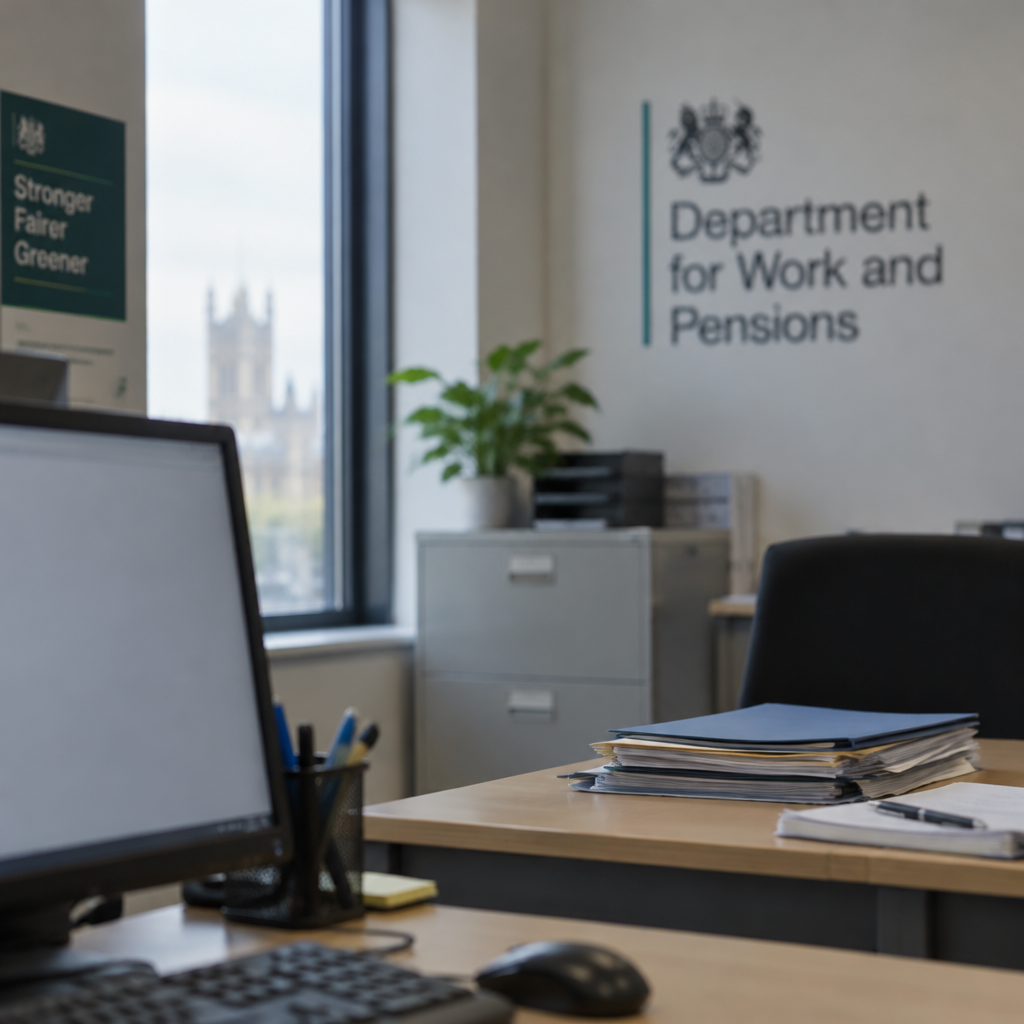
"We have taken some DWP online services offline as a precaution after we identified a cyber incident affecting our systems," the Department for Work and Pensions said on Friday morning.
What the DWP announced — services down, payments intact
The United Kingdom's largest government department confirmed a partial shutdown of online services after detecting a "cyber incident," while stressing that "regular benefit and pension payments are not affected and will be paid as normal." The statement advised users to "try again later" if an online service was unavailable and reiterated that the department will "never message you to ask for bank details or ask you to click on links."
The Register contacted both the DWP and the National Cyber Security Centre (NCSC) for more information. Beyond the public statement, the DWP declined to comment.
The GC3, NCSC and the mechanics of government response
The DWP said it is "working closely with the National Cyber Security Centre and Government Cyber Coordination Centre (GC3) to investigate and to bring services back online as quickly as possible and to minimize any disruption." The GC3's stated responsibility is to lead and coordinate incident response efforts in cases involving attacks on government.
The GC3 sits inside DSIT's Government Cyber Unit, a body established earlier this year with £210 million in funding and led by the government CISO, Bella Powell. That placement is material: the GC3 is the mechanism the DWP invoked to manage remediation and investigation for a publicly visible outage affecting citizen-facing services.

Audit-ready is a season. It shouldn't be.
Evidence in spreadsheets, controls drifting between audits, frameworks multiplying on flat headcount. Nubivance runs continuous compliance on Rapid7 Cyber GRC - SOC 2, HIPAA, ISO 27001, PCI, CMMC.
End the scrambleAutomated offensive frameworks, ARTEX, and the wider threat context
The NCSC issued a warning earlier this week about the rise of automated cyberattacks, particularly those that use automated offensive frameworks (AOFs). The story notes ARTEX — described as an open-source tool developed in China and launched in July — has been "implicated in myriad high-profile attacks" since its release and is "the most popular AOF at present."
Crucially, the account explicitly states there is nothing to suggest ARTEX is behind the DWP incident or any other evidence hinting at a possible root cause. Officials have not provided the usual operational details — which services were taken down, when they are expected to return, or whether any data has been compromised — leaving the provenance and motive of the incident unreported at this stage.
What this means for benefit recipients, technologists, and policymakers
- Benefit recipients: For now, the DWP has said benefit and pension payments will continue to be paid as normal, but some online self‑service functions may be unavailable temporarily; users are advised to retry services later and to remain alert for fraud attempts consistent with the DWP's warning about unsolicited requests for bank details.
- Technologists and security teams: The department's invocation of the NCSC and GC3 means government cyber coordination mechanisms are active. Security teams will be watching how quickly affected services are restored and whether officials disclose affected systems or any indicators of compromise.
- Policymakers and procurement leads: The incident lands amid recent government spending choices: at the end of October the government announced £130 million for AI cyber-defence technology as part of a wider £600 million cross-government AI spending package. The story also highlights continuing criticism that legacy and ageing IT remains neglected even as AI investments increase.
The DWP incident follows a string of publicly reported cyber events in the UK: a Department for Education breach that reportedly involved the exfiltration of circa 607,000 records — with the hacking group ExfilSquad claiming an additional circa 114,000 records from the Police National Legal Database — and an August incident first reported by The Telegraph concerning a suspected attack on a UK power plant that was later described as having affected only a very small generator.
For now the concrete facts are limited: a precautionary takedown of unspecified DWP online services, ongoing coordination with the NCSC and GC3, an explicit reassurance that benefit and pension payments are unaffected, and a refusal by the DWP to expand beyond its public statement. The unanswered, immediate questions are straightforward and pointed: which services were removed from the internet, when will they be restored, and has any personal data been exposed? The GC3 and NCSC are the organisations the public and Parliament will expect to answer them.