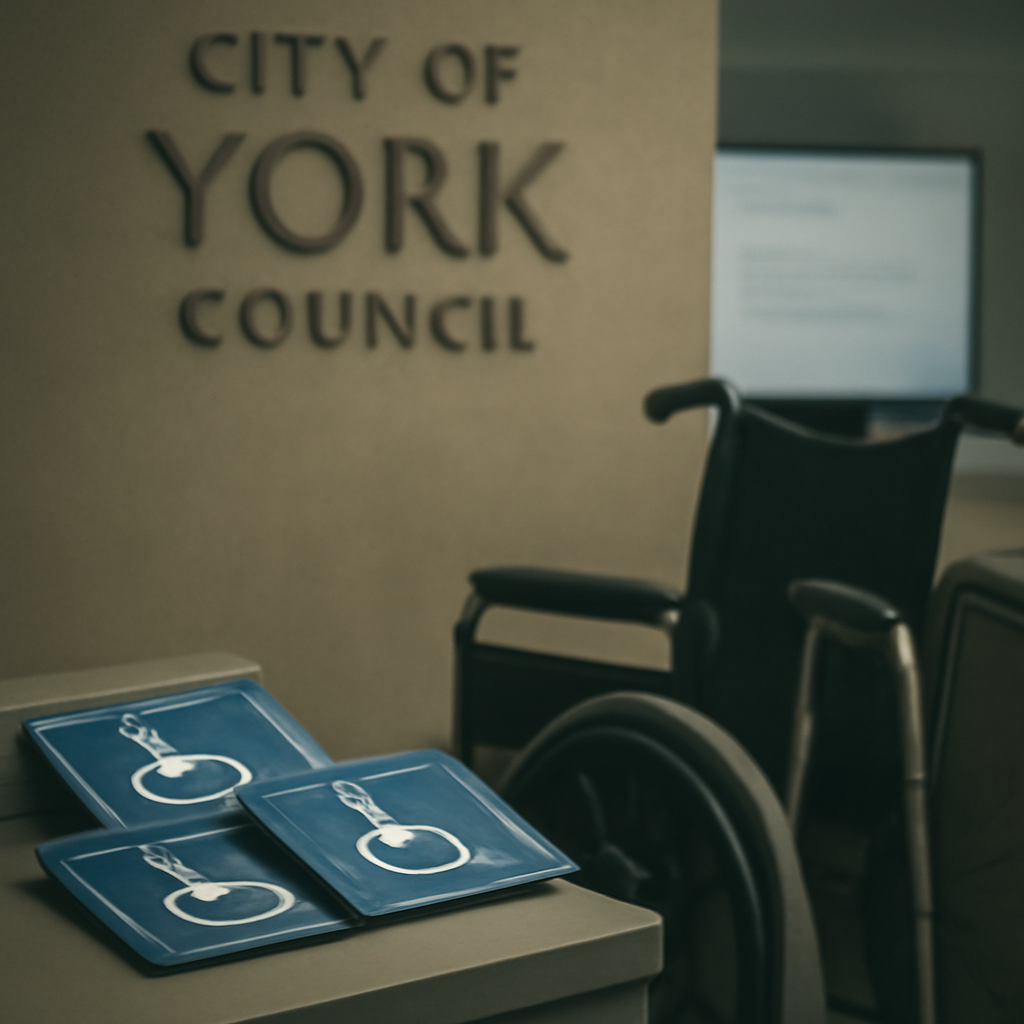
"Blue Badge holders exposed to each other after BCC function proves too complex," The Register reported.
City of York Council: a single email error with wide consequences
The Register says a communications error by the council in the UK's City of York disclosed the identities of "hundreds" of disabled residents. The exposure occurred when a message intended to be sent with recipients hidden instead revealed the list of recipients, according to the report. The story frames the incident as a single email blunder that affected holders of Blue Badges.
Blue Badge holders were the group named in the disclosure
The Register identifies the affected cohort as Blue Badge holders — the specific category named in the coverage. The account emphasizes that those holders were exposed to each other, meaning recipients of the same message saw the names or addresses of other recipients. The article uses the term "hundreds" to convey the scale of the impact rather than a precise tally.

Audit-ready is a season. It shouldn't be.
Evidence in spreadsheets, controls drifting between audits, frameworks multiplying on flat headcount. Nubivance runs continuous compliance on Rapid7 Cyber GRC - SOC 2, HIPAA, ISO 27001, PCI, CMMC.
End the scrambleBCC function, human error and the mechanics reported
The register's description attributes the failure to the handling of the blind carbon copy (BCC) function: "the BCC function proves too complex." That phrase captures the immediate proximate cause reported — the tool or the way it was used did not prevent the list of recipients from being revealed. The report presents this as a single-point operational failure in the process of sending a routine council communication.
What this means for technologists and local councils
- Technologists and communications teams: The episode underscores the risk in routine bulk email workflows; the BCC setting is central to the reported error. Teams responsible for email systems, templates and user training will be watching how BCC and recipient-management tools are configured and used.
- Local councils and service administrators: The Register's account highlights how a one-off operational misstep can produce a privacy breach affecting many residents. Councils that send targeted messages to groups with sensitive characteristics — here, Blue Badge holders — face a reputational and privacy-management imperative when errors occur.
How disabled residents and community organizations are affected
The report identifies disabled residents holding Blue Badges as the people directly exposed. For those residents, the disclosure meant their association with the badge-holding group became visible to other recipients. The Register frames this as an exposure of personal status tied to disability, a status many recipients would likely expect to remain confidential in the context of routine council communication.
Practical takeaways and a pointed conclusion
The incident reported by The Register reduces to a narrow set of facts: a City of York council email intended for a defined recipient group exposed the recipients to one another; the affected group was Blue Badge holders; and the proximate technical failure was tied to use of the BCC function. The combination of scale — "hundreds" — and the sensitivity of the characteristic named in the message makes the error a concrete example of how simple operational mistakes in public-sector communications can produce privacy harms.
The signal from the facts in the report is clear: when councils send targeted messages about sensitive statuses, the mechanics of email — and the people who use them — matter as much as policy. The Register's account leaves the next steps implicit: fixing the immediate vulnerability in practice and reassuring those affected. For now, the documented record is the single blunder, the exposed cohort, and the technical vector named in the coverage.