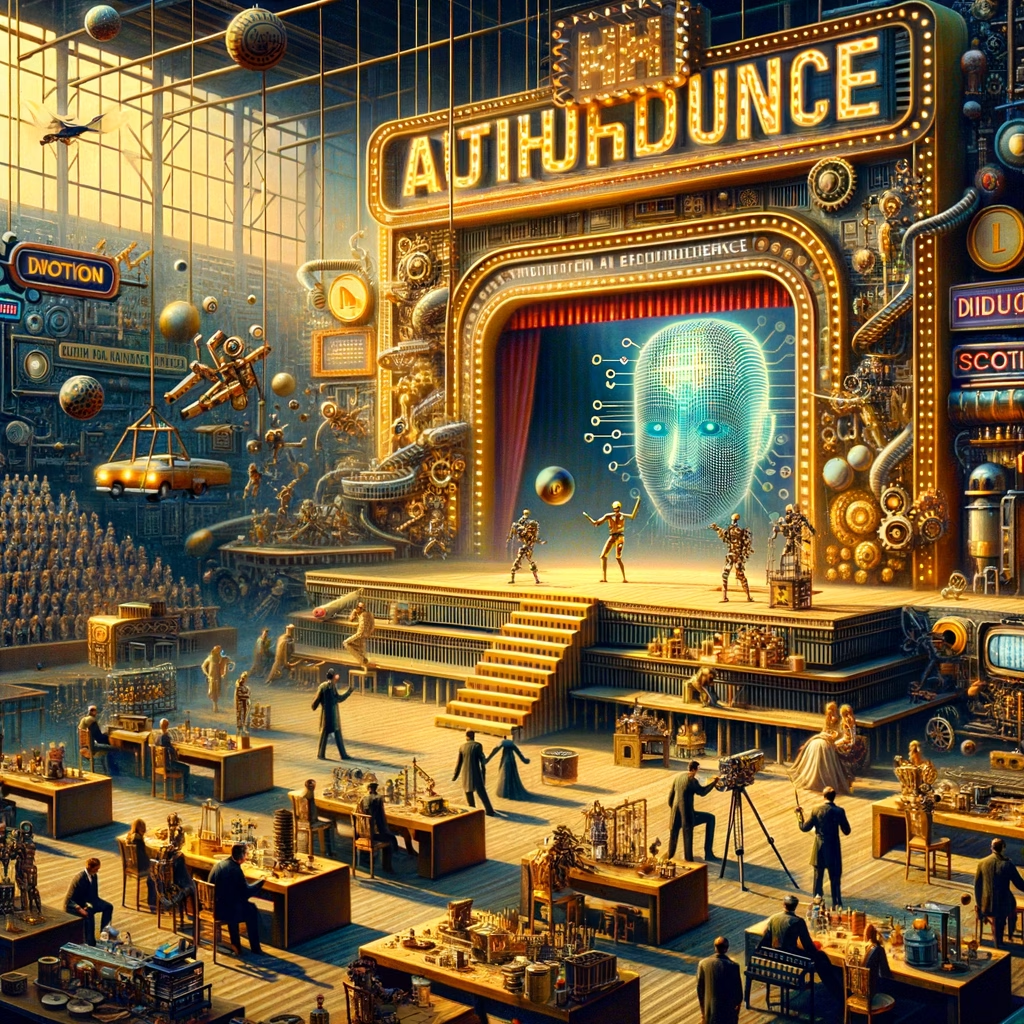
“How do you know the hand on your shoulder is real?” That question, once the stuff of cinema, now sits at the center of a sprawling fraud uncovered by researchers: an industrialized, AI-driven campaign that lures victims with synthetic officials, bogus regulatory pages, and paid search placement. Check Point calls the operation “Truman Show” — a name as theatrical as the scheme is consequential — and its findings raise uncomfortable questions about truth, trust and the economics of deception in the internet age.
The Truman Show scam combines three elements that separately have troubled security teams for years but together become devastatingly effective: high-visibility paid search ads that surface fraudulent sites, AI-generated deepfakes (audio and video) that impersonate recognizable officials, and onboarding/payment flows engineered to seem compliant with regulators. Victims encounter what looks like an authoritative site, are shown a convincing video from a familiar face, and are guided to wire funds or hand over credentials — all within a flow designed to lower suspicion and accelerate the illicit transaction.
This is not merely a refined phishing campaign. As Check Point documents, generative models let attackers mass-produce persuasive media—voice clones, consistent backstories, realistic images—and ad platforms let them buy prime real estate atop relevant search results. The result: a low-cost, high-conversion funnel that scales rapidly and is difficult to trace across borders. The operation transforms what was once an artisanal fraud into a production line.
The mechanics are straightforward and chillingly familiar. A victim searches for information about an investment, regulator or government service. Paid search elevates a fraudulent domain to the top of results. The site features a video of an apparent official endorsing a product or verifying a process, prompting the user to follow instructions that culminate in a payment or credential disclosure. Because the media and site bear official-looking markers and the ad appears at the top of the search page, ordinary heuristics for trust fail.
Why does this matter beyond individual losses? First, it shifts the cost-benefit calculus of fraud. AI reduces production costs and accelerates iteration; criminals can A/B-test messages, adjust scripts, and optimize conversions at scale. Second, it undermines institutional trust: when official seals and top search placements can be rented by bad actors, confidence in digital institutions and communications erodes. Third, the cross-border and modular nature of the scam complicates enforcement, making takedowns and prosecutions slow and piecemeal.
Technologists, policymakers and users each face different trade-offs and responsibilities. From a platform perspective, improved vetting of advertisers that claim government or financial affiliations is essential; automated signals (domain age, SSL anomalies, advertiser history) should be paired with human review for sensitive categories. Check Point and other researchers point toward provenance standards and watermarking for synthetic media as promising mitigations, though watermarking is not a panacea and can be evaded.
Policymakers must balance innovation against harms. Options include disclosure requirements for AI-generated content, stronger identity verification for entities placing political or financial ads, and clarified intermediary liability to accelerate takedowns. Critics caution that heavy-handed rules could stifle legitimate uses of generative models in medicine, accessibility, or education; the challenge is to raise the cost of abuse without freezing harmless innovation.
Practical defenses for users and institutions are immediate and attainable. Recommended measures include:
- Verify URLs and official domains; prefer contact details found on verified government or corporate sites rather than links from ads.
- Demand multi-factor authentication and set stronger verification thresholds for high-risk transfers.
- Financial institutions should flag atypical transfers and offer friction or human review for unusually structured requests.
- Platforms and ad networks should implement enhanced vetting for advertisers claiming official affiliations and deploy rapid takedown processes for domains and ads tied to fraud campaigns.
- Broader adoption of provenance metadata for synthetic media, combined with public awareness campaigns, can help users identify suspect content.
None of these solutions is sufficient on its own. Security researchers warn of an arms race: as detection improves, attackers will adapt by shifting vectors, localizing content, or exploiting less regulated channels. The asymmetry is stark — cheap deception versus costly, careful trust-building — and that imbalance favors well-resourced adversaries who can weaponize readily available AI tools.
The Truman Show operation is a signal more than an isolated incident: it demonstrates how generative AI and digital advertising can be stitched into a repeatable, scalable criminal business model. For citizens and institutions, the lesson is urgent and sobering. We can harden the surfaces of the web and educate users, but we also need coordinated tech, legal and social responses that recognize the systemic nature of the threat. Otherwise, what begins as an investment scam risks becoming a broader corrosion of the trust that underpins commerce, governance and community.
In the end, the real question may be less about whether technology can fake a voice or a face, and more about whether our systems of verification and our public norms can adapt quickly enough to preserve the baseline assumption of authenticity. If they cannot, the costs will be measured not only in stolen funds but in a quieter, deeper loss: the ability to believe what we see online. https://www.infosecurity-magazine.com/news/ai-truman-show-industrializes/



