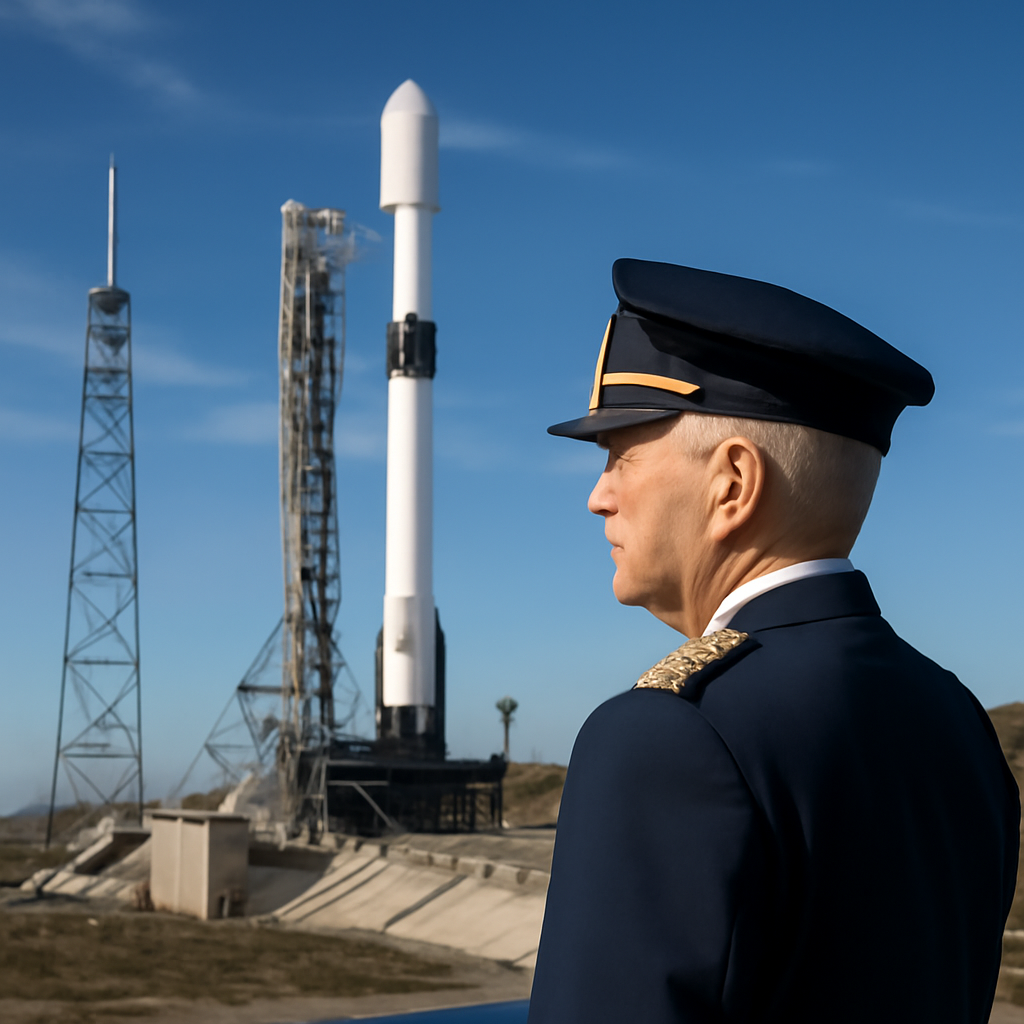
"Time is of essence." — Rear Adm. Anders Sundeman, Swedish Armed Forces space chief
Rear Adm. Anders Sundeman and Sweden's accelerated satellite launch
Sweden launched its first military satellite in May, four years ahead of schedule, because of what the space chief described as the “severe security situation.” The satellite was built by Planet Labs and lifted on a SpaceX Falcon 9 rocket from Vandenberg AFB, California, Rear Adm. Anders Sundeman told reporters during a media event in London. Sundeman framed the rapid timeline as a response to immediate needs, warning that timing and access to launch capacity will continue to shape Sweden’s space posture.
Sundeman told Defense One that Sweden is “worrying about the limited launching capability, also, in a global scale,” and explicitly flagged bottlenecks at U.S. and European launch facilities as a potential brake on the development of "urgently needed orbital capabilities."
U.S. launch providers and the problem of launch tempo
The reporting emphasizes Sweden’s reliance on U.S. launch providers as it grows its space assets. As demand for new satellites — both military and commercial — rises globally, Sundeman warned that U.S. providers are becoming "overbooked and strained" and that "as orbital demands increase, it will be harder to get rides from U.S. providers into space." That pressure on launch cadence was presented as a central constraint on how quickly Sweden can field additional capabilities.
Sweden plans to add more satellites in the near term: later this year it will launch a Finnish-made ICEYE synthetic aperture radar satellite, and the military aims to have 10 operational satellites on orbit in the coming years. Those ambitions collide with the current limits on launch availability, Sundeman said, making alternative launch options a strategic priority.

Audit-ready is a season. It shouldn't be.
Evidence in spreadsheets, controls drifting between audits, frameworks multiplying on flat headcount. Nubivance runs continuous compliance on Rapid7 Cyber GRC - SOC 2, HIPAA, ISO 27001, PCI, CMMC.
End the scrambleSSC Space, Esrange and the 2028 Firefly Alpha plan
Sweden has been working for five years to convert its main space-research center into an orbital launch site to reduce dependence on external providers. SSC Space — formerly the Swedish Space Corporation and owned by the Swedish government — is the European Union’s first mainland spaceport. According to a news release cited in the reporting, that facility will host its first orbital satellite launch aboard Texas-based Firefly’s Alpha rocket in 2028.
Charlotta Sund, CEO and SSC Space group president, said in the release: “Adding an orbital launch capability to mainland Europe will strengthen the continent’s capabilities and competitiveness in the commercial space arena, while contributing to greater resilience and strategic autonomy within the defense domain.” The Esrange effort was presented as a concrete attempt to increase regional launch capacity and reduce the strain Sundeman described.
Russian GPS interference, Chinese ground-station access, and security drivers
Security concerns were a recurring theme in the reporting. The Swedish Transport Agency has accused Russia of increased interference and jamming over the Baltic Sea. The BBC, cited in the reporting, documented a rise from 55 total incidents in 2023 to more than 700 interferences in 2025. Those trends were given as part of the rationale for accelerating Sweden’s satellite program.
The report also traces prior foreign access to Swedish infrastructure. The Secure World Foundation’s Global Counterspace Capabilities report said China previously had access to the Swedish Space Corporation’s ground stations in Kiruna, Chile and Australia. SSC officials in 2020 told reporters they would not renew China’s contracts, citing a change in the “geopolitical situation.”
What this means for the Swedish military, U.S. launch providers, and SSC Space
- The Swedish military: Will continue to prioritize speed and resilience — aiming for 10 operational satellites and making initial assets as “robust” as possible. Sundeman emphasized that those assets do not have offensive capabilities and that quantity and international cooperation are elements of future protection: “One things is, of course, large quantity,” he said. “And also, it’s the necessity to cooperate with others, that’s a kind of protection by itself.”
- U.S. launch providers: Face growing booking pressure from rising military and commercial satellite demand. That squeeze creates scheduling risks for countries like Sweden that must secure rides to meet accelerated timetables.
- SSC Space and Esrange operators: Are pursuing a domestic orbital launch capability with a first orbital mission targeted for 2028 on Firefly’s Alpha. Success at Esrange would directly address the “limited launching capability” Sundeman described and, in Charlotta Sund’s words, contribute to resilience and strategic autonomy within the defense domain.
Sweden’s rush to orbit — driven by regional interference trends and a strategic decision to push a Planet Labs-built satellite up four years early — exposes a narrow window between urgent operational need and the slower pace of global launch expansion. The near-term test is concrete: a Finnish ICEYE satellite planned for launch later this year and the broader goal of 10 operational satellites. The longer-term variable is whether the Esrange conversion and other European initiatives mature fast enough to relieve pressure on U.S. launch providers and match the tempo Sundeman says is now required.