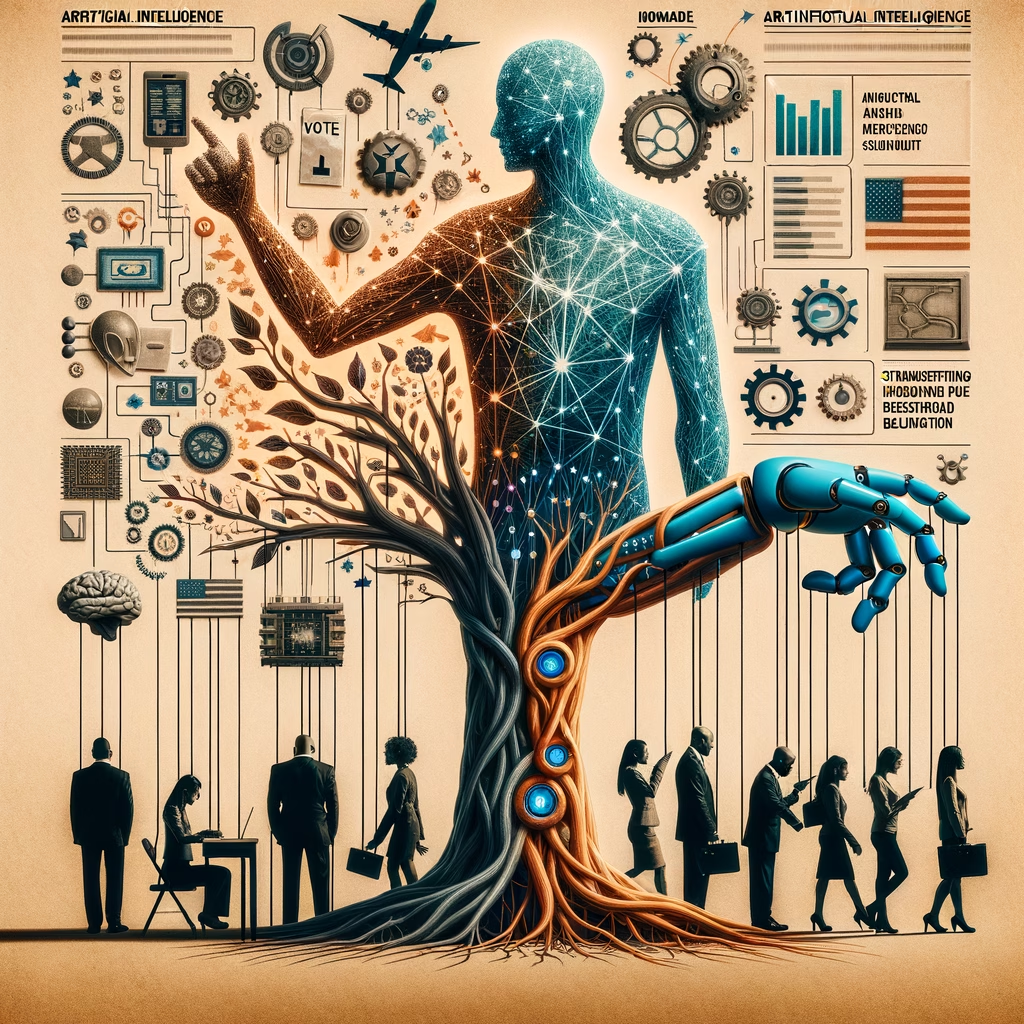
Can artificial intelligence mend the frayed trust at the heart of democracy — or will it tear it further apart?
That question hung in the air at the World Forum on Democracy in Strasbourg, where many in the room expected the worst. But as scholars and practitioners who study technology and governance have begun to show, the same set of capabilities that enable manipulation — scale, personalization, and automation — can also be repurposed to strengthen democratic institutions, improve public services, and deepen civic engagement. The choice will depend on design, oversight, and public will, not on fate alone. This is the argument sounding through recent analysis and policy proposals, including the ideas marshaled in discussions around Bruce Schneier’s Rewiring Democracy project and related commentary on AI’s civic uses.
Background: why AI matters to democracy
Democracies rest on three fragile pillars: shared facts, fair procedures, and perceived legitimacy. AI sits astride all three. On the negative side, large-scale synthetic media, microtargeted persuasion, and automated misinformation campaigns can corrode shared reality and amplify polarization. On the positive side, AI can help administrations deliver services faster and more fairly, make public deliberation more accessible, and reveal patterns in large civic data that humans alone cannot see. The tension — between amplification of harm and potential for civic amplification — is the central policy problem of our time.
Current situation: patchwork governance and active civil debate
Responses are already forming, but they are uneven. The European Union is moving toward comprehensive regulation; U.S. federal policy is a patchwork of agency guidance and state laws; private platforms and firms are adding controls and labels; and civil society groups press for stronger accountability measures. Researchers and watchdogs warn of an asymmetry: bad actors scale deception faster than institutions scale verification, creating windows of vulnerability around elections and public decision-making. At the same time, technologists and civic entrepreneurs are building “civic AI” tools intended to bolster participation and transparency.
Four promising ways AI is already being used to strengthen democracy
-
Improving administrative fairness and efficiency — AI to make public services more responsive
When governments apply predictive models and automation thoughtfully, they can speed routine decisions, allocate scarce resources more rationally, and reduce backlog in services like benefits adjudication or permitting. But these gains are conditional on transparency, auditability, and human oversight: without them, automation can replicate or hide bias. Policy guidance from public-sector oversight bodies stresses that explainability and independent audits are essential preconditions for trust.
-
Expanding genuine civic participation — AI as a civic translator and amplifier
AI tools that summarize long council debates, translate local regulations into accessible language, or synthesize thousands of citizens’ submissions into policy options can lower the barrier to meaningful participation. These “civic translators” can make deliberation scalable while preserving plural input — provided the tools are open, interoperable, and subject to public scrutiny so they do not become opaque gatekeepers of interpretation. Experts recommend funding civic tech labs and building open platforms so public-interest actors, not only private companies, control the intermediaries.
-
Detecting and labeling synthetic content — tools that restore provenance and trust
One immediate defense against disinformation is clear, machine-assisted provenance: labeling synthetic political content, embedding provenance metadata, and deploying detection tools to alert platforms and users. Requiring provenance metadata and mandatory labeling makes it harder for manipulation to masquerade as authentic public discourse, and it gives citizens and journalists a factual basis for evaluation. Civil society and security researchers consistently call for these pragmatic, near-term safeguards.
-
Independent audits, impact assessments, and legal safeguards — institutional checks on power
Transparent, independent audits and statutory impact assessments for systems used in elections, law enforcement, or social benefits can expose bias and prevent entrenchment of unfair practices. Policy communities — from academic institutes to advocacy organizations — have pushed for legally grounded accountability regimes, including provisions that would require public datasets for validation and a legally enforceable pathway for contesting automated decisions. These mechanisms put democratic deliberation back into the technology loop.
Why these uses matter — and why they won’t be automatic
These four pathways matter because they translate technical capabilities into civic outcomes: fairness in service delivery, more inclusive deliberation, more trustworthy information, and institutional checks on opaque systems. But none of them will appear without active stewardship. Prioritizing transparency and accountability often slows deployment; prioritizing speed and scale can yield short-term gains at long-term civic cost. The political incentives of incumbents, the commercial incentives of platforms (engagement over civic health), and the technical incentives of builders (performance and scale) can all work against democratic priorities unless policy and civil society intervene.
Different perspectives
Technologists: Many in the tech community emphasize the potential for open-source models, explainable AI, and privacy-preserving techniques (for example, differential privacy) to support public services without compromising liberties. They tend to call for standards, tooling, and collaboration with public-sector partners.
Policymakers: Regulators see a twin challenge — enabling innovation that improves government while preventing entrenchment of bias and manipulation. The EU’s legislative momentum and U.S. federal and state-level actions reflect divergent approaches but a shared recognition that legal frameworks will shape how AI touches civic life.
Users and civil society: Voters and civic groups oscillate between enthusiasm for convenience and alarm about surveillance and persuasion. Their bottom line is simple: tools that affect civic rights or public benefits should be transparent, contestable, and subject to independent scrutiny.
Adversaries: Both state and non-state actors will exploit weak spots. Cyber operations, influence campaigns, and covert monetized division are likely to find new vector with advanced AI unless verification and resilience measures keep pace. This urgency underlies calls for immediate, practical measures like labeling and audits.
Practical near-term steps
-
Mandate labeling and provenance metadata for synthetic political content so citizens and platforms can trace origins.
-
Require independent audits and impact assessments for high-stakes AI systems used in elections, benefits, or enforcement.
-
Fund civic technology labs and open platforms to ensure public-interest alternatives to proprietary intermediaries.
-
Invest in digital literacy and public education so citizens can evaluate information and participate in deliberation with discernment.
Conclusion
AI will not be a deus ex machina that saves democracy, nor is it merely an instrument of decline. It is a set of tools whose civic impact will be decided in the next few years by laws, standards, and the public’s willingness to demand accountability. The same technologies that can fabricate a false narrative can also verify provenance, summarize deliberation, and make government more responsive — if we insist that transparency, independent oversight, and public control guide their deployment. As scholars and practitioners remind us, the path forward is not preordained. The real question is not whether AI will change politics — it will — but whether the change will strengthen our democratic institutions or hollow them out. Which future will we choose?
Source: https://www.schneier.com/blog/archives/2025/11/four-ways-ai-is-being-used-to-strengthen-democracies-worldwide.html