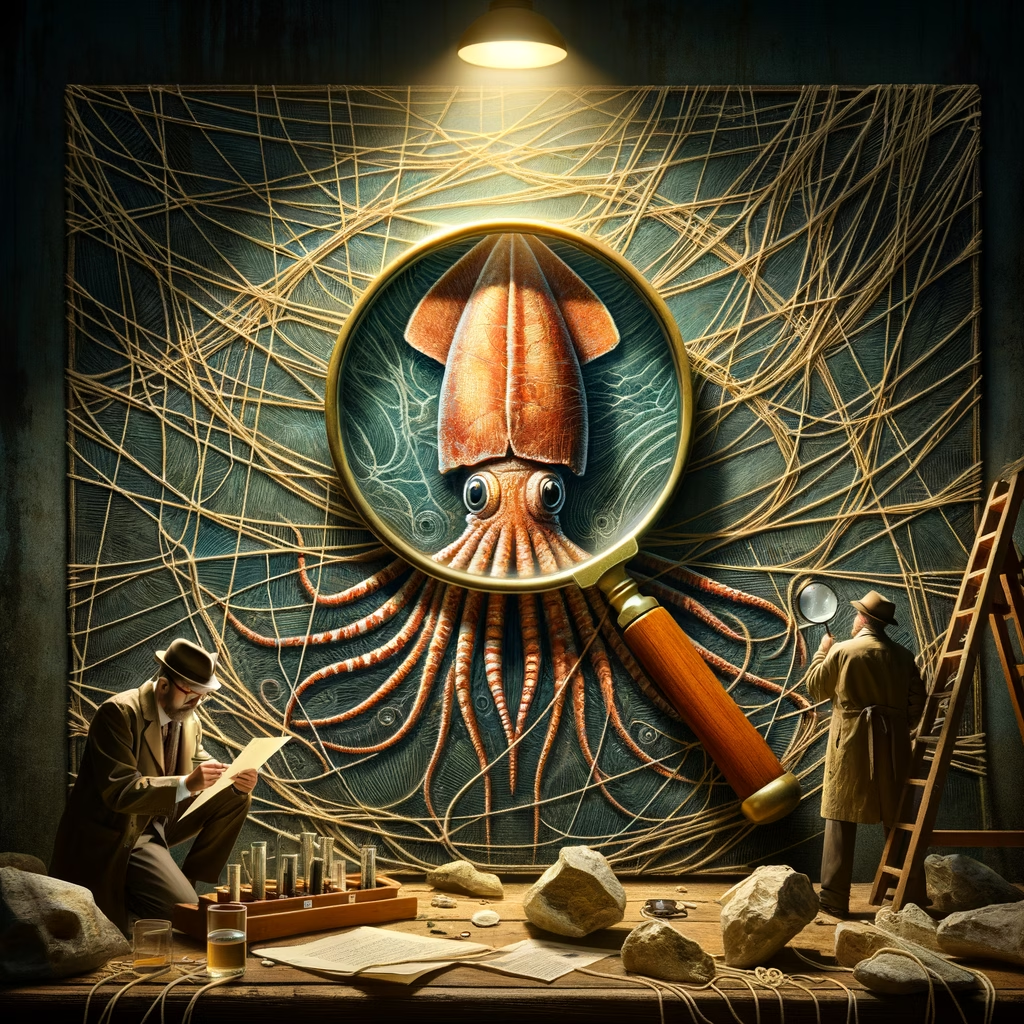
Imagine a paleontologist, brushing away the dust of millennia, excitedly uncovering what they believe to be the ancient remains of a squid, only to later find out that it was never a squid at all, but rather an arrow worm. This scenario underscores a profound dilemma in the world of paleontology: how easily can misidentifications occur, and what does it mean for our understanding of the past?
Recent findings indicate that what scientists long considered squid fossils may indeed be misidentified remains of arrow worms, or chaetognaths. These small, transparent marine creatures date back hundreds of millions of years and have a complex evolutionary history that is often overshadowed by more charismatic organisms like squids and octopuses. The revelation has sparked a re-evaluation of previous fossil records, raising questions about how scientific consensus can sometimes rest on shaky foundations.
For decades, paleontologists relied on a limited set of morphological traits to categorize fossils. Squid fossils, characterized by their distinctive shapes, were often seen as a common find. However, recent advances in imaging technology and genetic analysis have unearthed a more nuanced understanding of these ancient organisms. In a paper published in the journal Nature, lead researcher Dr. Emily Carter of the University of Cambridge noted, “This misidentification highlights the need for a more rigorous approach in fossil classification.”
Current methodologies in paleontology are being called into question. The reliance on traditional classification methods, which may prioritize visual characteristics over genetic data, is now seen as a liability. Arrow worms, while morphologically distinct from squids, can exhibit certain similarities, particularly in fossilized states. This raises critical concerns about the potential consequences of such misidentifications on our understanding of marine evolution. The ramifications stretch beyond academic interest; they affect our grasp of ancient ecosystems and the evolutionary paths that have shaped life as we know it.
While the scientific community is largely focused on clarifying the taxonomy of ancient marine life, the implications of these findings reach beyond academia. For policymakers, understanding the complexities of marine biodiversity can guide conservation efforts, especially in light of current environmental challenges. “We must recognize the interconnectedness of all marine life,” says Dr. James O’Reilly, a marine biologist with the National Oceanic and Atmospheric Administration. “Misidentifications can skew our understanding of ecosystem dynamics.”
Users, such as educators and naturalists, may also feel the ripple effects of these revelations. Teaching materials and public exhibits that previously showcased squid fossils may need revision, prompting a re-engagement with the public on the importance of scientific accuracy. In a world where misinformation can spread rapidly, ensuring factual integrity in educational settings is more critical than ever.
Moreover, the misidentification serves as a cautionary tale for researchers across disciplines. As technology continues to advance, scientists must remain vigilant against the allure of certainty based solely on existing paradigms. The need for interdisciplinary collaboration has never been more apparent. A comprehensive approach that includes paleontology, genetics, and advanced imaging could prevent future oversights.
In closing, as we dig deeper into the annals of our planet’s history, one has to wonder: What other stories remain buried under layers of sediment, waiting for the right tools and perspectives to bring them to light? The world of paleontology is both a frontier and a reminder of our own limitations in understanding the past, urging us to tread carefully as we piece together the puzzle of life on Earth.
For further reading, visit the original source: https://www.schneier.com/blog/archives/2025/08/friday-squid-blogging-a-case-of-squid-fossil-misidentification.html