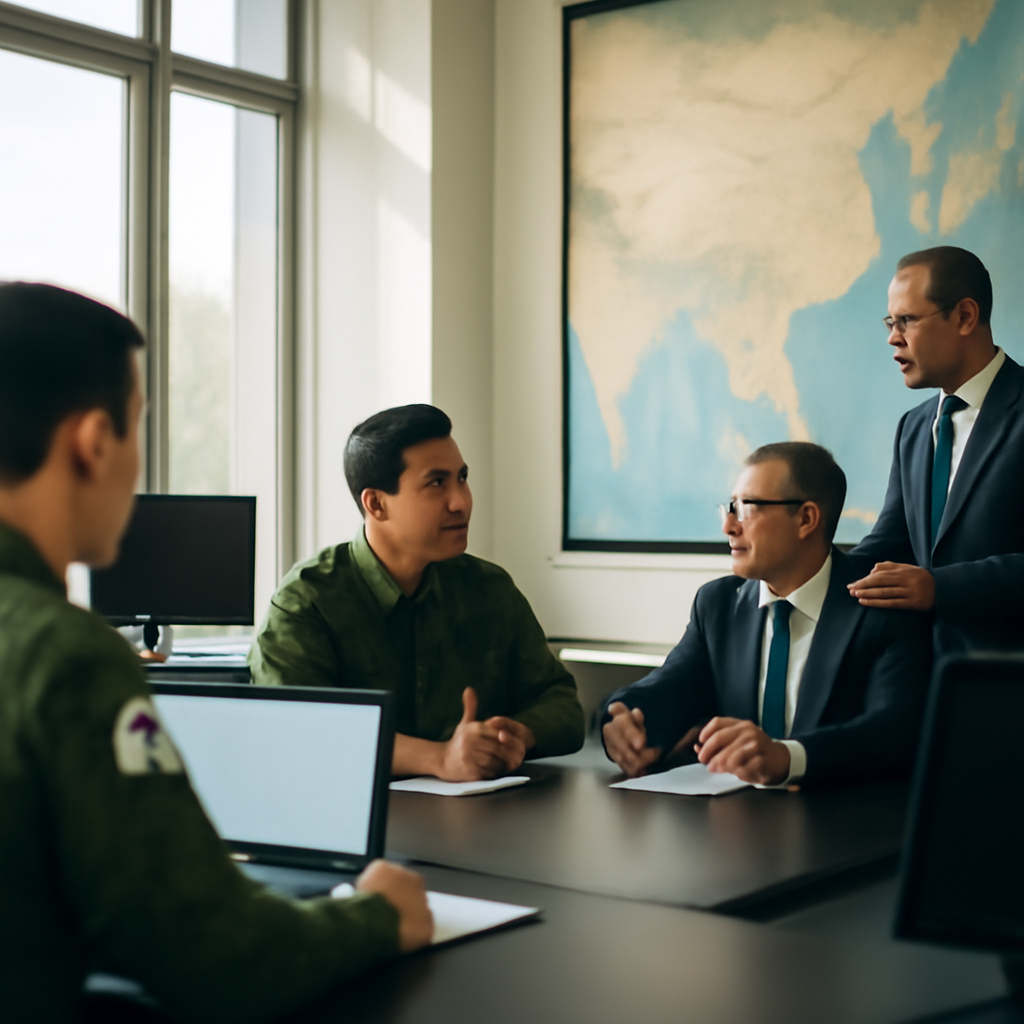
"South Korea is the ‘dagger in the heart of Asia,’" USFK commander Xavier Brunson said in May — a blunt image that captures why Seoul can neither ignore nor easily escape the consequences of a major conflict over Taiwan.
Xavier Brunson’s warning and what Washington expects
Brunson’s phrase appears in a short but consequential argument: if the United States becomes consumed by a high-intensity China–US contingency over Taiwan, Seoul will be under immediate pressure to protect US forces and civilians on the peninsula and to provide sustainment support across the Pacific theatre. The source describes growing emphasis in Washington on the potential role of US Forces Korea (USFK) and on South Korea’s military and industrial capacity in regional scenarios — both as a defensive anchor on the peninsula and as a logistical node for wider operations.
Why a Taiwan war would change the alliance calculus
The core claim is straightforward and repeated: when Washington is engaged in peer warfare in the Indo‑Pacific, it will require substantial military effort and may not have the capacity to defend South Korea if North Korea chooses to capitalise on the disruption. The article argues that a conflict over Taiwan would demand effort far beyond recent Middle Eastern operations, that the US may sustain significant losses that could take years to recover even if it prevails, and that there is no guarantee of American success.

Audit-ready is a season. It shouldn't be.
Evidence in spreadsheets, controls drifting between audits, frameworks multiplying on flat headcount. Nubivance runs continuous compliance on Rapid7 Cyber GRC - SOC 2, HIPAA, ISO 27001, PCI, CMMC.
End the scrambleSouth Korea’s strategic dilemma: deter North Korea while monitoring China
Given China’s geographic dominance in the region and North Korea’s persistent threat, Seoul is depicted as having "little room to manoeuvre" should war break out. The analysis urges that South Korea must increase reliance on its own military capabilities to deter conventional or nuclear attacks from North Korea, noting that "shouldering a greater burden for its own defence" is less about domestic politics or responding to US demands than about the strategic reality that the US may be unable to conduct simultaneous high‑intensity operations.
Sea lanes, economic disruption and the need to protect shipping
One practical consequence the piece stresses is maritime: any conflict or crisis over Taiwan would "effectively close off access to the East China Sea and South China Sea," forcing South Korean ships to use east coast ports and reroute through the Sea of Japan and the Pacific route to reach the Middle East or Europe. The resulting disruptions to economic activity will compel Seoul to provide military protection to rerouted vessels and to coordinate closely with Washington and Tokyo to deconflict and optimise such operations.
Balancing immediate caution with contingency planning
The analysis counsels against rushing to a permanent policy choice now, noting the dangers of moving too quickly given South Korea’s proximity to and economic relationship with China, ongoing changes in alliance structure, and the unpredictable escalation dynamics of a Sino‑US confrontation. Yet it warns that avoiding contingency planning and failing to build political, economic and societal resilience would be equally damaging. Experts quoted in the piece consider a direct Chinese attack on South Korean territory unlikely, but the argument stresses that even without direct attack, the operational and economic burdens on Seoul would be severe.
What this means for South Korea’s military, Seoul’s policymakers, and the shipping sector
- South Korea’s military and defense planners: Expect a higher operational load — monitoring and responding to Chinese activity while deterring North Korea alone — and plan to expand independent deterrence and sustainment capacities so US distraction does not leave the peninsula vulnerable.
- Seoul’s policymakers and diplomats: Prepare political and economic resilience measures and contingency plans that balance necessary military contributions and protection of national interests with the risks of escalation and the reality of deep economic ties to China.
- South Korean shipping, logistics and industry: Anticipate disrupted sea lanes, rerouted traffic through east coast ports and the Sea of Japan, and the need for military protection and international coordination with Washington and Tokyo to maintain supply chains and commercial routes.
Conclusion: the piece makes a clear, non‑ideological point — proximity to a great‑power conflict imposes effects regardless of policy preference. South Korea can delay choosing a singular course of action, but it cannot postpone preparing for the operational, economic and alliance stresses a Taiwan contingency would impose. The practical next step the analysis leaves on the table: plan now for worst‑case logistics, defence and civil resilience so Seoul is not forced into reactive decisions at the moment of crisis.