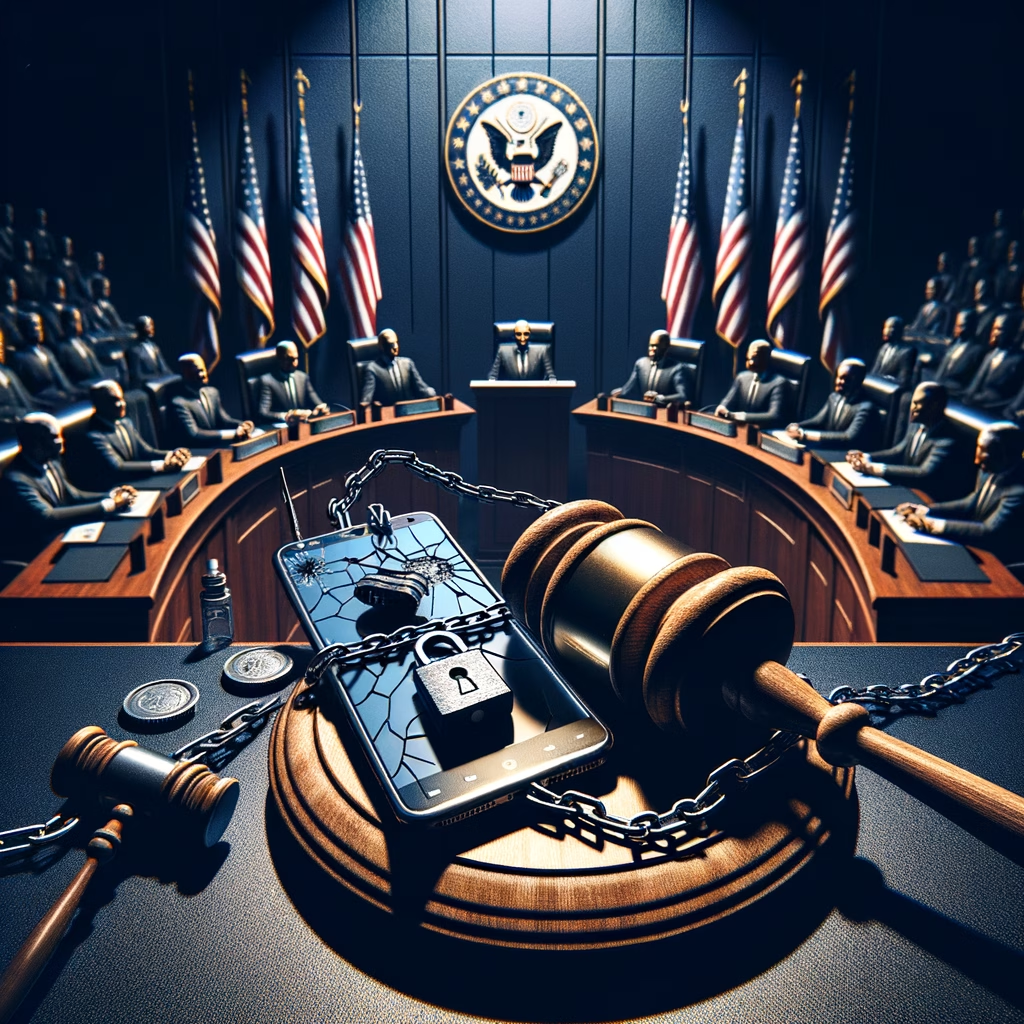
Mobile security: why this moment is urgent
In an age when smartphones and tablets are doorways to personal, professional, and governmental secrets, mobile security is no longer optional. Devices hold emails, contact lists, documents, credentials, and two-factor tokens—so a single compromise can cascade across networks, expose sources, and undermine public trust. Recent events on Capitol Hill brought that danger into sharp relief: the FBI issued guidance to help federal officials protect their devices, but a prominent senator declared the advice inadequate. That dispute highlights a critical point: as mobile devices become more central to governance, mobile security must match that importance.
What went wrong: lessons from a real breach
The controversy followed the theft of a contacts list from a senior White House official, which enabled targeted impersonation attempts by text and phone against lawmakers. Such incidents show how attractive everyday devices are to adversaries and how quickly weak defenses can create broader vulnerabilities. FBI agents briefed Capitol staff on protective steps, yet Senator Ron Wyden argued the Bureau’s recommendations ignored powerful, built-in tools available on many consumer phones—features that, if used consistently, would materially reduce risk.
Why Senator Wyden criticized the FBI’s guidance
Wyden’s critique focused on omission: the guidance, he said, failed to emphasize practical, hardware-backed protections already present on modern devices. Full-disk encryption, secure boot, hardware-backed key storage, and mandatory biometric or otherwise strong locks can materially mitigate many attack vectors. The letter argued these features are underused even when readily available. For officials handling sensitive information, the absence of such measures isn’t a minor oversight; it’s a national-security liability.
Practical gaps in current government advice
A recurring problem in institutional recommendations is vagueness. “Update your software, use strong passwords, and beware of suspicious links” has value, but it’s not enough for high-risk users. Officials need concrete, enforceable steps: enable device encryption and automatic OS updates, deploy multi-factor authentication (MFA) that resists SIM-swapping (like hardware security keys or app-based authenticators), implement application allowlists, limit administrative privileges, and use mobile-device management (MDM) to separate personal and official data.
Education and organizational culture matter just as much as tools. Users must learn threat models specific to their roles—phishing, SIM swapping, targeted social-engineering, and malicious Wi‑Fi—and practice incident reporting and response. Training makes technology effective; without it, even the best defenses are applied inconsistently or bypassed.
Balancing security and usability in mobile security
One reason some agencies offer softer guidance is usability. Overly cumbersome rules risk noncompliance: if protections slow workflows, users may bypass them. The real challenge is designing protections that are robust yet minimally intrusive. Examples include automatically provisioning MFA, transparently enforcing device encryption, and issuing hardware security tokens that integrate with existing processes. Agencies can also prioritize: stricter controls for high-risk personnel, and progressively user-friendly solutions for broader staff.
Concrete steps governments should adopt
To raise the baseline of mobile security across government and large organizations, consider these practical measures:
– Update official guidance to prioritize built-in security features and provide specific configurations rather than generic tips.
– Mandate hardware-backed MFA (security keys or equivalent) for staff handling sensitive or classified information.
– Deploy centralized mobile-device management that enforces encryption, automatic updates, application allowlists, and a clear separation between personal and official data.
– Limit administrative privileges on devices and channel app installation through curated stores or MDM-managed approvals.
– Centralize patch management for government-issued devices and offer support for keeping third-party apps current.
– Expand hands-on training with simulated mobile attacks and clear incident-response protocols, ensuring staff know how to act quickly and correctly when something suspicious occurs.
– Pilot stricter controls for high-risk roles before a wider rollout, refining the balance between security and usability.
Why these changes matter beyond government
Weak mobile security doesn’t only threaten privacy; it undermines decision-making, exposes sensitive communications, and gives adversaries leverage. Successful mobile attacks and social-engineering campaigns have caused lasting damage to institutions and national security. Strengthening mobile security for officials sets a precedent for private-sector and public users alike: when policymakers adopt concrete protections, it encourages broader adoption and raises the overall security posture of the ecosystem.
Conclusion: mobile security must be a priority, not an afterthought
Senator Wyden’s critique of the FBI’s guidance should be a wake-up call. Mobile security must be integrated, well-resourced, and specific—more than a checklist or a set of platitudes. As devices become more powerful and more entwined with government functions, the consequences of compromise increase. Agencies should adopt concrete, usable protections and invest in the training and tools that ensure those protections are actually employed. If they fail to do so, complacency will leave officials—and the public—exposed to evolving threats. For policymakers, security teams, and everyday users alike, the imperative is clear: treat mobile security as essential infrastructure and act accordingly.



